MCQ
The diatomic molecule is treated as:
  • A
    Harmonic oscillator
  • B
    Rigid rotator
  • C
    Both a and b
  • D
    None

Answer

  1. Rigid rotator

Need a full question paper?

Generate a complete, print-ready paper with questions like this in minutes — across 16+ boards, with answer keys.
Start Generating Free

Similar questions

A stone of mass $900 \mathrm{~g}$ is tied to a string and moved in a vertical circle of radius $1 \mathrm{~m}$ making $10\  \mathrm{rpm}$. The tension in the string, when the stone is at the lowest point is (if $\pi^2=9.8$ and $g=9.8 \mathrm{~m} / \mathrm{s}^2$ )
A transverse wave is represented by the equation $y = {y_0}\sin \frac{{2\pi }}{\lambda }(vt - x)$ For what value of  $\lambda$, the maximum particle velocity equal to two times the wave velocity
In the 5th overtone of an open organ pipe, these are $(N-$ stands for nodes and $A-$ for antinodes)
When an engine passes near to a stationary observer then its apparent frequencies occurs in the ratio $5/3$. If the velocity sound is $340 m/s$, than the velocity of engine is .... $m/s$
A bullet hits and gets embedded in a solid block resting on a horizontal frictionless table. What is conserved ?
A uniformly tapering conical wire is made from a material of Young's modulus $Y$  and has a normal, unextended length $L.$ The radii, at the upper and lower ends of this conical wire, have values $R$ and $3R,$  respectively. The upper end of the wire is fixed to a rigid support and a mass $M$ is suspended from its lower end. The equilibrium extended length, of this wire, would equal 
An equilateral prism of mass $m$ rests on a rough horizontal surface with coefficient of friction $\mu$. A horizontal force $F$ is applied on the prism as shown in the figure.If the coefficient of friction is sufficiently high so that the prism does not slide before toppling, then the minimum force required to topple the prism is $-$
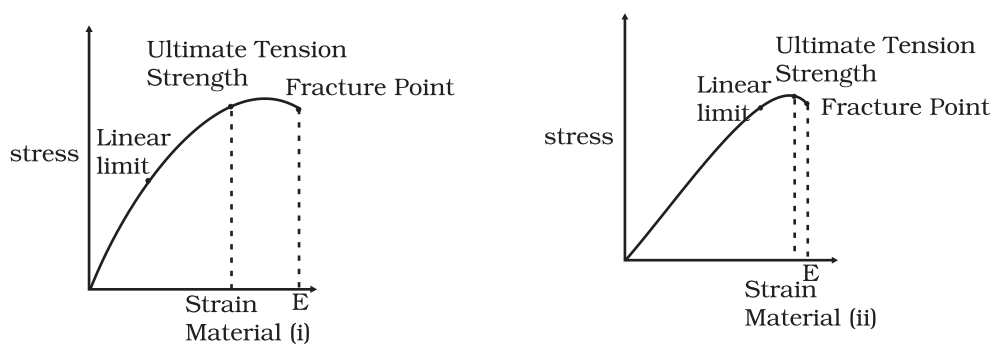
The stress - strain graphs for two materials are shown in (assume same scale).

  1. Material (ii) is more elastic than material (i) and hence material (ii) is more brittle.
  2. Material (i) and (ii) have the same elasticity and the same brittleness.
  3. Material (ii) is elastic over a larger region of strain as compared to (i).
  4. Material (ii) is more brittle than material (i).
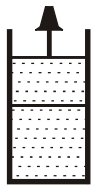
In the figure a container is shown to have a movable (without friction) piston on top. The container and the piston are all made of perfectly insulating material allowing no heat transfer between outside and inside the container. The container is divided into two compartments by a rigid partition made of a thermally conducting material that allows slow transfer of heat. The lower compartment of the container is filled with $2$ moles of an ideal monatomic gas at $700 \ K$ and the upper compartment is filled with $2$ moles of an ideal diatomic gas at $400$

K. The heat capacities per mole of an ideal monatomic gas are $C_v=\frac{3}{2} \ R, C_p=\frac{5}{2} R$, and those for an ideal diatomic gas are $C _{ v }=\frac{5}{2} \ R , C _{ P }=\frac{7}{2} R$.

$1.$ Consider the partition to be rigidly fixed so that it does not move. When equilibrium is achieved, the final temperature of the gases will be :

$(A)$ $550 \ K$ $(B)$ $525 \ K$ $(C)$ $513 \ K$ $(D)$ $490 \ K$

$2.$ Now consider the partition to be free to move without friction so that the pressure of gases in both compartments is the same. Then total work done by the gases till the time they achieve equilibrium will be:

$(A)$ $250 \ R$ $(B)$ $200 \ R$ $(C)$ $100 \ R$ $(D)$ $-100 \ R$

Give the answer question $1$ and $2.$
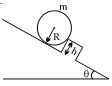
Find minimum height of obstacle so that the sphere can stay in equilibrium.