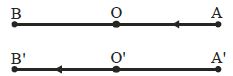
The displacement of a particle moving in $S.H.M.$ at any instant is given by $y = a\sin \omega t$. The acceleration after time $t = \frac{T}{4}$ is (where $T$ is the time period)
Easy


Download our appand get started for free
Experience the future of education. Simply download our apps or reach out to us for more information. Let's shape the future of learning together!No signup needed.*
Similar Questions
- 1A particle is doing simple harmonic motion of amplitude $0.06 \mathrm{~m}$ and time period $3.14 \mathrm{~s}$. The maximum velocity of the particle is. . . . .. . $\mathrm{cm} / \mathrm{s}$.View Solution
- 2Assume that the earth is a solid sphere of uniform density and a tunnel is dug along its diameter throughout the earth. It is found that when a particle is released in this tunnel, it executes a simple harmonic motion. The mass of the particle is $100 g$. The time period of the motion of the particle will be (approximately) (take $g =10\,ms ^{-2}$, radius of earth $=6400\,km$ )View Solution
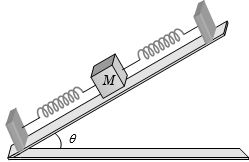
- 3On a smooth inclined plane, a body of mass $M$ is attached between two springs. The other ends of the springs are fixed to firm supports. If each spring has force constant $K$, the period of oscillation of the body (assuming the springs as massless) isView Solution
- 4pendulum made of a uniform wire of cross sectional area $A$ has time period $T$. When an additional mass $M$ is added to its bob, the time period changes to $T_M$. If the Young's modulus of the material of the wire is $Y$ then $\frac{1}{Y}$ is equal to : ($g$ = gravitational acceleration)View Solution
- 5A simple pendulum suspended from the ceiling of a stationary lift has period $T_0$. When the lift descends at steady speed, the period is $T_1$, and when it descends with constant downward acceleration, the period is $T_2$. Which one of the following is true?View Solution
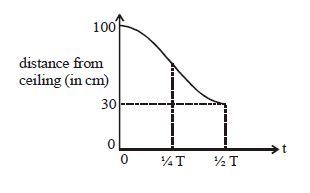
- 6A spring hangs vertically from the ceiling and a mass is attached to its free end. When the mass is pulled down and released, it oscillates vertically with simple harmonic motion of period $T$ . The variation with time $t$ of its distance from the ceiling is as shown. Which statement gives a correct deduction from this graph?View Solution
- 7A body is moving in a room with a velocity of $20\, m / s$ perpendicular to the two walls separated by $5$ meters. There is no friction and the collisions with the walls are elastic. The motion of the body isView Solution
- 8View SolutionA simple pendulum is set into vibrations. The bob of the pendulum comes to rest after some time due to
- 9An ideal spring with spring-constant $K$ is hung from the ceiling and a block of mass $M$ is attached to its lower end. The mass is released with the spring initially unstretched. Then the maximum extension in the spring isView Solution
- 10Two particles undergo $SHM$ along parallel lines with the same time period $(T)$ and equal amplitudes. At a particular instant, one particle is at its extreme position while the other is at its mean position. They move in the same direction. They will cross each other after a further timeView Solution