The displacement of a particle varies with time as $x = 12\sin \omega t - 16{\sin ^3}\omega t$ (in $cm$). If its motion is $S.H.M.$, then its maximum acceleration is
Medium


Download our appand get started for free
Experience the future of education. Simply download our apps or reach out to us for more information. Let's shape the future of learning together!No signup needed.*
Similar Questions
- 1A cylindrical block of wood (density $= 650\, kg\, m^{-3}$), of base area $30\,cm^2$ and height $54\, cm$, floats in a liquid of density $900\, kg\, m^{-3}$ . The block is depressed slightly and then released. The time period of the resulting oscillations of the block would be equal to that of a simple pendulum of length ..... $cm$ (nearly)View Solution
- 2A $1.00 \times {10^{ - 20}}kg$ particle is vibrating with simple harmonic motion with a period of $1.00 \times {10^{ - 5}}sec$ and a maximum speed of $1.00 \times {10^3}m/s$. The maximum displacement of the particle isView Solution
- 3A sphere of radius $r$ is kept on a concave mirror of radius of curvature $R$. The arrangement is kept on a horizontal table (the surface of concave mirror is frictionless and sliding not rolling). If the sphere is displaced from its equilibrium position and left, then it executes $S.H.M.$ The period of oscillation will beView Solution
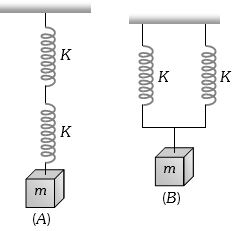
- 4Two identical spring of constant $K$ are connected in series and parallel as shown in figure. A mass $m$ is suspended from them. The ratio of their frequencies of vertical oscillations will beView Solution
- 5The equation of a simple harmonic motion is $X = 0.34\cos (3000t + 0.74)$ where $X$ and $t$ are in $mm$ and $sec$. The frequency of motion isView Solution
- 6The potential energy of a simple harmonic oscillator at mean position is $2\,joules$. If its mean $K.E.$ is $4\,joules$, its total energy will be .... $J$View Solution
- 7View SolutionWhat is constant in S.H.M.
- 8The displacement $x$ (in metre) of a particle in, simple harmonic motion is related to time t (in seconds) asView Solution
$x = 0.01\cos \left( {\pi \,t + \frac{\pi }{4}} \right)$
The frequency of the motion will be
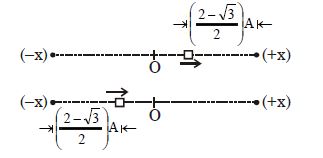
- 9Two bodies performing $SHM$ have same amplitude and frequency. Their phases at a certain instant are as shown in the figure. The phase difference between them isView Solution
- 10The bob of a simple pendulum of mass m and total energy $E$ will have maximum linear momentum equal toView Solution