Question
The Electric flux through the surface:

Answer

  1. Is the same for all the figures.
Key concept: According to Gauss' law of electrostatics, the total electric flux out of a closed surface is equal to the charge enclosed divided by the permittivity,
$\text{i.e.,}\phi=\frac{\text{Q}_\text{enclosed}}{\epsilon_0}$
Thus, electric flux through a surface doesn't depend on the shape, size or area of a surface but it depends on the amount of charge enclosed by the surface.
In given figures the charge enclosed are same that means the electric flux through all the surfaces should be the same. Hence option (d) is correct.

Need a full question paper?

Generate a complete, print-ready paper with questions like this in minutes — across 16+ boards, with answer keys.
Start Generating Free

Similar questions

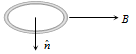
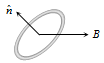
A current carrying loop is placed in a uniform magnetic field in four different orientations$\text{, I,II, III IV}$ arrange them in the decreasing order of potential Energy
$(a)$$(b)$  $(c)$  $(d)$
Due to the earth's magnetic field, charged cosmic ray particles(a) Require greater kinetic energy to reach the equator than the poles(b) Require less kinetic energy to reach the equator than the poles(c) Can never reach the equator(d) Can never reach the poles


The photoelectric threshold wavelength for a metal surface is 6600 Å. The work function for this is(a) 1.87 V(b) 1.87 eV(c) 18.7 eV(d) 0.18 eV
       
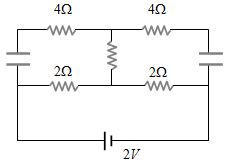
Find the power of the circuit
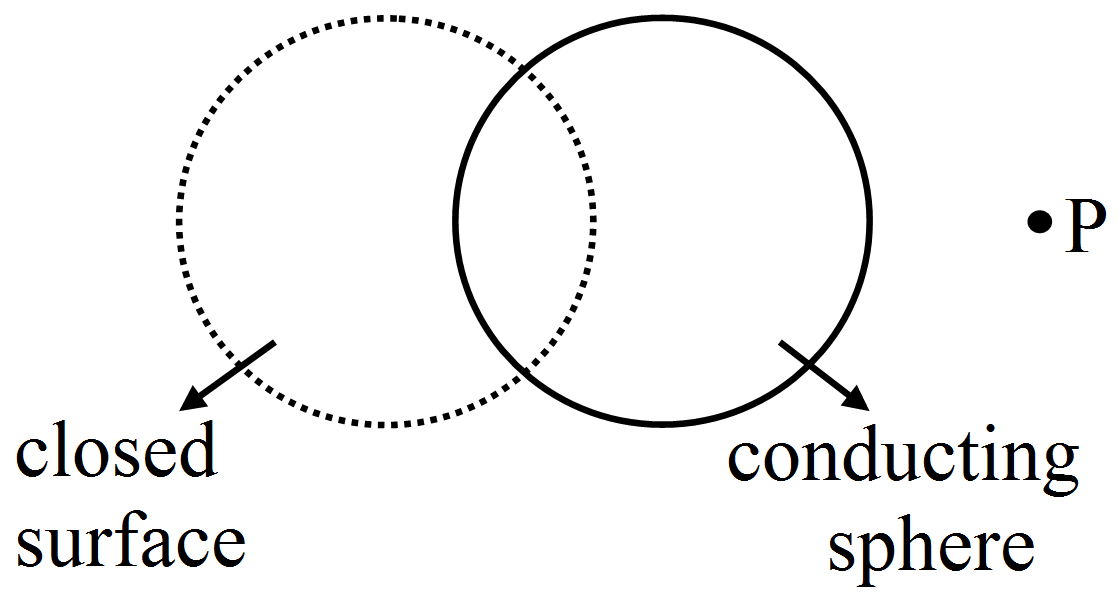
Figure shows a closed surface which intersects a conducting sphere. If a positive charged is placed at the point P, the flux of the electic field through the closed surface:
The unit of specific resistance is:
Two waves are said to be coherent :
If 2.2 kilowatt power is transmitted through a 10 ohm line at 22000 volt, the power loss in the form of heat will be(a) 0.1 watt(b) 1 watt(c) 10 watt(d) 100 watt
       
Displacement current is continuous:
A particle of mass m is attached to a light string of length l, the other end of which is fixed. Initially the string is kept horizontal and the particle is given an upward velocity v. The particle is just able to complete a circle.
  1. The string becomes slack when the particle reaches its highest point.
  2. The velocity of the particle become zero at the highest point.
  3. The kinetic energy of the ball in initial position was $\frac{1}{2}\text{m}\nu^2=\text{mgl}.$
  4. The particle again passes through the initial position.