The equivalent resistance of the following infinite network of resistances is
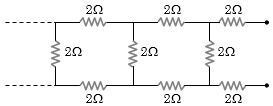
AIIMS 1995, Medium


Download our appand get started for free
Experience the future of education. Simply download our apps or reach out to us for more information. Let's shape the future of learning together!No signup needed.*
Similar Questions
- 1In copper wire each atom releases one free electron. If diameter is $1\, mm$ and current is $1.1\,A$ find drift velocity. ($\rho = 9 \times 10^{+3}\, kg/m^3$ $M = 63\, gm/mole$)View Solution
- 2Two resistors $400\, \Omega$ and $800\, \Omega$ are connected in series across a $6 V$ battery. The potential difference measured by a voltmeter of $10\, k \Omega$ across $400\, \Omega$ resistor is close to$....V$View Solution
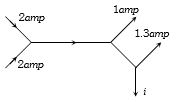
- 3The figure below shows currents in a part of electric circuit. The current $i$ is ............. $amp$View Solution
- 4All resistances in figure are $1\,\Omega$ each. The value of current ' $I$ ' is $\frac{a}{5}\,A$. The value of $a$ isView Solution
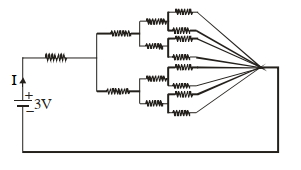
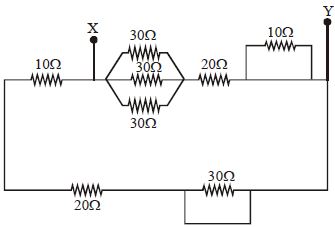
- 5Net resistance between $X$ and $Y$ is ............... $\Omega$View Solution
- 6A current $I$ flows through a uniform wire of diameter $d,$ when the mean drift velocity is $v_d.$ The same current will flow through a wire of diameter $d/2$ made of the same material, if the mean drift velocity of the electrons isView Solution
- 7Water of volume $2\, litre$ in a container is heated with a coil of $1\, kW$ at $27 \,^oC$. The lid of the container is open and energy dissipates at rate of $160\, J/s$. In how much time temperature will rise from $27\,^oC$ to $77\,^oC$ $[$ Given specific heat of water is $4.2\, kJ/kg$ $]$View Solution
- 8Two resistances ${R_1}$ and ${R_2}$ when connected in series and parallel with $120\, V$ line, power consumed will be $25\, W$ and $100\, W$ respectively. Then the ratio of power consumed by ${R_1}$ to that consumed by ${R_2}$ will beView Solution
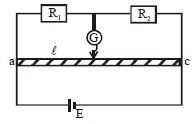
- 9Fig. shows rough sketch of meter bridge. $(G)$ deflects zero at length $\ell \, cm$. Now $R_1$ and $R_2$ are interchanged then balancing length increases by $25\, cm$. Find $R_1/R_2$View Solution
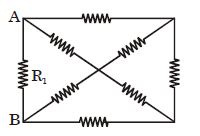
- 10As shown, the circuit is made of $8$ different resistors. It is found that when $R_1 = 4\,\,\Omega,$ the resistance between $A$ and $B$ is $2\,\,\Omega.$ Now replace $R_1$ by a $6\,\,\Omega$ resistor, what is the resistance between $A$ and $B$?View Solution