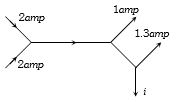
The figure below shows currents in a part of electric circuit. The current $i$ is ............. $amp$
Medium
Download our app for free and get started
According to Kirchhoff's first law
At junction $A$, ${i_{AB}} = 2 + 2 = 4\,A$
At junction $B$, ${i_{AB}} = {i_{BC}} - 1 = 3\,A$
At junction $C$, $i = {i_{BC}} - 1.3 = 3 - 1.3 = 1.7\,A$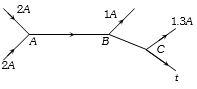

Download our appand get started for free
Experience the future of education. Simply download our apps or reach out to us for more information. Let's shape the future of learning together!No signup needed.*
Similar Questions
- 1Length of a hollow tube is $5\,m$, it’s outer diameter is $10\, cm$ and thickness of it’s wall is $5\, mm$. If resistivity of the material of the tube is $1.7 \times 10^{-8} \,\Omega m$ then resistance of tube will beView Solution
- 2A resistor dissipates $192\, {J}$ of energy in $1\, {s}$ when a current of $4\, {A}$ is passed through it. Now, when the current is doubled, the amount of thermal energy dissipated in $5 \,{s}$ in $.....\,J.$View Solution
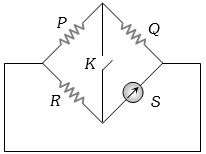
- 3In the following Wheatstone bridge $P/Q = R/S$. If key $K$ is closed, then the galvanometer will show deflectionView Solution
- 4Three resistors each of $4\,\Omega $ are connected together to form a network. The equivalent resistance of the network cannot be ............ $\Omega$View Solution
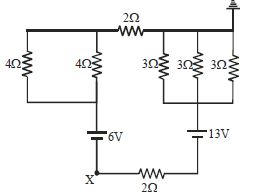
- 5Find potential at point $'x'$ in given circuit ............... $V$View Solution
- 6Potentiometer wire of length $1 \,m$ is connected in series with $490\,\Omega $ resistance and $2\,V$ battery. If $0.2\, mV/cm $ is the potential gradient, then resistance of the potentiometer wire is ................ $\Omega$View Solution
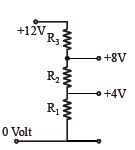
- 7A potential divider is used to give outputs of $4\,V$ and $8\,V$ from a $12\,V$ source. Which combination of resistances, $(R_1 : R_2 : R_3)$ gives the correct voltagesView Solution
- 8A current of $2\,A$ flows through a wire of crosssectional area $25.0\,mm ^2$. The number of free electrons in a cubic meter are $2.0 \times 10^{28}$. The drift velocity of the electrons is $...............\times 10^{-6}\,ms ^{-1}$ (given, charge on electron $=1.6 \times 10^{-19}\,C$ )View Solution
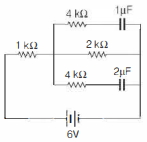
- 9What are the charges stored in the $1 \,\mu F$ and $2 \,\mu F$ capacitors in the circuit below, once the currents become steady?View Solution
- 10A $100\, W \, bulb\, B_1$ and two $60\, W \,bulbs \,B_2$ and $B_3$, are connected to a $220\, V$ source, as shown in Figure. Now $P_1, P_2$ and $P_3$ are the output powers of the bulbs $B_1, B_2$ and $B_3$ respectively. ThenView Solution