Question
The heat current is written as $\frac{\triangle\text{Q}}{\triangle\text{t}}.$ Why don't we write $\frac{\text{dQ}}{\text{dt}}?$

Answer

The amount of heat crossing through any cross-section of a slab in time $\triangle\text{t}$ is called heat current.
It is written as $\frac{\triangle\text{Q}}{\triangle\text{t}}$ and not as complete derivative $\frac{\text{dQ}}{\text{dt}}.$
This is because the amount of heat crossing through any cross section is a function of many variables like temperature difference, area of cross-section, etc.
So, we cannot write it as a complete derivative with respect to time.

Need a full question paper?

Generate a complete, print-ready paper with questions like this in minutes — across 16+ boards, with answer keys.
Start Generating Free

Similar questions

Establish the relation between critical angle and refractive index.
Calculate the number of photons emitted per second by a 10W sodium vapour lamp. Assume that 60% of the consumed energy is converted into light. Wavelength of sodium light = 590nm.
Two identical cells of emf 1.5 V each joined in parallel supply energy to an external circuit consisting of two resistances of 7 $\Omega$ each joined in parallel. A very high resistance voltmeter reads the terminal voltage of cells to be 1.4 V. Calculate the internal resistance of each cell.
What are the advantages of using soft iron as a core, instead of steel, in the coils of galvanometers?
  1. Using Bohr's second postulate of quantization of orbital angular momentum show that the circumference of the electron in the $n^{th}$ orbital state in hydrogen atom is n times the de Broglie wavelength associated with it.
  2. The electron in hydrogen atom is initially in the third excited state.What is the maximum number of spectral lines which can be emitted when it finally moves to the ground state?
State the underlying principle of a potentiometer. Write two factors by which current sensitivity of a potentiometer can be increased. Why is a potentiometer preferred over a voltmeter for measuring the emf of a cell?
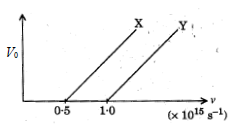
The following graph shows the variation of stopping potential $V_0$ with the frequency $v$ of the incident radiation for two photosensitive metals $X$ and $Y$ :
  1. Which of the metals has larger threshold wavelength? Give reason.
  2. Explain, giving reason, which metal gives out electrons, having larger kinetic energy, for the same wavelength of the incident radiation.
  3. If the distance between the light source and metal $X$ is halved, how will the kinetic energy of electrons emitted from it change? Give reason.
Which constituent radiation of the electromagnetic spectrum is used:
  1. In RADAR,
  2. To photograph internal parts of a human body,
  3. For taking photographs of the sky during night and foggy conditions?
Give one reason for your answer in each case.
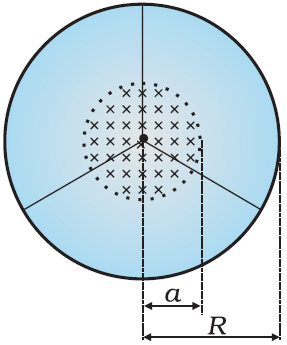
A line charge $\lambda$ per unit length is lodged uniformly onto the rim of a wheel of mass $M$ and radius $R.$ The wheel has light non-conducting spokes and is free to rotate without friction about its axis $($Fig.$). A$ uniform magnetic field extends over a circular region within the rim. It is given by,
$B = – B_0k (r \leq a; a < R)$
$= 0 ($otherwise$)$
What is the angular velocity of the wheel after the field is suddenly switched off?
What is de-Broglie wave? Write an expression for its wavelength.