MCQ
The local maximum value of the function $f(x)=\left(\frac{2}{x}\right)^{x^{2}}, x>0$, is
  • A
    $(2 \sqrt{\mathrm{e}})^{\frac{1}{\mathrm{e}}}$
  • B
    $\left(\frac{4}{\sqrt{\mathrm{e}}}\right)^{\frac{\mathrm{e}}{4}}$
  • $(\mathrm{e})^{\frac{2}{\mathrm{e}}}$
  • D
    $1$

Answer

Correct option: C.
$(\mathrm{e})^{\frac{2}{\mathrm{e}}}$
c
$f(x)=\left(\frac{2}{x}\right)^{x^{2}} ; x>0$

$\ell n f(x)=x^{2}(\ell \ln 2-\ell n x)$

$f^{\prime}(x)=f(x)\{-x+(\ell n 2-\ell n x) 2 x\}$

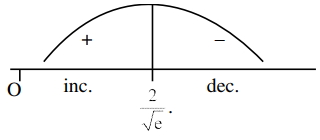
$f^{\prime}(x)=\underbrace{f(x)}_{+} \cdot \underbrace{x}_{+} \underbrace{(2 \ell n 2-2 \ell n x-1)}_{g(x)}$

$g(x)=2 \ell n^{2}-2 \ell n x-1$

$=\ell n \frac{4}{x^{2}}-1=0 \Rightarrow x=\frac{2}{\sqrt{e}}$

$\mathrm{LM}=\frac{2}{\sqrt{\mathrm{e}}}$

Local maximum value $=\left(\frac{2}{2 / \sqrt{\mathrm{e}}}\right)^{\frac{4}{\mathrm{e}}} \Rightarrow \mathrm{e}^{\frac{2}{\mathrm{e}}}$
Need a full question paper?

Generate a complete, print-ready paper with questions like this in minutes — across 16+ boards, with answer keys.

Start Generating Free

Similar questions

Let $f(x) = [x]\sin \left( {\frac{\pi }{{[x + 1]}}} \right)$, where $[.]$ denotes the greatest integer function. The domain of $f$ is ….and the points of discontinuity of $f$ in the domain are
The lateral edge of a regular rectangular pyramid is $'a'$ cm long . The lateral edge makes an angle $\alpha$ with the plane of the base. The value of $\alpha$ for which the volume of the pyramid is greatest, is
If $x = y\sqrt {1 - {y^2},} $ then ${{dy} \over {dx}} = $
The general solution of the differential equation $\text{e}^\text{x}\ \text{dy}+(\text{y e}^\text{x}+2\text{x})\text{dx}=0\ \text{is}$
  1. $\text{x e}^\text{y}+\text{x}^2=\text{C}$
  2. $\text{x e}^\text{y}+\text{y}^2=\text{C}$
  3. $\text{y e}^\text{x}+\text{x}^{2}=\text{C}$
  4. $\text{y e}^\text{y}+\text{x}^2=\text{C}$
The area bounded by the curve $x^2+y^2=1$ in first quadrant is
If the curve ay + x2 = 7 and x3 = y cut orthogonally at (1, 1), then a is equal to:
  1. 1
  2. -6
  3. 6
  4. 0
The area (in sq. units) bounded by the curves $\text{y}=\sqrt{\text{x}},2\text{y}-\text{x}+3=0$ and x-axis lying in the first quadrant is:
  1. $9$
  2. $36$
  3. $18$
  4. $\frac{27}{4}$
$\int {{{13}^x}dx} $ is
Let the volume of a parallelopiped whose coterminous edges are given by $\overrightarrow{\mathrm{u}}=\hat{\mathrm{i}}+\hat{\mathrm{j}}+\lambda \hat{\mathrm{k}}, \overrightarrow{\mathrm{v}}=\hat{\mathrm{i}}+\hat{\mathrm{j}}+3 \hat{\mathrm{k}} $ and $\overrightarrow{\mathrm{w}}=2 \hat{\mathrm{i}}+\hat{\mathrm{j}}+\hat{\mathrm{k}}$ be $1\; cu.$ unit. If $\theta$ be the angle between the edges $\overrightarrow{\mathrm{u}}$ and $\overrightarrow{\mathrm{w}},$ then $\cos \theta$ can be
Let $A _{1}$ be the area of the region bounded by the curves $y =\sin x , y =\cos x$ and $y$ -axis in the first quadrant. Also, let $A _{2}$ be the area of the region bounded by the curves $y=\sin x$ $y =\cos x , x$ -axis and $x =\frac{\pi}{2}$ in the first quadrant. Then ..... .