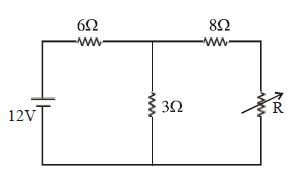
The maximum power delivered to resistance $R$ is ............... $W$
Medium
Download our app for free and get started
$P_{\max }=\frac{V_{a b}^{2}}{4 R_{a b}} ; P_{\max }=\frac{16}{4 \times 10}=0.4 \mathrm{\,watt}$
$\mathrm{V}_{\mathrm{ab}}=\frac{12}{9} \times 3=4 \mathrm{\,volt}$
$\mathrm{R}_{\mathrm{ab}}=8+\frac{6 \times 3}{9}=8+2=10\, \Omega$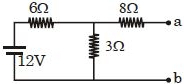

Download our appand get started for free
Experience the future of education. Simply download our apps or reach out to us for more information. Let's shape the future of learning together!No signup needed.*
Similar Questions
- 1The resistivity of alloys $ = {R_{{\rm{alloy}}}}$; the resistivity of constituent metals ${R_{{\rm{metal}}}}$. Then, usuallyView Solution
- 2View SolutionIn the circuit shown in the figure below, which of the following statement is incorrect ?
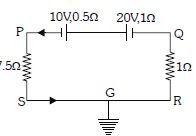
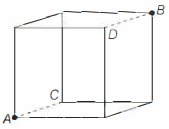
- 3A cube is formed with ten identical resistances $R$ (thick lines) and two shorting wires (dotted lines) along the arms $A C$ and $B D$ as shown in the figure below. Resistance between point $A$ and $B$ is ...........$\Omega$View Solution
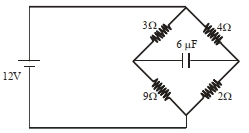
- 4In the circuit shown, the energy stored in the capacitor is $n\,\mu J$. The value of $n$ is ..............View Solution
- 5Length of a hollow tube is $5\,m$, it’s outer diameter is $10\, cm$ and thickness of it’s wall is $5\, mm$. If resistivity of the material of the tube is $1.7 \times 10^{-8} \,\Omega m$ then resistance of tube will beView Solution
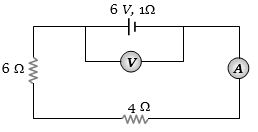
- 6View SolutionIn the circuit shown here, the readings of the ammeter and voltmeter are
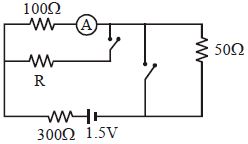
- 7In the circuit shown, the reading of the ammeter (ideal) is the same with both switches open as with both closed find the value of resistance $R$ in $ohm$ . ................ $\Omega$View Solution
- 8A primary cell has an $e.m.f.$ of $1.5\,volts$, when short-circuited it gives a current of $3$ amperes. The internal resistance of the cell is .............. $ohm$View Solution
- 9A battery of internal resistance one ohm and $emf$ $3\,volt$ sends a current through $1\,metre$ of uniform wire of resistance $5\,\Omega $. The pole of the cell of $emf$ $1.4\,volt$ are connected to two points on the wire so that no current passes through this cell. Then, the potential gradient of the wire isView Solution
- 10A potentiometer consists of two wires $AC$ and $CB$ of same material and of equal lengths but diameters in the ratio $3 : 1.$ Then the potential gradients on the two wires will be in the ratio :-View Solution