The phase (at a time $t$) of a particle in simple harmonic motion tells
Easy
Download our app for free and get started
The phase (at a time $t)$ of a particle in $SHM$ is a physical quantity that wholly expresses the position and direction of motion of that particle of time $t$

Download our appand get started for free
Experience the future of education. Simply download our apps or reach out to us for more information. Let's shape the future of learning together!No signup needed.*
Similar Questions
- 1If the displacement equation of a particle be represented by $y = A\sin PT + B\cos PT$, the particle executesView Solution
- 2View SolutionA graph of the square of the velocity against the square of the acceleration of a given simple harmonic motion is
- 3The amplitude of a damped oscillator decreases to $0.9\,times$ its original magnitude in $5\,s.$ In another $10\,s$ it will decrease to $\alpha $ times its original magnitude, where $\alpha $ equalsView Solution
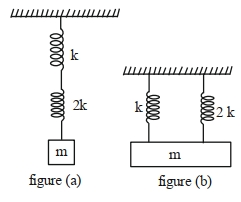
- 4As per given figures, two springs of spring constants $K$ and $2\,K$ are connected to mass $m$. If the period of oscillation in figure $(a)$ is $3 s$, then the period of oscillation in figure $(b)$ will be $\sqrt{ x }$ s. The value of $x$ is$.........$View Solution
- 5The velocity of a particle executing SHM varies with displacement $( x )$ as $4 v ^2=50- x ^2$. The time period of oscillations is $\frac{x}{7} s$. The value of $x$ is $............$ $\left(\right.$ Take $\left.\pi=\frac{22}{7}\right)$View Solution
- 6A simple harmonic oscillator has an amplitude a and time period $T$. The time required by it to travel from $x = a$ to $x = \frac{a }{2}$ isView Solution
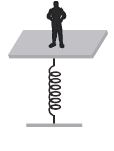
- 7A man weighing $60\ kg$ stands on the horizontal platform of a spring balance. The platform starts executing simple harmonic motion of amplitude $0.1\ m$ and frequency $\frac{2}{\pi } Hz$. Which of the following staements is correctView Solution
- 8When a mass $M$ is attached to the spring of force constant $k$, then the spring stretches by $l$. If the mass oscillates with amplitude $l$, what will be maximum potential energy stored in the springView Solution
- 9A loaded vertical spring executes $S.H.M.$ with a time period of $4\; sec$. The difference between the kinetic energy and potential energy of this system varies with a period of ........$sec$View Solution
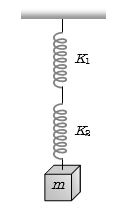
- 10A mass $M$ is suspended by two springs of force constants $K_1$ and $K_2$ respectively as shown in the diagram. The total elongation (stretch) of the two springs isView Solution