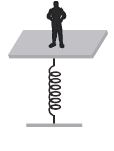
A man weighing $60\ kg$ stands on the horizontal platform of a spring balance. The platform starts executing simple harmonic motion of amplitude $0.1\ m$ and frequency $\frac{2}{\pi } Hz$. Which of the following staements is correct
Diffcult
Download our app for free and get started
The maximum force acting on the body executing simple harmonic motion is
$\mathrm{m\omega}^{2} \mathrm{a}=\mathrm{m} \times(2 \pi \mathrm{f})^{2} \mathrm{a}=60 \times\left(2 \pi \times \frac{2}{\pi}\right)^{2} \times 0.1 \mathrm{N}$
$=60 \times 16 \times 0.1=96 \mathrm{N}=\frac{96}{9.8} \approx 10 \mathrm{kgf}$ and this
force is towards mean position.
The reaction of the force on the platform away from the mean position. It readuces the weight of man on upper extreme, i.e., net weight $=(60-10) \mathrm{kgf}$
This force adds to the weight at lower extreme position i.e., net weight becomes $=(60+10) \mathrm{kgf}$ Therefore, the reading the weight recorded by spring balance fluctuates between $50$ $kgf$ and $70$ $\mathrm{kgf}$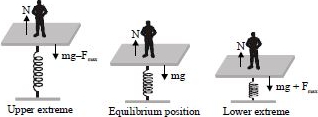

Download our appand get started for free
Experience the future of education. Simply download our apps or reach out to us for more information. Let's shape the future of learning together!No signup needed.*
Similar Questions
- 1Given below are two statements:View Solution
Statement $I :$ A second's pendulum has a time period of $1$ second.
Statement $II :$ It takes precisely one second to move between the two extreme positions.
In the light of the above statements, choose the correct answer from the options given below:
- 2A pendulum has time period $T$ in air. When it is made to oscillate in water, it acquired a time period $T' = \sqrt 2 T$. The density of the pendulum bob is equal to (density of water $= 1$)View Solution
- 3The amplitude of a particle executing $SHM$ is $4 \,cm$. At the mean position the speed of the particle is $16\, cm/sec$. The distance of the particle from the mean position at which the speed of the particle becomes $8\sqrt 3 \,cm/s,$ will be .... $cm$View Solution
- 4What is the velocity of the bob of a simple pendulum at its mean position, if it is able to rise to vertical height of $10\,cm$ ($g = 9.8\, m/s^2$) ..... $m/s$View Solution
- 5The kinetic energy of $SHM$ is $1/n$ time its potential energy. If the amplitude of the $SHM$ be $A$, then what is the displacement of the particle?View Solution
- 6View SolutionIf a particle is executing simple harmonic motion, then acceleration of particle
- 7Two particles are in $SHM$ in a straight line. Amplitude $A$ and time period $T$ of both the particles are equal. At time $t=0,$ one particle is at displacement $y_1= +A$ and the other at $y_2= -A/2,$ and they are approaching towards each other. After what time they cross each other ?View Solution
- 8The amplitude of a wave represented by displacement equationView Solution
$y = \frac{1}{{\sqrt a }}\,\sin \,\omega t \pm \frac{1}{{\sqrt b }}\,\cos \,\omega t$ will be
- 9Time period of a simple pendulum is $T$. The angular displacement for amplitude is $\beta$. How much time the bob of pendulum will take to move from equilibrium position $O$ to $A$, making an angle $\alpha$ at the supportView Solution
- 10The $ P.E.$ of a particle executing $SHM$ at a distance $x$ from its equilibrium position isView Solution