MCQ
The $r.m.s.$ velocity will be greater for
  • Hydrogen
  • B
    Oxygen
  • C
    Equal for both
  • D
    Nothing is definite

Answer

Correct option: A.
Hydrogen
a
$(R \cdot M \cdot S)=\sqrt{\frac{3 R T}{M}}$

$\therefore(R \cdot M \cdot S) \propto \frac{1}{\sqrt{M}} \quad$ [when other terms are constant]

Out of Hydrogen and oxygen, hydrogen has the lower molecular mass. Thus, $(RMS)$ velocity will be greater for hydrogen.

Need a full question paper?

Generate a complete, print-ready paper with questions like this in minutes — across 16+ boards, with answer keys.
Start Generating Free

Similar questions

The unit of Stefan's constant $\sigma $ is
Two wires are in unison. If the tension in one of the wires is increased by $2\%, 5$ beats are produced per second. The initial frequency of each wire is  .... $Hz$
The pressure exerted by a gas is dependent on its density:
The ratio of the speed of sound in nitrogen gas to that in helium gas, at $300 K$ is
A particle moves along a straight line such that its displacement at any time $t$ is given by $s = (t^3 -3t^2 + 2)\,m$ The displacement when the acceleration becomes zero is........$m$
The acceleration due to gravity at pole and equator can be related as
An isolated rail car of mass $M$ is moving along a straight, frictionless track at an initial speed $v_0$. The car is passing under a bridge when $a$ crate filled with $N$ bowling balls, each of mass $m$, is dropped from the bridge into the bed of the rail car. The crate splits open and the bowling balls bounce around inside the rail car, but none of them fall out. Is the momentum of the rail car $+$ bowling balls system conserved in this collision?
Two moles of an ideal monoatomic gas occupies a volume $V$ at $27^o C$. The gas expands adiabatically to a volume $2\ V$. Calculate $(a)$ the final temperature of the gas and $(b)$ change in its internal energy.
A cylinder with a movable piston contains $3\,moles$ of hydrogen at standard temperature and pressure. The walls of the cylinder are made of a heat insulator, and the piston is insulated by having a pile of sand on it. By what factor does the pressure of the gas increases if the gas is compressed to half its original volume? 
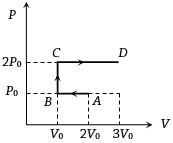
$P-V$ diagram of an ideal gas is as shown in figure. Work done by the gas in process $ABCD$ is