MCQ
The same retarding force is applied to stop a train. The train stops after $80 m$. If the speed is doubled, then the distance will be
  • A
    The same
  • B
    Doubled
  • C
    Halved
  • Four times

Answer

Correct option: D.
Four times
d
(d)Stopping distance $S \propto {u^2}$. If the speed is doubled then the stopping distance will be four times.

Need a full question paper?

Generate a complete, print-ready paper with questions like this in minutes — across 16+ boards, with answer keys.

Start Generating Free

Similar questions

The angle made by the vector $\left( {\hat i\,\, + \;\,\hat j} \right)$ with $x-$ axis and $y$ axis is
The specific heat of a gas:
A charged particle moves in a gravity-free space without change in velocity. Which of the following is are possible:

  1. $\text{E}=0,\ \text{B}=0$

  2. $\text{E}=0,\ \text{B}\not=0$

  3. $\text{E}\not=0,\ \text{B}=0$

  4. $\text{E}\not=0,\ \text{B}\not=0$

Two wires of the same material have lengths in the ratio 1 : 2 and their radii are in the ratio $1:\sqrt 2 $. If they are stretched by applying equal forces, the increase in their lengths will be in the ratio
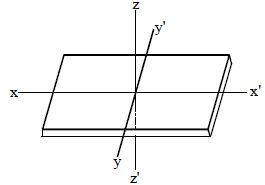
The rectangular plate shown in the figure is rotated in turn about $x-x,\, y-y$ and $z-z$ axes passing through its centre of mass $O$ . Its moment of inertia is
If density of earth increased $4 $ times and its radius become half of what it is, our weight will
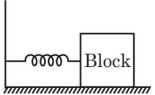
For a simple harmonic motion in a mass spring system shown, the surface is frictionless. When the mass of the block is $1\,kg$, the angular frequency is $\omega_1$. When the mass block is $2\,kg$ the angular frequency is $\omega_2$. The ratio $\omega_2 / \omega_1$ is
For Carnot engine, which process should be chosen to take the working substance from T1 to T2 or vice-versa?
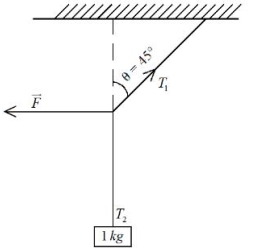
A $1 \mathrm{~kg}$ mass is suspended from the ceiling by a rope of length $4 \mathrm{~m}$. A horizontal force ' $F$ ' is applied at the mid point of the rope so that the rope makes an angle of $45^{\circ}$ with respect to the vertical axis as shown in figure. The magnitude of $F$ is:
A steel ball of radius $2\, cm$ is at rest on a frictionless surface. Another ball of radius $4\,cm$ moving at a velocity of $81 \,cm/sec$ collides elastically with first ball. After collision the smaller ball moves with speed of ............. $\mathrm{cm} / \mathrm{sec}$