The temperature coefficient of resistance for a wire is $0.00125\,^oC$. At $300\,K$ its resistance is $1\, ohm$. The temperature at which the resistance becomes $2\, ohm$ is .......... $K$
IIT 1980, Medium
Download our app for free and get started
$\frac{{{\rho _1}}}{{{\rho _2}}} = \frac{{(1 + \alpha {t_1})}}{{(1 + \alpha {t_2})}} \Rightarrow \frac{1}{2} = \frac{{(1 + 0.00125 \times 27)}}{{(1 + 0.00125 \times t)}}$
$ \Rightarrow t = 854\,^oC$ $\Rightarrow T = 1127\,K$
$ \Rightarrow t = 854\,^oC$ $\Rightarrow T = 1127\,K$

Download our appand get started for free
Experience the future of education. Simply download our apps or reach out to us for more information. Let's shape the future of learning together!No signup needed.*
Similar Questions
- 1A $60\, watt$ bulb operates on $220\,V$ supply. The current flowing through the bulb isView Solution
- 2The charge flowing through a resistance $R$ varies with time according to $Q = at -bt^2.$ The total heat produced in $R$ is : (assume that direction of current not reversed)View Solution
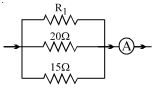
- 3In the given circuit the current flowing through the resisitance $20$ $\mathrm{ohms}$ is $0.3$ $\mathrm{ampere}$ while the ammeter reads $0.8$ $\mathrm{ampere}.$ What is the value of $R_1$? ................ $\mathrm{ohm}$View Solution
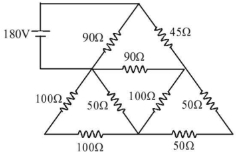
- 4In the circuit shown in the figure, find the current in $45\, \Omega$ $..........\,A$View Solution
- 5In an electric circuit, a cell of certain emf provides a potential difference of $1.25\, {V}$ across a load resistance of $5\, \Omega .$ However, it provides a potential difference of $1\, {V}$ across a load resistance of $2\, \Omega$. The $emf$ of the cell is given by $\frac{x}{10} v$. Then the value of $x$ is ..... .View Solution
- 6Equal potentials are applied on an iron and copper wire of same length. In order to have the same current flow in the two wires, the ratio $r$ (iron)/$r$ (copper) of their radii must be (Given that specific resistance of iron = $1.0 \times {10^{ - 7}}$ $ ohm-m$ and specific resistance of copper = $1.7 \times {10^{ - 8}}\,ohm-m$)View Solution
- 7Two wires of same length and thickness having specific resistances $6\, \Omega \,cm$ and $3 \,\Omega\, cm$ respectively are connected in parallel. The effective resistivity is $\rho\, \Omega \,cm$. The value of $\rho$ to the nearest integer, is ..... .View Solution
- 8Electric room radiator which operates at $225\, volts$ has resistance of $50\, ohms$. Power of the radiator is approximately ............... $W$View Solution
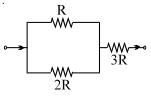
- 9The ratio of powers dissipatted respectively in $R$ and $3R$, as shown is:View Solution
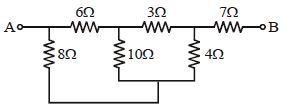
- 10The equivalent resistance between the points $A$ and $B$ is :-View Solution