The terminal potential difference of a cell is greater than its $e.m.f.$ when it is
Easy
Download our app for free and get started
(c) In charging $V > E$.

Download our appand get started for free
Experience the future of education. Simply download our apps or reach out to us for more information. Let's shape the future of learning together!No signup needed.*
Similar Questions
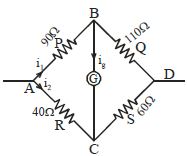
- 1In a Wheatstone bridge, $P = 90\,\Omega $, $Q = 110\,\Omega $ , $R = 40\,\Omega $ and $S = 60\,\Omega $ and a cell of $4\,V\,emf$. Then the potential difference between the diagonal along which a galvanometer is connected is ............. $V$View Solution
- 2Masses of $3$ wires of same metal are in the ratio $1 : 2 : 3$ and their lengths are in the ratio $3 : 2 : 1$. The electrical resistances are in ratioView Solution
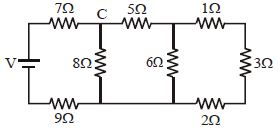
- 3In the ladder network shown, current through the resistor $3\, \Omega$ is $0.25\,A$. The input voltage $'V'$ is equal to:- ........... $V$View Solution
- 4Four wires of equal length and of resistances $10$ $ ohms$ each are connected in the form of a square. The equivalent resistance between two opposite corners of the square is ............. $ohm$View Solution
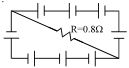
- 5$\mathrm{A}$ circuit is comprised of eight identical batteries and a resistor $R = 0.8\,\Omega$ . Each battery has an $\mathrm{emf}$ of $1.0\, V$ and internal resistance of $0.2\,\Omega$ . The voltage difference across any of the battery is ............. $V$View Solution
- 6When a current $I$ is passed through a wire of constant resistance, it produces a potential difference $V$ across its ends. The graph drawn between $\log\, I$ and $\log\, V$ will beView Solution
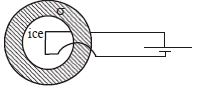
- 7Figure shows a thick shell made of electrical conductivity $\sigma$ and has inner & outer radii of $10\ cm$ & $20\ cm$ respectively and is filled with ice inside it. Its inside and outside surface are kept at different potentials by a battery of internal resistance $\frac{2}{\pi} \Omega \ \&\ \epsilon = 5V$. Find value of $\sigma$ for which ice melts at maximum possible rate if $25\%$ of heat generated by shell due to joule heating is used to melt ice.View Solution
- 8Five resistors are connected as shown in the diagram. The equivalent resistance between $A$ and $B$ is .............. $ohm$View Solution
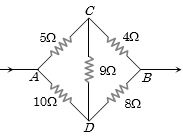
- 9In the circuit shown in figure, if ammeter and voltmeter are ideal, then the power consumed in $9 \,\Omega$ resistor will be .......... $W$View Solution
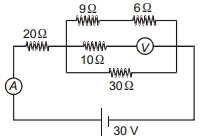
- 10View SolutionWhich is a wrong statement