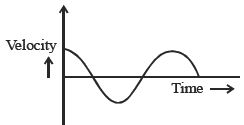
The total energy of the body executing $S.H.M.$ is $E$. Then the kinetic energy when the displacement is half of the amplitude, is
Medium
Download our app for free and get started
(c) Total energy in $SHM $ $E = \frac{1}{2}m{\omega ^2}{a^2}$; (where $a =$ amplitude)
Potential energy $U = \frac{1}{2}m{\omega ^2}({a^2} - {y^2}) $
$= E - \frac{1}{2}m{\omega ^2}{y^2}$
When $y = \frac{a}{2}$
$⇒$ $U = E - \frac{1}{2}m{\omega ^2}\left( {\frac{{{a^2}}}{4}} \right)$
$= E - \frac{E}{4} = \frac{{3E}}{4}$

Download our appand get started for free
Experience the future of education. Simply download our apps or reach out to us for more information. Let's shape the future of learning together!No signup needed.*
Similar Questions
- 1A block of mass $1 \,kg$ attached to a spring is made to oscillate with an initial amplitude of $12\, cm$. After $2\, minutes$ the amplitude decreases to $6\, cm$. Determine the value of the damping constant for this motion. (take In $2=0.693$ )View Solution
- 2A $5\, kg$ collar is attached to a spring of spring constant $500\, Nm^{-1}$. It slides without friction over a horizontal rod. The collar is displaced from its equillibrium position by $10\, cm$ and released. The time period of oscillation isView Solution
- 3A mass $m = 1.0\,kg$ is put on a flat pan attached to a vertical spring fixed on the ground. The mass of the spring and the pan is negligible. When pressed slightly and released, the mass executes simple harmonic motion. The spring constant is $500\,N/m.$ What is the amplitude $A$ of the motion, so that the mass $m$ tends to get detached from the pan ? (Take $g = 10\,m/s^2$ ). The spring is stiff enough so that it does not get distorted during the motion.View Solution
- 4In a simple pendulum, the period of oscillation $T$ is related to length of the pendulum $l$ asView Solution
- 5A spring of force constant $k$ is cut into two pieces such that one piece is double the length of the other. Then the long piece will have a force constant ofView Solution
- 6The acceleration of a particle performing S.H.M. is at a distance of $3\; cm$ from the mean position is $ 12\,cm/sec^2 $. Its time period is ..... $\sec$View Solution
- 7The displacement of simple harmonic oscillator after $3$ seconds starting from its mean position is equal to half of its amplitude. The time period of harmonic motion is $\dots \; s$View Solution
- 8View SolutionIf the metal bob of a simple pendulum is replaced by a wooden bob, then its time period will
- 9A pendulum suspended from the ceiling of a train has a period $T$, when the train is at rest. When the train is accelerating with a uniform acceleration a, the period of oscillation willView Solution
- 10View SolutionThe graph in figure represents