To find the resistance of a galvanometer by the half deflection method the following circuit is used with resistances $R_1 = 9970\,\Omega,$ $R_2 = 30\,\Omega$ and $R_3 = 0\,\Omega.$ The deflection in the galvanometer is $d$. With $R_3 = 107\,\Omega$ the deflection changed to $\frac {d}{2}$The galvanometer resistance is approximately ............... $\Omega$
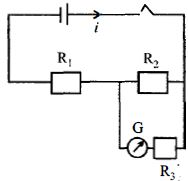
JEE MAIN 2013, Diffcult


Download our appand get started for free
Experience the future of education. Simply download our apps or reach out to us for more information. Let's shape the future of learning together!No signup needed.*
Similar Questions
- 1A $10\, m$ long wire of $20\,\Omega$ resistance is connected with a battery of $3\, volt$ $e.m.f.$ (negligible internal resistance) and a $10 \,\Omega$ resistance is joined to it is series. Potential gradient along wire in volt per meter isView Solution
- 2A cell, shunted by a $8 \; \Omega$ resistance, is balanced across a potentiometer wire of length $3 \; m$. The balancing length is $2 \; m$ when the cell is shunted by $4 \; \Omega$ resistance. The value of internal resistance of the cell will be $\dots \; \Omega .$View Solution
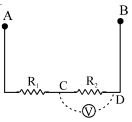
- 3Resistances $R_1$ and $R_2$ each $60\,\Omega$ are connected in series as shown in figure. The Potential difference between $A$ and $B$ is kept $120$ volt. Then what ............. $V$ will be the reading of voltmeter connected between the point $C$ and $D$ if resistance of voltmeter is $120\,\Omega .$View Solution
- 4In an experiment of potentiometer for measuring the internal resistance of primary cell a balancing length $\ell $ is obtained on the potentiometer wire when the cell is open circuit. Now the cell is short circuited by a resistance $R$. If $R$ is to be equal to the internal resistance of the cell the balancing length on the potentiometer wire will beView Solution
- 5View SolutionThe colour sequence in a carbon resistor is red, brown, orange and silver. The resistance of the resistor is
- 6In a potentiometer circuit there is a cell of $e.m.f.$ $2\, volt$, a resistance of $5\, ohm$ and a wire of uniform thickness of length $1000\, cm$ and resistance $15\, ohm$. The potential gradient in the wire isView Solution
- 7Assertion : A larger dry cell has higher $emf$View Solution
Reason : The $emf$ of a dry cell is proportional to its size
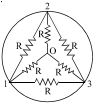
- 8Inside $a$ super conducting ring six identical resistors each of resistance $R$ are connected as shown in figure. Imagine a battery of $emf$ $E$ between the point $0$ and $1$, with its positive terminal connected with $O.$View Solution
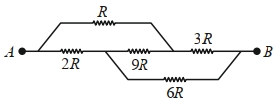
- 9The equivalent resistance between $A$ and $B$ of the network shown in figureView Solution
- 10First, a set of ${n}$ equal resistors of $10\; \Omega$ each are connected in series to a battery of emf $20\; {V}$ and internal resistance $10\; \Omega .$ A current $I$ is observed to flow. Then, the $n$ resistors are connected in parallel to the same battery. It is observed that the current is increased $20$ times, then the value of $n$ is .... .View Solution