Two pendulums of length $121\,cm$ and $100\,cm$ start vibrating in phase. At some instant, the two are at their mean position in the same phase. The minimum number of vibrations of the shorter pendulum after which the two are again in phase at the mean position is :
NEET 2022, Medium
Download our app for free and get started
$( n ) T _{\ell}=( n +1) T _{ s }$
$( n ) 2 \pi \sqrt{\frac{1.21}{ g }}=( n +1) 2 \pi \sqrt{\frac{1}{ g }}$
$( n )(1.1)=( n +1)$
$0.1( n )=1$
$n =10$
No. of oscillation of smaller one
$= n +1$
$=10+1$
$=11$

Download our appand get started for free
Experience the future of education. Simply download our apps or reach out to us for more information. Let's shape the future of learning together!No signup needed.*
Similar Questions
- 1The time period of a simple pendulum is $2\, sec$. If its length is increased $4$ times, then its period becomes ..... $\sec$View Solution
- 2Two simple pendulums of lengths $1.44 \,m$ and $1\, m$ start swinging together. After how many vibrations will they again start swinging togetherView Solution
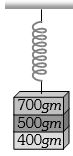
- 3Three masses $700g, 500g$, and $400g$ are suspended at the end of a spring a shown and are in equilibrium. When the $700g$ mass is removed, the system oscillates with a period of $3$ seconds, when the $500 \,gm$ mass is also removed, it will oscillate with a period of ...... $s$View Solution
- 4A uniform cylinder of length $L$ and mass $M$ having cross-sectional area $A$ is suspended, with its length vertical, from a fixed point by a massless spring, such that it is half submerged in a liquid of density $\sigma $ at equilibrium position. When the cylinder is given a downward push and released, it starts oscillating vertically with a small amplitude. The time period $T$ of the oscillations of the cylinder will beView Solution
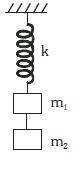
- 5Two masses $m_1$ and $m_2$ are supended together by a massless spring of constant $k$. When the masses are in equilibrium, $m_1$ is removed without disturbing the system; the amplitude of vibration isView Solution
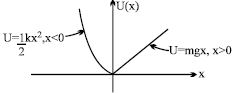
- 6A particle of mass $m$ moves in the potential energy $U$ shown above. The period of the motion when the particle has total energy $E$ isView Solution
- 7Two particles $P$ and $Q$ describe $SHM$ of same amplitude $a$ , frequency $v$ along the same straight line. The maximum distance between the two particles is $a \sqrt 2$ . The initial phase difference between the particles isView Solution
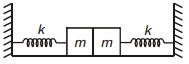
- 8View SolutionAn assembly of identical spring-mass systems is placed on a smooth horizontal surface as shown. At this instant, the springs are relaxed. The left mass is displaced to the/left and theiright mass is displaced to the right by same distance and released. The resulting collision is elastic. The time period of the oscillations of system is
- 9The displacement of an oscillator is given by $x = a\, \sin \, \omega t + b\, \cos \, \omega t$. where $a, b$ and $\omega$ are constant. Then :-View Solution
- 10To find the spring constant $(k)$ of a spring experimentally, a student commits $2 \%$ positive error in the measurement of time and $1 \%$ negative error in measurement of mass. The percentage error in determining value of $\mathrm{k}$ is :View Solution