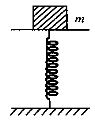
Two simple pendulums of lengths $1.44 \,m$ and $1\, m$ start swinging together. After how many vibrations will they again start swinging together
Medium


Download our appand get started for free
Experience the future of education. Simply download our apps or reach out to us for more information. Let's shape the future of learning together!No signup needed.*
Similar Questions
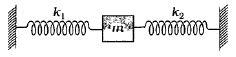
- 1Two springs, of force constants $k_1$ and $k_2$ are connected to a mass $m$ as shown. The frequency of oscillation of the mass is $f$ If both $k_1$ and $k_2$ are made four times their original values, the frequency of oscillation becomesView Solution
- 2View SolutionIdentify the function which represents a periodic motion.
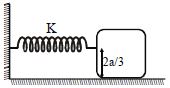
- 3Find maximum amplitude for safe $SHM$ (block does not topple during $SHM$) of $a$ cubical block of side $'a'$ on a smooth horizontal floor as shown in figure (spring is massless)View Solution
- 4A body is executing Simple Harmonic Motion. At a displacement $x$ its potential energy is ${E_1}$ and at a displacement y its potential energy is ${E_2}$. The potential energy $E$ at displacement $(x + y)$ isView Solution
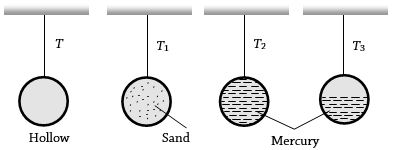
- 5The period of a simple pendulum, whose bob is a hollow metallic sphere, is $T$.The period is $T_1$ when the bob is filled with sand, $T_2$ when it is filled with mercury and $T_3$ when it is half filled with mercury. Which of the following is trueView Solution
- 6A ring is suspended from a point $S$ on its rim as shown in the figure. When displaced from equilibrium, it oscillates with time period of $1\,second.$ The radius of the ring is ..... $m$ (take $g = \pi ^2$ )View Solution

- 7For any $S.H.M.$, amplitude is $6\, cm$. If instantaneous potential energy is half the total energy then distance of particle from its mean position is .... $cm$View Solution
- 8A spring has a certain mass suspended from it and its period for vertical oscillation is $T$. The spring is now cut into two equal halves and the same mass is suspended from one of the halves. The period of vertical oscillation is nowView Solution
- 9Two bodies performing $SHM$ have same amplitude and frequency. Their phases at a certain instant are as shown in the figure. The phase difference between them isView Solution
- 10A mass of $2.0\, kg$ is put on a flat pan attached to a vertical spring fixed on the ground as shown in the figure. The mass of the spring and the pan is negligible. When pressed slightly and released the mass executes a simple harmonic motion. The spring constant is $200\, N/m.$ What should be the minimum amplitude of the motion so that the mass gets detached from the pan (take $g = 10 m/s^2$).View Solution