MCQ
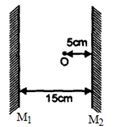
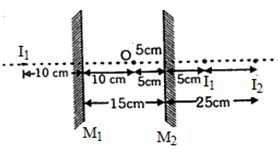
Two plane mirrors are parallel to each other and an object $O$ is placed between them. Then the distance of the first three images from the mirror $M_2$ ​ will be (in $cm$)
  • A
    $5, 10,15$
  • B
    $5, 15, 30$
  • $5, 25, 35$
  • D
    $5, 15, 25$

Answer

Correct option: C.
$5, 25, 35$
c

Need a full question paper?

Generate a complete, print-ready paper with questions like this in minutes — across 16+ boards, with answer keys.

Start Generating Free

Similar questions

The far point of a myopia eye is at 40 cm. For removing this defect, the power of lens required will be
A silver sphere of radius $1\ cm$ and work function $4.7 \ eV$ is suspended from an insulating thread in free-space. It is under continuous illumination of $200 \ nm$ wavelength light. As photoelectrons are emitted, the sphere gets charged and acquires a potential. The maximum number of photoelectrons emitted from the sphere is $A \times 10^2$ (where $1 < A < 10$ ). The value of  $'Z '$ is
Given below are two statements :

$Statement$ $I$ : Most of the mass of the atom and all its positive charge are concentrated in a tiny nucleus and the electrons revolve around it, is Rutherford's model.

$Statement$ $II$ : An atom is a spherical cloud of positive charges with electrons embedded in it, is a special case of Rutherford's model.

In the light of the above statements, choose the most appropriate from the options given below.
A ray of light is incident on one face of a transparent slab of thickness $15 \,cm$. The angle of incidence is $60^o$. If the lateral displacement of the ray on emerging from the parallel plane is $5$ index of the material of the slab is
A solid sphere, a hollow sphere and a disc, all having same mass and radius, are placed at the top of an incline and released. The friction coefficients between the objects and the incline are same and not sufficient to allow pure rolling. Least time will be taken in reaching the bottom by:
Due to the earth's magnetic field, charged cosmic ray particles
Avalanche breakdown in a $PN$ junction diode is due to
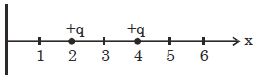
Two charged particles, each with a charge of $+q$, are located along the $x$ -axis at $x = 2$ and $x = 4$, as shown below. Which of the following shows the graph of the magnitude of the electric field along the $x$ -axis from the origin to $x = 6$?
Which one of the following spherical lenses does not exhibit dispersion? The radii of curvature of the surfaces of the lenses are as given in the diagrams
Radius of the first orbit of the electron in a hydrogen atom is $0.53\;\mathring A$. So, the radius of the third orbit will be...........$\mathring A$