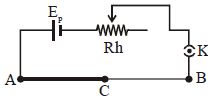
Two resistances ${R_1}$ and ${R_2}$ when connected in series and parallel with $120\, V$ line, power consumed will be $25\, W$ and $100\, W$ respectively. Then the ratio of power consumed by ${R_1}$ to that consumed by ${R_2}$ will be
Medium
Download our app for free and get started
(a) $P = \frac{{{V^2}}}{R}$$ \Rightarrow $ $\frac{{{P_P}}}{{{P_S}}} = \frac{{{R_S}}}{{{R_P}}} = \frac{{({R_1} + {R_2})}}{{{R_1}{R_2}/({R_1} + {R_2})}} = \frac{{{{({R_1} + {R_2})}^2}}}{{{R_1}\,{R_2}}}$
$ \Rightarrow $ $\frac{{100}}{{25}} = \frac{{{{({R_1} + {R_2})}^2}}}{{{R_1}{R_2}}}$$ \Rightarrow $ $\frac{{{R_1}}}{{{R_2}}} = \frac{1}{1}$
$ \Rightarrow $ $\frac{{100}}{{25}} = \frac{{{{({R_1} + {R_2})}^2}}}{{{R_1}{R_2}}}$$ \Rightarrow $ $\frac{{{R_1}}}{{{R_2}}} = \frac{1}{1}$

Download our appand get started for free
Experience the future of education. Simply download our apps or reach out to us for more information. Let's shape the future of learning together!No signup needed.*
Similar Questions
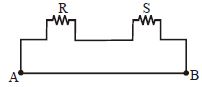
- 1In a meter bridge, the null point is found at a distance of $25\, cm$ from $A$ . If now a resistance of $10\,\Omega $ is connected in parallel with $S$, the null point occurs at mid point of $AB$. The value of $R$ is .............. $\Omega$View Solution
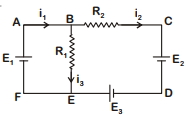
- 2For the circuit given below, the Kirchoff's loop rule for the loop $BCDEB$ is given by the equationView Solution
- 3A uniform wire of resistance $9$ $\Omega$ is cut into $3$ equal parts. They are connected in the form of equilateral triangle $ABC$. A cell of $e.m.f.$ $2\,V$ and negligible internal resistance is connected across $B$ and $C$. Potential difference across $AB$ is ............... $V$View Solution
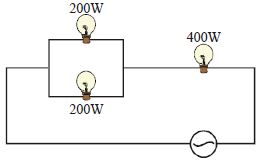
- 4Three electric bulbs of $200\,W,\,\,200\,W$ and $400\,W$ are shown in figure. The resultant power of the combination is ................ $W$View Solution
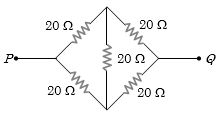
- 5The equivalent resistance between $P$ and $Q$ in the given figure, is ............... $\Omega$View Solution
- 6For comparing the $e.m.f.$'s of two cells with a potentiometer, a standard cell is used to develop a potential gradient along the wires. Which of the following possibilities would make the experiment unsuccessfulView Solution
- 7In a Wheatstone's bridge, three resistances $P, Q$ and $R$ connected in the three arms and the fourth arm is formed by two resistances $S_1$ and $S_2$ connected in parallel. The condition for the bridge to be balanced will beView Solution
- 8Two wires of resistance $R_1$ and $R_2$ have temperature coefficient of resistance ${\alpha _1\,}{\rm{ and \,}}{\alpha _2}$, respectively. These are joined in series. The effective temperature coefficient of resistance isView Solution
- 9Three copper rods are subjected to different potential difference. Compare the drift speed of electrons through them. Assume that all $3$ are at the same temperature.View Solution
Length Diameter Potential difference $(A)$ $L$ $3d$ $V$ $(B)$ $2L$ $d$ $2V$ $(C)$ $3L$ $2d$ $2V$ - 10A potentiometer consists of two wires $AC$ and $CB$ of same material and of equal lengths but diameters in the ratio $3 : 1.$ Then the potential gradients on the two wires will be in the ratio :-View Solution