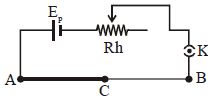
A potentiometer consists of two wires $AC$ and $CB$ of same material and of equal lengths but diameters in the ratio $3 : 1.$ Then the potential gradients on the two wires will be in the ratio :-
Medium
Download our app for free and get started

Download our appand get started for free
Experience the future of education. Simply download our apps or reach out to us for more information. Let's shape the future of learning together!No signup needed.*
Similar Questions
- 1Masses of three wires of copper are in the ratio of $1 : 3 : 5$ and their lengths are in the ratio of $5:3:1.$ The ratio of their electrical resistances areView Solution
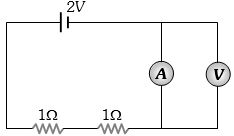
- 2In the circuit shown, $A$ and $V$ are ideal ammeter and voltmeter respectively. Reading of the voltmeter will be ............... $V$View Solution
- 3$n$ identical cells are joined in series with its two cells $A$ and $B$ in the loop with reversed polarities. $EMF$ of each shell is $E$ and internal resistance $r$. Potential difference across cell $A$ or $B$ is (here $n > 4$)View Solution
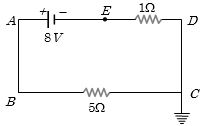
- 4In the given circuit, the potential of the point $E$ isView Solution
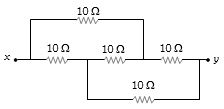
- 5The equivalent resistance between $x$ and $y$ in the circuit shown is ............. $\Omega$View Solution
- 6$A$ uniform copper wire carries a current $i$ amperes and has $p$ carriers per meter$^3$. The length of the wire is $\lambda$ meters and its cross-section area is $s$ meter $^2$. If the charge on a carrier is $q$ coulombs, the drift velocity in $ms^{-1}$ is given byView Solution
- 7Two electric lamps of $40\, watt$ each are connected in parallel. The power consumed by the combination will be ........... $watt$View Solution
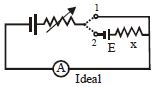
- 8In the circuit shown the variable resistance is so adjusted that the ammeter reading is same in both the position $1$ and $2$ of the key. The reading of ammeter is $2A$. If $E = 20V$, then $x$ is :- ................... $\Omega$View Solution
- 9Give colors of the ring in sequence marked on a resistance of $56 \ k\Omega$ with tolerance $\pm 5\%$View Solution
- 10Two wires of same material have length $L$ and $2L $ and cross-sectional areas $4A$ and $A$ respectively. The ratio of their specific resistance would beView Solution