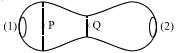
Two wires $A$ and $B$ of the same material, having radii in the ratio $1: 2$ carry currents in the ratio $4: 1$. The ratio of drift speed of electrons in $A$ and $B$ is .......
Medium
Download our app for free and get started
(a)
$4 i= neA V_D$
$i=n e(4 A) V_D^{\prime}$
$4=\frac{V_D}{4 V_D^a}$
$\frac{V_D}{V_D^{\prime}}=16: 1$

Download our appand get started for free
Experience the future of education. Simply download our apps or reach out to us for more information. Let's shape the future of learning together!No signup needed.*
Similar Questions
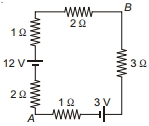
- 1Potential difference $V_B-V_A$ in the network shown is ............. $V$View Solution
- 2Four resistances of $100$ $\Omega$ each are connected in the form of square. Then, the effective resistance along the diagonal points is .............. $\Omega$View Solution
- 3View SolutionIn meter bridge or Wheatstone bridge for measurement of resistance, the known and the unknown resistances are interchanged. The error so removed is
- 4A flow of $10^{7}$ electrons per second in a conducting wire constitutes a current ofView Solution
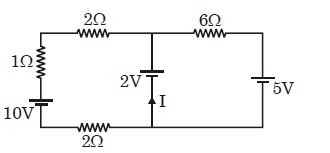
- 5Find the value of $I$ ?................ $\mathrm{A}$View Solution
- 6A metal wire of resistance $3\,\Omega $ is elongated to make a uniform wire of double its previous length. The new wire is now bent and the ends joined to make a circle. If two points on this circle make an angle $60^o$ at the centre, the equivalent resistance between these two points will beView Solution
- 7In a potentiometer arrangement, a cell of $emf$ $1.25\,V$ gives a balance point at $35.0\,cm$ length of the wire. If the cell is replaced by another cell and the balance point shifts to $63.0\,cm,$ the $emf$ of the second cell ............... $V$View Solution
- 8A potential $V_0$ is applied across a uniform wire of resistance $R$. The power dissipation is $P_1$. The wire is then cut into two equal halves and a potential of $V _0$ is applied across the length of each half. The total power dissipation across two wires is $P_2$. The ratio $P_2: P_1$ is $\sqrt{x}: 1$. The value of $x$ is $.............$.View Solution
- 9View SolutionOn increasing the temperature of a conductor, its resistance increases because
- 10Ametallic conductor of irregular cross-section is as shown in the figure. Aconstant potential difference is applied across the ends $(1)$ and $(2)$. Then :View Solution