MCQ
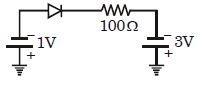
What is the current through an ideal $P-N$ junction diode shown in figure below.....$mA$
  • A
    $0$
  • B
    $10 $
  • $20$
  • D
    $50$

Answer

Correct option: C.
$20$
c
$\mathrm{i}=\frac{2}{100}=20 \mathrm{\,mA}$

Need a full question paper?

Generate a complete, print-ready paper with questions like this in minutes — across 16+ boards, with answer keys.

Start Generating Free

Similar questions

For a radioactive material, half-life is $10$ minutes. If initially there are $600$ number of nuclei, the time taken (in minutes) for the disintegration of $450$ nuclei is
Only paraxial rays are used in image formation by spherical mirror; because this:
A wire length $2\,m$ carrying a current of $1\,A$ is bent to form a circle. The magnetic moment of the coil is
In any electromagnetic wave, electric and magnetic field are represented by $\vec{E}$ and $\vec{B}$ respectively. The direction of propagation of this wave is along :
A charged body has an electric flux $F$ associated with it. Now if the body is place inside a conducting shell then the electric flux outside the shell is:
A symmetric double convex lens is cut in two equal parts by a plane perpendicular to the principal axis. If the power of the original lens was $4 D$, the power of a cut lens will be
Which of the following formula is correct for a spherical lens?
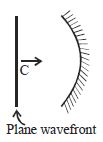
When a plane wave front incident on a concave mirror as shown in figure then shape of reflected wave front
Two infinitely long parallel conducting plates having surface charge densities $ + \sigma $ and $ - \sigma $ respectively, are separated by a small distance. The medium between the plates is vacuum. If ${\varepsilon _0}$ is the dielectric permittivity of vacuum, then the electric field in the region between the plates is
A charge is brought from a point on the equatorial plane of a dipole to its mid-point. Which of the following quantities remains constant?