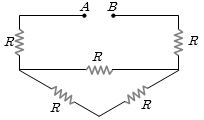
What is the equivalent resistance between $A$ and $B$ in the figure below if $R = 3\,\Omega $
AIIMS 2009, Medium


Download our appand get started for free
Experience the future of education. Simply download our apps or reach out to us for more information. Let's shape the future of learning together!No signup needed.*
Similar Questions
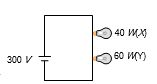
- 1Two bulbs $X$ and $Y$ having same voltage rating and of power $40\, watt$ and $60\, watt$ respectively are connected in series across a potential difference of $300\, volt$, thenView Solution
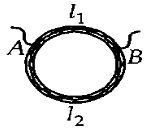
- 2A ring is made of a wire having a resistance $R_0 = 12 \,\,\Omega$. Find the points $A$ and $B,$ as shown in the figure, at which a current carrying conductor should be connected so that the resistance $R$ of the sub circuit between these points is equal to $\frac{8}{3}\,\Omega$.View Solution
- 3View SolutionAssertion : In a simple battery circuit, the point of the lowest potential is positive terminal of the battery.
Reason : The current flows towards the point of the higher potential, as it does in such a circuit from the negative to the positive terminal.
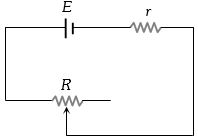
- 4A battery of $e.m.f.$ $E$ and internal resistance $r$ is connected to a variable resistor $R$ as shown here. Which one of the following is trueView Solution
- 5The resistivity $(\rho)$ of semiconductor varies with temperature. Which of the following curve represents the correct behaviourView Solution
- 6You are given several identical resistances each of value $R = 10\,\Omega $ and each capable of carrying maximum current of $1\, ampere$. It is required to make a suitable combination of these resistances to produce a resistance of $5\,\Omega $ which can carry a current of $4\, amperes$. The minimum number of resistances of the type $R$ that will be required for this jobView Solution
- 7There is a current of $20$ amperes in a copper wire of ${10^{ - 6}}$ square meter area of cross-section. If the number of free electrons per cubic meter is ${10^{29}}$, then the drift velocity isView Solution
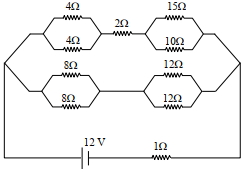
- 8The voltage drop across $15\, \Omega$ resistance in the given figure will be $.....V.$View Solution
- 9The charge flowing through a resistance $R$ varies with time $t$ as $ Q=at-bt^2 $ where $a$ and $b$ are positive constants . The total heat produced in $R$ isView Solution
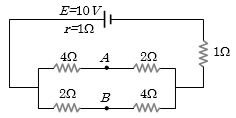
- 10In the circuit shown below, the cell has an $e.m.f.$ of $10\,V$ and internal resistance of $1\, ohm$. The other resistances are shown in the figure. The potential difference ${V_A} - {V_B}$ is ................ $V$View Solution