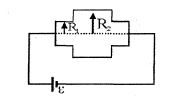
A cylindrical resistance is connected across battery $\varepsilon $ . Cylinder has uniform free electron density, mid part of cylinder has larger radius as shown in figure. Then $V_d$ (drift velocity) $V/S$ (distance across the length of the resistance)
- A
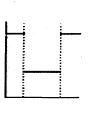
- B
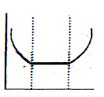
- C

- D
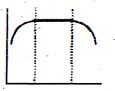
Medium


Download our appand get started for free
Experience the future of education. Simply download our apps or reach out to us for more information. Let's shape the future of learning together!No signup needed.*
Similar Questions
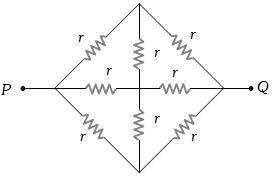
- 1The equivalent resistance between the points $P$ and $Q$ in the network given here is equal to ................ $\Omega$ (given $r = \frac{3}{2}\Omega $)View Solution
- 2There is a current of $40$ ampere in a wire of ${10^{ - 6}}\,{m^2}$ area of cross-section. If the number of free electron per ${m^3}$ is ${10^{29}}$, then the drift velocity will beView Solution
- 3View SolutionIn the circuit as shown in figure the
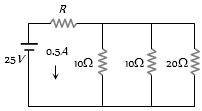
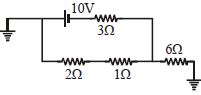
- 4Find current in $6\,\Omega $ resistanceView Solution
- 5Two resistances ${R_1}$ and ${R_2}$ when connected in series and parallel with $120\, V$ line, power consumed will be $25\, W$ and $100\, W$ respectively. Then the ratio of power consumed by ${R_1}$ to that consumed by ${R_2}$ will beView Solution
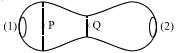
- 6Ametallic conductor of irregular cross-section is as shown in the figure. Aconstant potential difference is applied across the ends $(1)$ and $(2)$. Then :View Solution
- 7The internal resistance of a $2.1\, V$ cell which gives a current of $0.2\, A$ through a resistance of $10\,\Omega$ is ............. $\Omega$View Solution
- 8View SolutionThe resistance of a discharge tube is
- 9An electrical circuit consists of ten $100 \,\Omega$ resistors. Out of these $10$ resistors, a group of $n _1$ resistors are connected in parallel and another group of $n _2$ resistors are separately connected in parallel. These two groups are then connected in series and this combination is connected to a voltage source of $100 \,V$. If the net current though the circuit is $2.5 \,A$. The values of $n _1$ and $n _2$ areView Solution
- 10A wire of $1 \,\Omega$ has a length of $1\, m$. It is stetched till its length increases by $25\, \%$. The percentage change in resistance to the neartest integer is .....$\%$View Solution