Which of the following is vector quantity
Easy
Download our app for free and get started
Distance as well as power is scalar quantity.
Current density $\vec{J}=\frac{I}{A} \hat{n}$, is a vector quantity.
Current density $\vec{J}=\frac{I}{A} \hat{n}$, is a vector quantity.

Download our appand get started for free
Experience the future of education. Simply download our apps or reach out to us for more information. Let's shape the future of learning together!No signup needed.*
Similar Questions
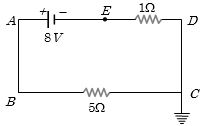
- 1In the given circuit, the potential of the point $E$ isView Solution
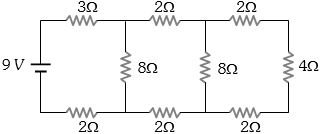
- 2View SolutionIn the circuit shown in the figure, the current through
- 3Two cells of $e.m.f.$ $E_1$ and $E_2$ are joined in series and the balancing length of the potentiometer wire is $625$ $cm$. If the terminals of $E_1$ are reversed, the balancing length obtained is $125 \,cm$. Given $E_2 > E_1$, the ratio $E_1: E_2$ will beView Solution
- 4View SolutionAssertion : Long distance power transmission is done at high voltage.
Reason : At high voltage supply power losses are less.
- 5Two wires of equal diameters, of resistivities ${\rho _1}$ and ${\rho _2}$ and lengths $l_1$ and $l_2$, respectively, are joined in series. The equivalent resistivity of the combination isView Solution
- 6Two resistors of resistance $R_1$ and $R_2$ having $R_1 > R_2$ are connected in parallel. For equivalent resistance $R$, the correct statements isView Solution
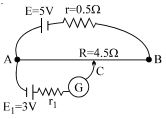
- 7In the given potentiometer circuit length of the wire $AB$ is $3\, m$ and resistance is $R = 4.5 \, \Omega$ . The length $AC$ for no deflection in galvanometer isView Solution
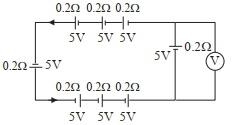
- 8The reading in the ideal voltmeter $(V)$ shown in the given circuit diagram is :View Solution
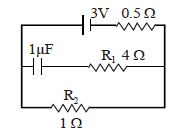
- 9A $1\,\mu F$ capacitor is connected in the circuit shown below. The emf of the cell is $3\ volts$ and internal resistance is $0.5\ ohms$ . The resistors $R_1$ and $R_2$ have values $4\ ohms$ and $1\ ohm$ respectively. The charge on the capacitor in steady state must be.......$\mu C$View Solution
- 10A $10 \,m$ long potentiometer wire is connected to a battery having a steady voltage. A Leclanche cell is balanced at $4 \,m$ length of the wire. If the length is kept the same, but its cross-section is doubled, the null point will be obtained at ........... $m$View Solution