$x$ and $y$ displacements of a particle are given as $x(t) = a\,sin\,\omega t$ and $y(t) = a\,sin\,2\omega t.$ Its trajectory will look like
- A
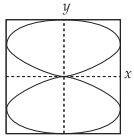
- B
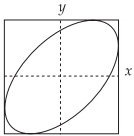
- C
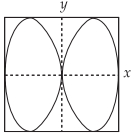
- D
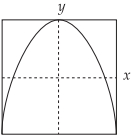
JEE MAIN 2015, Diffcult


Download our appand get started for free
Experience the future of education. Simply download our apps or reach out to us for more information. Let's shape the future of learning together!No signup needed.*
Similar Questions
- 1A body is vibrating in simple harmonic motion with an amplitude of $0.06\, m$ and frequency of $15\, Hz$. The velocity and acceleration of body isView Solution
- 2If a spring extends by $x$ on loading, then energy stored by the spring is (if $T$ is the tension in the spring and $K$ is the spring constant)View Solution
- 3A particle is executing simple harmonic motion with a time period $T.$ At time $t = 0$, it is at its position of equilibrium. The kinetic energy-time graph of the particle will look likeView Solution
- 4A vertical mass spring system executes simple harmonic oscillations with a period of $2\,s$. A quantity of this system which exhibits simple harmonic variation with a period of $1\, sec$ isView Solution
- 5A particle of mass $250\,g$ executes a simple harmonic motion under a periodic force $F =(-25\,x) N$. The particle attains a maximum speed of $4\,m / s$ during its oscillation. The amplitude of the motion is $...........cm$.View Solution
- 6The angular frequency of motion whose equation is $4\frac{{{d^2}y}}{{d{t^2}}} + 9y = 0$ is ($y =$ displacement and $t =$ time)View Solution
- 7An object is attached to the bottom of a light vertical spring and set vibrating. The maximum speed of the object is $15\, cm/sec$ and the period is $628$ milli-seconds. The amplitude of the motion in centimeters isView Solution
- 8The maximum potential energy of a block executing simple harmonic motion is $25\,J$. A is amplitude of oscillation. At $A / 2$, the kinetic energy of the block is $...............$View Solution
- 9The potential energy of a particle with displacement $X$ is $U(X)$. The motion is simple harmonic, when ($K$ is a positive constant)View Solution
- 10A particle executes linear simple harmonic motion with an amplitude of $2\, cm$. When the particle is at $1\, cm$ from the mean position the magnitude of its velocity is equal to that of its acceleration. Then its time period in seconds isView Solution