Question 15 Marks
Obtain expression for force on unit length of two straight parallel current carrying conductors. Under what conditions is this force attractive or repulsive? Define the standard unit of electric current.
Answer
View full question & answer→Force between Two Parallel Current Carrying Conductors :
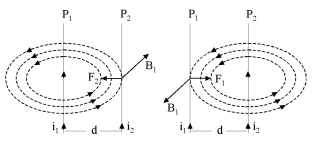
In the given figure, $P _1$ and $P _2$ are two current carrying conductors of infinite length which are situated at a distance $d$ from each other in the plane of the paper.
Current $i_1$ and $i_2$ are flowing in the same direction in the two wires and due to this magnetic field will be produced around them.
Here one current carrying conductor is present in the produced magnetic field due to other current carrying conductor.
Magnetic field produced at a distance $d$ due to current carrying conductor $P _1$
$ B_1=\frac{\mu_0 i_1}{2 \pi d} $
Force acting on length $/$ of current carrying conductor $P _2$ present in this magnetic field
$\overrightarrow{ F }_2={ }_{i_2}\left(\vec{l} \times \overrightarrow{ B }_1\right)$
$F _2=i_2 / B _1 \sin \theta$
$F _2=i_2 / B _1$
$\because\left[\vec{l} \perp \overrightarrow{B}_1\right] $
On putting value of $B _1$ from equation $(1),$
$ F_2=i_2 l \times \frac{\mu_{o} i_1}{2 \pi d}$
$F_2=\frac{\mu_{o} i_2 l}{2 \pi d} \text { Newton } $
Direction of this force $F _2$ is perpendicular to the current carrying conductor $P _2$ and magnetic force $B _1$ produced on it.
Hence this force is inward the plane of paper and towards conductor $P _1$.
This direction of force can be determined with the help of Fleming's left-hand rule.
$ \frac{F_2}{T}=\frac{\mu_0 i_1 i_2}{2 \pi d} N / m $
This is magnetic force working on unit length of current carrying conductor $P _2$.
Magnetic field produced at a distance $d$ due to current carrying conductor
$P _2$. $ B_2=\frac{\mu_0 i_2}{2 \pi d} $
Magnetic field working on unit length $/$ of $P _1$ due to $P _2$,
$\overrightarrow{ F }_1=i_1\left(\vec{l} \times \overrightarrow{ B }_2\right) \quad$ or $ F _1=i_1 / B _2$
or $F _1=\frac{i_1 / \mu_0 i_2}{2 \pi d}$
or $ F _1=\frac{\mu_0 i_1 i_2 l}{2 \pi d}$
or $ \frac{F_1}{T}=\frac{\mu_0 i_1 i_2}{2 \pi d} N / m $
From equations $ (3)$ and $(4),$
$ \frac{F_1}{T}=\frac{F_2}{l}=\frac{\mu_{o} i_1 i_2}{2 \pi d} N / m $
It is clear from the figure that when current in two parallel current carrying conductors is in the same direction, force of attraction is exerted between them.
Special conditions :
$(i) $ If currents are in mutually opposite directions, then there will be repulsion
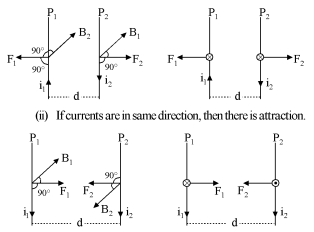
Mutual force acting on each wire per unit length of two parallel wires
$\frac{ F _1}{l}=\frac{\mu_0}{2 \pi}\left(\frac{i_1 i_2}{d}\right) N / m$
But $\mu_0=4 \pi \times 10^{-7} N / m ^2$
Hence, $\frac{ F _1}{l}=\frac{4 \pi \times 10^{-7}}{2 \pi}\left(\frac{i_1 i_2}{d}\right) N / m$
$=\left(2 \times 10^{-7}\right)\left(\frac{i_1 i_2}{d}\right) N / m$
If $i_1=i_2=i$ ampere and $d=1 m$, then $F _{1 / l}=\left(2 \times 10^{-7}\right) i^2 N / m$
Therefore, if the force applied per meter length between these wires is $2 \times 10^{-7}$ then $1$ Ampere current will flow through the wires.
So $1$ ampere is that electric current which when flows through two straight, long and parallel wires kept at a distance of $1$ m from each other in air $($or vacuum$)$ exerts a force of $2 \times 10^{-7} N / m$ on one meter length of each wire.
In the given figure, $P _1$ and $P _2$ are two current carrying conductors of infinite length which are situated at a distance $d$ from each other in the plane of the paper.
Current $i_1$ and $i_2$ are flowing in the same direction in the two wires and due to this magnetic field will be produced around them.
Here one current carrying conductor is present in the produced magnetic field due to other current carrying conductor.
Magnetic field produced at a distance $d$ due to current carrying conductor $P _1$
$ B_1=\frac{\mu_0 i_1}{2 \pi d} $
Force acting on length $/$ of current carrying conductor $P _2$ present in this magnetic field
$\overrightarrow{ F }_2={ }_{i_2}\left(\vec{l} \times \overrightarrow{ B }_1\right)$
$F _2=i_2 / B _1 \sin \theta$
$F _2=i_2 / B _1$
$\because\left[\vec{l} \perp \overrightarrow{B}_1\right] $
On putting value of $B _1$ from equation $(1),$
$ F_2=i_2 l \times \frac{\mu_{o} i_1}{2 \pi d}$
$F_2=\frac{\mu_{o} i_2 l}{2 \pi d} \text { Newton } $
Direction of this force $F _2$ is perpendicular to the current carrying conductor $P _2$ and magnetic force $B _1$ produced on it.
Hence this force is inward the plane of paper and towards conductor $P _1$.
This direction of force can be determined with the help of Fleming's left-hand rule.
$ \frac{F_2}{T}=\frac{\mu_0 i_1 i_2}{2 \pi d} N / m $
This is magnetic force working on unit length of current carrying conductor $P _2$.
Magnetic field produced at a distance $d$ due to current carrying conductor
$P _2$. $ B_2=\frac{\mu_0 i_2}{2 \pi d} $
Magnetic field working on unit length $/$ of $P _1$ due to $P _2$,
$\overrightarrow{ F }_1=i_1\left(\vec{l} \times \overrightarrow{ B }_2\right) \quad$ or $ F _1=i_1 / B _2$
or $F _1=\frac{i_1 / \mu_0 i_2}{2 \pi d}$
or $ F _1=\frac{\mu_0 i_1 i_2 l}{2 \pi d}$
or $ \frac{F_1}{T}=\frac{\mu_0 i_1 i_2}{2 \pi d} N / m $
From equations $ (3)$ and $(4),$
$ \frac{F_1}{T}=\frac{F_2}{l}=\frac{\mu_{o} i_1 i_2}{2 \pi d} N / m $
It is clear from the figure that when current in two parallel current carrying conductors is in the same direction, force of attraction is exerted between them.
Special conditions :
$(i) $ If currents are in mutually opposite directions, then there will be repulsion
Mutual force acting on each wire per unit length of two parallel wires
$\frac{ F _1}{l}=\frac{\mu_0}{2 \pi}\left(\frac{i_1 i_2}{d}\right) N / m$
But $\mu_0=4 \pi \times 10^{-7} N / m ^2$
Hence, $\frac{ F _1}{l}=\frac{4 \pi \times 10^{-7}}{2 \pi}\left(\frac{i_1 i_2}{d}\right) N / m$
$=\left(2 \times 10^{-7}\right)\left(\frac{i_1 i_2}{d}\right) N / m$
If $i_1=i_2=i$ ampere and $d=1 m$, then $F _{1 / l}=\left(2 \times 10^{-7}\right) i^2 N / m$
Therefore, if the force applied per meter length between these wires is $2 \times 10^{-7}$ then $1$ Ampere current will flow through the wires.
So $1$ ampere is that electric current which when flows through two straight, long and parallel wires kept at a distance of $1$ m from each other in air $($or vacuum$)$ exerts a force of $2 \times 10^{-7} N / m$ on one meter length of each wire.