Question 1514 Marks
Solve the following systems of equations:
$\frac{22}{\text{x}+\text{y}}+\frac{15}{\text{x}-\text{y}}=5,$
$\frac{55}{\text{x}+\text{y}}+\frac{45}{\text{x}-\text{y}}=14.$
AnswerLet $\frac{1}{\text{x}+\text{y}}=\text{u}$ and $\frac{1}{\text{x}-\text{y}}=\text{v}.$ Then the given system of equation becomes
$22\text{u}+15\text{v}=5\ ......(\text{i})$
$55\text{u}+45\text{v}=14\ ......(\text{ii})$
Multiplying equation (i) by 3, and equation (ii) by $1$, we get
$66\text{u}+45\text{v}=15\ ......(\text{iii})$
$55\text{u}+45\text{v}=14\ ......(\text{iv})$
Subtracting equation $(iv)$ from equation $(iii)$ we get
$66\text{u}-55\text{u}=15-4$
$\Rightarrow11\text{u}=1$
$\Rightarrow\text{u}=\frac{1}{11}$
Putting $\text{u}=\frac{1}{11}$ in equation $(i)$ we get
$22\times\frac{1}{11}+15\text{v}=5$
$\Rightarrow2+15\text{v}=5$
$\Rightarrow15\text{v}=5-2$
$\Rightarrow15\text{v}=3$
$\Rightarrow\text{v}=\frac{3}{15}=\frac{1}{5}$
Now, $\text{u}=\frac{1}{\text{x}+\text{y}}$
$\Rightarrow\frac{1}{\text{x}+\text{y}}=\frac{1}{11}$
$\Rightarrow\text{x}+\text{y}=11\ .....(\text{v})$
And $\text{v}=\frac{1}{\text{x}-\text{y}}$
$\Rightarrow\frac{1}{\text{x}-\text{y}}=\frac{1}{5}$
$\Rightarrow\text{x}-\text{y}=5\ .....(\text{vi})$
Adding equation (v) and equation (vi) we get
$2\text{x}=11+5$
$\Rightarrow2\text{x}=16$
$\Rightarrow\text{x}=\frac{16}{2}=8$
Putting $x = 8$ in equation $(v)$ we get
$8+\text{y}=11$
$\Rightarrow\text{y}=11-8=3$
Hence, solution of the given system of equation is $x = 8, y = 3.$
View full question & answer→Question 1524 Marks
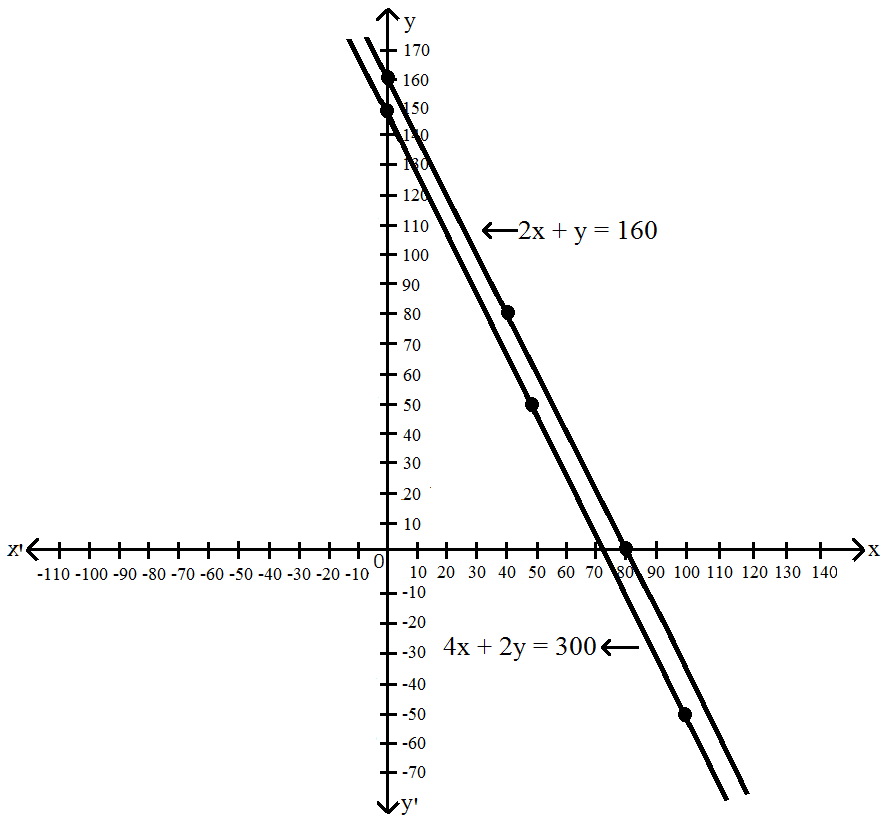
The cost of $2\ kg$ of apples and $1\ kg$ of grapes on a day was found to be $Rs. 160$. After a month, the cost of $4\ kg$ of apples and $2\ kg$ of grapes is Rs. $300$ Represent the situation algebraically and geometrically.
AnswerLet the cost of apples and grapes be x and y represent
The cost of 2kg. appies and $1\ kg$. grapes is Rs. $160$
$2x + y = 160 ........(i)$
The cost of 4kg. apples and $2\ kg$. grapes is Rs. $300$
$4x + 2y = 300 .......(ii)$
equation $(i)$ and $(ii)$ show the algebraic situation.
graphical represent:
Using $(i):$
Putting $x = 0$, we get $y = 160$
Putting $x = 40$, we get $y = 80$
Putting $x = 80$, we get $y = 0$
|
$x$
|
$0$
|
$40$
|
$80$
|
|
$y$
|
$160$
|
$80$
|
$0$
|
Using $(ii):$
Putting $x = 0,$ we get $y = 150$
Putting $x = 50$, we get $y = 50$
Putting $x = 100$, we get $y = -50$
|
$x$
|
$0$
|
$50$
|
$100$
|
|
$y$
|
$150$
|
$50$
|
$-50$
|
View full question & answer→Question 1534 Marks
The sum of a two-digit number and the number formed by reversing the order of digit is $66$. If the two digits differ by $2$, find the number. How many such numbers are there?
AnswerLet the ten's and the unit's in the first number be x and y, respectively, so, the first number may be written as $10x + y$ in the expanded form (for example, $56 = 10 (5) + 6)$
When the digits are reversed, x becomes the unit's digit and y becomes the ten's digit. This number, in the expanded notation is $10y + x$ (For example, when $56$ is reversed, we get $65 = 10(6) + 5).$
According to the given condition,
$(10x + y) + (10y + x) = 66$
$i.e., 11(x + y) = 66$
$i.e., x + y = 6 .....(i)$
We are also given that the digits differ by $2$, therefore, either
$x - y = 2 .....(ii)$
or $y - x = 2 ......(iii)$
If $x - y = 2$, then solving $(i)$ and $(2)$ by elimination we get $x = 4$ and $y = 2$
In this case we get the number $42$
If $y - x = 2$, then solving $(i)$ and $(iii)$ by elimination we get $x = 2$ and $y = 4$. In this case, we get the number $24$
Thus, there are two such numbers $42$ and $24.$
View full question & answer→Question 1544 Marks
Solve the following systems of equations:
$\frac{5}{\text{x}-1}+\frac{1}{\text{y}-2}=2,$
$\frac{6}{\text{x}-1}-\frac{3}{\text{y}-2}=1.$
AnswerLet $\frac{1}{\text{x} - 1 } = \text{u}$ and $ \frac{1}{\text{y} - 2} = \text{v}$
$\Rightarrow5\text{u} + \text{v} = 2$
and $6\text{u} - 3\text{v} = 1$
solving and getting $\text{u} = \frac{1}{3}$ and $\text{v} = \frac{1}{3}$
$\Rightarrow\text{x} - 1 = 3\Rightarrow\text{x} = 4 $
and, $\text{y} - 2 = 3 \Rightarrow\text{y} = 5$
$\Rightarrow\text{x} = 4 \text{ and } \text{y} = 5.$
View full question & answer→Question 1554 Marks
A fraction becomes $\frac{9}{11}$ if is added to both numerator and the denominator. If $3$ is added to both the numerator and the denominator it becomes $\frac{5}{6}.$ Find the fraction.
AnswerLet the fraction be $\frac{\text{x}}{\text{y}}$
According to the given information,
$\frac{\text{x}+2}{\text{y}+2}=\frac{9}{11}$
$11\text{x}+22=9\text{y}+18$
$11\text{x}-9\text{y}=-4\ ....(\text{i})$
$\frac{\text{x}+3}{\text{y}+3}=\frac{5}{6}$
$6\text{x}+18=5\text{y}+15$
$6\text{x}-5\text{y}=-3\ ....(\text{ii})$
From equation (i) we obtain $\text{x}=\frac{-4+9\text{y}}{11}\ ....(\text{iii})$
Substituting this in equation (ii) we obtain
$ 6\Big(\frac{-4+9\text{y}}{11}\Big)-5\text{y}=-3$
$-24+54\text{y}-55\text{y}=-33$
$-\text{y}=-9$
$\text{y}=9\ ....(\text{iv})$
Substituting this in equation (iii) we obtain
$\text{x}=\frac{-4+81}{11}=7$
Hence, the fraction is $\frac{7}{9}$
View full question & answer→Question 1564 Marks
Solve the following systems of equations:
$\frac{\text{x}}{2}+\text{y}=0.8,$
$\frac{7}{\text{x}+\frac{\text{y}}{2}}=10.$
AnswerThe given equations are
$\Rightarrow\frac{\text{x}}{2}+\text{y}=0.8$
$\Rightarrow x + 2y = 1.6 ......(i)$
And, $\frac{7}{\text{x}+\frac{\text{y}}{2}}=10$
$\Rightarrow10\Big(\text{x}+\frac{\text{y}}{2}\Big)=7$
$\Rightarrow 20x + 10y = 14$
$\Rightarrow 10x + 5y = 7 .......(ii)$
Multiplying $(i)$ by $10$, we get
$\Rightarrow 10x + 20y = 16 ......(iii)$
Subtracting $(ii)$ from $(iii),$ we get
$\Rightarrow 15y = 9$
$\Rightarrow\text{y}=\frac{9}{15}=0.6$
Putting $y = 0.6$ in $(iii)$, we get
$\Rightarrow 10x + 20 \times 0.6 = 16$
$\Rightarrow 10x = 16 - 12$
$\Rightarrow\text{x}=\frac{4}{10}$
$\Rightarrow\text{x}=0.4$
Thus, $x = 0.4$ and $y = 0.6$
View full question & answer→Question 1574 Marks
Solve the following systems of equations:
${\text{x}}+\frac{\text{y}}{2}=4,$
$\frac{\text{x}}{3}+2\text{y}=5.$
AnswerThe given equations are,
${\text{x}}+\frac{\text{y}}{2}=4\ .....(\text{i})$
$\frac{\text{x}}{3}+2\text{y}=5\ ......(\text{ii})$
Multiply equation $(i)$ by $4$ and subtract equations $(i) - (ii)$, we get $4x + 2y = 16$
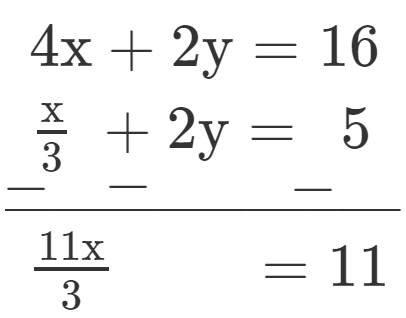
$\Rightarrow\text{x}=3$
Put the value of x in equation (i), we get
$3+\frac{\text{y}}{2}=4$
$\Rightarrow\frac{\text{y}}{2}=1$
$\Rightarrow\text{y}=2$
Hence the value of $x$ and $y$ are $x = 3$ and $y = 2.$ View full question & answer→Question 1584 Marks
When $3$ is added to the denominator and $2$ is subtracted from the numerator a fraction becomes $\frac{1}{4}.$ And when $6$ is added to numerator and the denominator is multiplied by $3$, it becomes $\frac{2}{3}.$ Find the fraction.
AnswerLet the numerator and denominator of the fraction be x and y respectively. Then the fraction is $\frac{\text{x}}{\text{y}}$
If 3 is added to the denominator and $2$ is subtracted from the numerator, the fraction becomes $\frac{1}{4}$
Thus, we have
$\frac{\text{x}-2}{\text{y}+3}=\frac{1}{4}$
$\Rightarrow 4(x - 2) = y + 3$
$\Rightarrow 4x - 8 = y + 3$
$\Rightarrow 4x - y - 11 = 0$
If 6 is added to the numerator and the denominator is multiplied by $3$, the fraction becomes $\frac{2}{3}$
$\frac{\text{x}+6}{3\text{y}}=\frac{2}{3}$
Thus we have
$\Rightarrow 3(x + 6) = 6y$
$\Rightarrow 3x + 18 = 6y$
$\Rightarrow 3x - 6y + 18 = 0$
$\Rightarrow 3(x - 2y + 6) = 0$
$\Rightarrow x - 2y + 6 = 0$
So, we have two equations
$4x - y - 11 =0$
$x - 2y + 6 =0$
Here x and y are unknowns. We have to solve the above equations for x and y.
By using cross-multiplication, we have
$ \Rightarrow\frac{\text{x}}{(-1)\times6-(-2)\times(-11)}=\frac{-\text{y}}{4\times6-1\times(-11)}$
$=\frac{1}{4\times(-2)-1\times(-1)}$
$\Rightarrow\frac{\text{x}}{-6-22}=\frac{-\text{y}}{24+11}=\frac{1}{-8+1}$
$\Rightarrow\frac{\text{x}}{-28}=\frac{-\text{y}}{35}=\frac{1}{-7}$
$\Rightarrow\frac{\text{x}}{28}=\frac{\text{y}}{35}=\frac{1}{7}$
$\Rightarrow\text{x}=\frac{28}{7},\ \text{y}=\frac{35}{7}$
$\Rightarrow\text{x}=4,\ \text{y}=5$
Hence, the fraction is $\frac{4}{5}$
View full question & answer→Question 1594 Marks
Determine graphically the coordinates of the vertices of a triangle, the equations of whose sides are:
$y = x, 3y = x, x + y = 8.$
AnswerThe system of the given equations is,
$y = x$
$3y = x$
$x + y = 8$
Now, $y = x$
$\Rightarrow x = y$
When y = $0$, we have
$x = 0$
When$ y = -3$, we have
$x = -3$
Thus, we have the following table.
|
$x$
|
$0$
|
$-3$
|
|
$y$
|
$O$
|
$-3$
|
We have, $3y = x$
$\Rightarrow x = 3y$
When $y = 0$, we have
$x = 3 \times 0 = 0$
When y = -1, we have
$y = 3 \times (-1) = -3$
Thus, we have the following table.
|
$x$
|
$0$
|
$-3$
|
|
$y$
|
$O$
|
$-1$
|
We have, $x + y = 6$
$\Rightarrow x = 8 - y$
When $y = 4$, we have
$y = 8 - 4 = 4$
When $y = 5$, we have
$y = 8 - 5 = 3$
Thus, we have the following table.
Graph of the given system of equations.
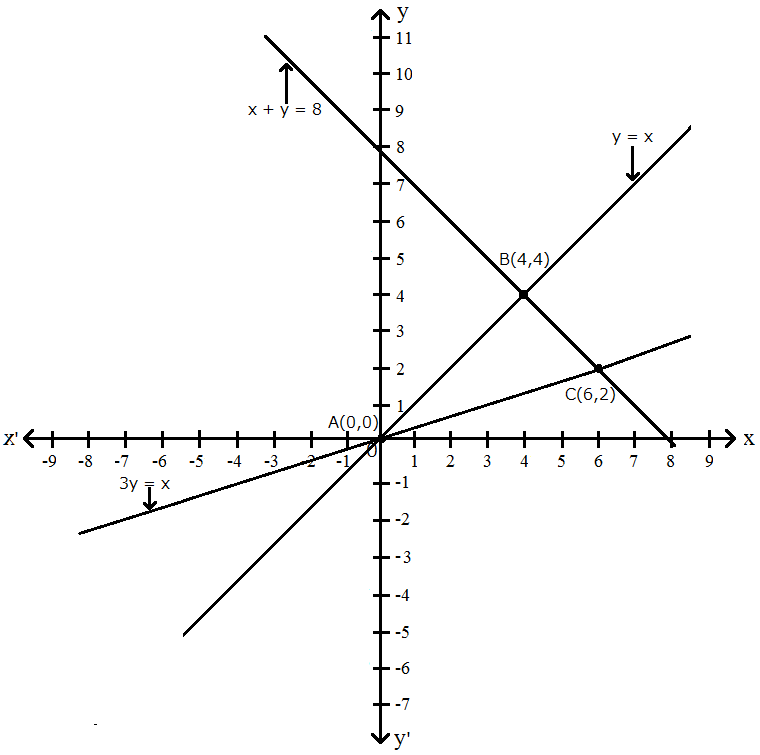
From the graph of the three equations, we find that the three lines taken in pairs intersect each other at points $A(0, 0), B(4, 4)$ and $C(6, 2)$.
Hence, the vertices of the required triangle are $(0, 0), (4, 4)$ and $(6, 2).$ View full question & answer→Question 1604 Marks
Solve the following systems of equations:
$\frac{2}{\sqrt{\text{x}}}+\frac{3}{\sqrt{\text{y}}}=2,$
$\frac{4}{\sqrt{\text{x}}}-\frac{9}{\sqrt{\text{y}}}=-1.$
Answer$\frac{2}{\sqrt{\text{x}}}+\frac{3}{\sqrt{\text{y}}}=2$
$\frac{4}{\sqrt{\text{x}}}-\frac{9}{\sqrt{\text{y}}}=-1$
Let $\frac{1}{\sqrt{\text{x}}}=\text{p}$ and $\frac{1}{\sqrt{\text{y}}}=\text{q}$
The given equations reduse to
$2\text{p}+3\text{q}=2\ .....(\text{i})$
$4\text{p}-9\text{q}=-1\ .....(\text{ii})$
Multiplying equation (i) by 3, we obtain
$6\text{p}+9\text{q}=6\ .....(\text{iii})$
Adding equation (ii) and (iii), we obtain
$10\text{p}=5$
$\text{p}=\frac{1}{2}$
Putting the value of p in equation (i) we obtain
$2\times\frac{1}{2}+3\text{q}=2$
$3\text{q}=1$
$\text{q}=\frac{1}{3}$
$\therefore\text{p}=\frac{1}{\sqrt{\text{x}}}=\frac{1}{2}$
$\sqrt{\text{x}}=2$
$\text{x}=4$
$\text{q}=\frac{1}{\sqrt{\text{y}}}=\frac{1}{3}$
$\sqrt{\text{y}}=3$
$\text{y}=9$
$\therefore\text{x}=4,\text{y}=9$.
View full question & answer→Question 1614 Marks
A takes $3$ hours more than $B$ to walk a distance of $30\ km$. But, if $A$ doubles his pace (speed) he is ahead of $B$ by $1\frac{1}{2}$ hours. Find the speeds of $A$ and $B.$
AnswerLet the speed of $A$ and $B$ be $x \ Km/hr$ and $y \ Km/hr$ respectively. Then,
Time taken by $A$ to cover $30\text{km}=\frac{30}{\text{x}}\text{hrs}$
And, Time taken by $B$ to cover $30\text{km}=\frac{30}{\text{y}}\text{hrs}$
By the given conditions we have
$\frac{30}{\text{x}}-\frac{30}{\text{y}}=3$
$\frac{10}{\text{x}}-\frac{10}{\text{y}}=1\ ...(\text{i})$
If A doubles his pace, then speed of A is 2x km/hr
Time taken by A to cover $30\text{km}=\frac{30}{2\text{x}}\text{hrs}$
Time taken by B to cover $30\text{km}=\frac{30}{\text{y}}\text{hrs}$
According to the given condition, we have
$\frac{30}{\text{y}}-\frac{30}{2\text{x}}=1\frac{1}{2}$
$\frac{30}{\text{y}}-\frac{30}{2\text{x}}=\frac{3}{2}$
$\frac{30}{\text{y}}\times\frac{1}{3}-\frac{30}{2\text{x}}\times\frac{1}{3}=\frac{3}{2}\times\frac{1}{3}$
$\frac{10}{\text{y}}-\frac{5}{\text{x}}=\frac{1}{2}$
$-\frac{10}{\text{x}}+\frac{20}{\text{y}}=1\ ...(\text{ii})$
Putting $\frac{1}{\text{x}}={\text{u}}$ and $\frac{1}{\text{y}}={\text{v}}$ in equation (i) and (ii) we get
$10\text{u}-10\text{v}=1$
$10\text{u}-10\text{v}-1=0\ ....(\text{iii})$
$-10\text{u}+20\text{v}=1$
$-10\text{u}+20\text{v}-1=0\ ...(\text{iv})$
Adding equations (iii) and (iv), we get
$10\text{v}-2=0$
$10\text{v}=2$
$\text{v}=\frac{2}{10}$
$\text{v}=\frac{1}{5}$
Putting $\text{v}=\frac{1}{5}$ in equation (iii) we get
$10\text{u}-10\text{v}-1=0$
$10\text{u}-10\times\frac{1}{5}-1=0$
$10\text{u}-2-1=0$
$10\text{u}-3=0$
$10\text{u}=3$
$\text{u}=\frac{3}{10}$
Now, $\frac{1}{\text{x}}=\frac{3}{10}$
$\text{x}=\frac{10}{3}$
and, $\text{v}=\frac{1}{5}$
$\frac{1}{\text{y}}=\frac{1}{5}$
$\text{y}=5$
Hence the A's speed is $\frac{10}{3}\text{km/hr}$
The $B$'s speed is $5 \ km/hr.$
View full question & answer→Question 1624 Marks
Solve the following systems of equations:
$\frac{3}{\text{x}}-\frac{1}{\text{y}}=-9$
$\frac{2}{\text{x}}+\frac{3}{\text{y}}=5$
AnswerLet $\frac{1}{\text{x}}=\text{u}$ and $\frac{1}{\text{y}}=\text{v}$
$3\text{u}-\text{v}=-9\ .....(\text{i})$
$2\text{u}+3\text{v}=5\ .....(\text{ii})$
Multiplying $(i)$ by $3$, we get
$\Rightarrow9\text{u}-3\text{v}=-27\ .....(\text{iii})$
Adding $(ii)$ and $(iii)$ we get,
$\Rightarrow11\text{u}=-22$
$\Rightarrow\text{u}=\frac{-22}{11}=-2$
Putting $u = -2$ in $(iii)$ we get,
$\Rightarrow9(-2)-3\text{v}=-27$
$\Rightarrow-3\text{v}=-27+18$
$\Rightarrow\text{v}=\frac{-9}{-3}=3$
$\therefore\text{u}=\frac{1}{\text{x}}\Rightarrow\text{x}=\frac{1}{\text{u}}$
$\text{x}=\frac{-1}{2}$
and $\text{v}=\frac{1}{\text{y}}\Rightarrow\text{y}=\frac{1}{\text{v}}$
$\text{y}=\frac{1}{3}$
Thus, $\text{x}=\frac{-1}{2}$ and $\text{y}=\frac{1}{3}$
View full question & answer→Question 1634 Marks
Solve the following system of equations by the method of cross-multiplication:
$\frac{57}{\text{x}+\text{y}}+\frac{6}{\text{x}-\text{y}}=5,$
$\frac{38}{\text{x}+\text{y}}+\frac{21}{\text{x}-\text{y}}=9.$
Answer$\frac{57}{\text{x}+\text{y}}+\frac{6}{\text{x}-\text{y}}=5$
$\frac{38}{\text{x}+\text{y}}+\frac{21}{\text{x}-\text{y}}=9$
Let $x + y = p$ and $x - y = q$
$\therefore\frac{57}{\text{p}}+\frac{6}{\text{q}}=5$
$\Rightarrow\frac{57}{\text{p}}+\frac{6}{\text{q}}-5=0\ .....(\text{i})$
$\frac{38}{\text{p}}+\frac{21}{\text{q}}=9$
$\Rightarrow\frac{38}{\text{p}}+\frac{21}{\text{q}}-9=0$
$ \text { Here } a_1=57, b_1=6, c_1=-5 $
$ a_2=38, b_2=21, c_2=-9$
$\therefore\frac{\frac{1}{\text{p}}}{-54+105}=\frac{\frac{1}{\text{q}}}{-190+513}=\frac{1}{1197-228}$
$\Rightarrow\frac{\frac{1}{\text{p}}}{51}=\frac{\frac{1}{\text{q}}}{323}=\frac{1}{969}$
$\therefore\frac{\frac{1}{\text{p}}}{51}=\frac{1}{969}$
$\frac{1}{\text{p}}=\frac{51}{969}=\frac{1}{19}$
$\therefore\text{p}=19$
and $\frac{\frac{1}{\text{q}}}{323}=\frac{1}{969}$
$\frac{1}{\text{q}}=\frac{323}{969}=\frac{1}{3}$
$\therefore\text{q}=3$
Now,
$\text{x}\ +\ \text{y}\ =\ 19\\\text{x}\ -\ \text{y}\ =\ \ \ 3\over2\text{x}\ \ \ \ \ \ =\ 22$
Adding, $2x = 22$
$⇒ x = 11$
Subtracting, $2y = 164$
$⇒ y = 8$
Hence $x = 11, y = 8.$
View full question & answer→Question 1644 Marks
Solve graphically that the following system of equation has infinitely many solutions:
$x - 2y = 5$
$3x - 6y = 15$
AnswerWe have,
$x - 2y = 5$
$3x - 6y = 15$
Now, $x - 2y = 5$
$\Rightarrow x = 2y + 5$
When $y = -1$, we have,
$x = 2(-1) + 5 = 3$
When $y= 0$, we have,
$x = 2 \times 0 + 5 = 5$
Thus, we have the following table giving points on the line $x - 2y = 5$
Now, $3x - 6y = 15$
$\Rightarrow 3x = 15 + 6y$
$\Rightarrow\text{x}=\frac{15+6\text{y}}{3}$
When $y = -2, $we have,
$\text{x}=\frac{15+6(-2)}{3}=1$
When $y = -3$, we havce,
$\text{x}=\frac{15+6(-3)}{3}=-1$
Thus, we have the following table giving points on the line$ 3x - 6y = 15$
|
$x$
|
$1$
|
$-1$
|
|
$y$
|
$-2$
|
$-3$
|
Graph of the given equations,
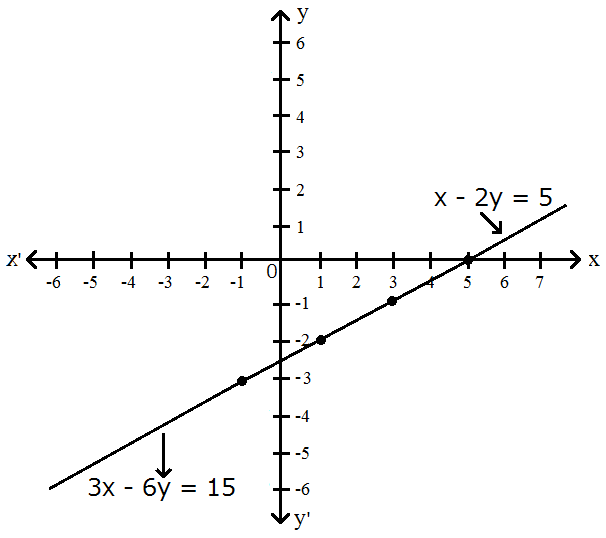
After plot all points observe that all points on a line so that system of equation has infinite many solution. View full question & answer→Question 1654 Marks
Solve the following systems of equations:
$\frac{44}{\text{x}+\text{y}}+\frac{30}{\text{x}-\text{y}}=10,$
$\frac{55}{\text{x}+\text{y}}+\frac{40}{\text{x}-\text{y}}=13.$
AnswerLet $\frac{1}{\text{x}+\text{y}}=\text{u}$ and $\frac{1}{\text{x}-\text{y}}=\text{v}.$
Then the system of the given equations becomes
$44u + 30v = 10 ......(i)$
$55u + 40v = 13 .......(ii)$
Multiplying equation $(i)$ by $4$ and equation $(ii)$ by $3$ we get
$176u + 120v = 40 ......(iii)$
$165u + 120v = 39 ........(iv)$
Subtracting equation $(iv)$ by equation $(iii)$ we get
$176 - 165u = 40 - 39$
$\Rightarrow 11u = 1$
$\Rightarrow\text{u}=\frac{1}{11}$
Putting $\text{u}=\frac{1}{11}$ in equation $(i)$ we get
$44\times\frac{1}{11}+30\text{v}=10$
$4 + 30v = 10$
$\Rightarrow 30v = 10 - 4$
$\Rightarrow 30v = 6$
$\Rightarrow\text{v}=\frac{6}{30}=\frac{1}{5}$
Now, $\text{u}=\frac{1}{\text{x}+\text{y}}$
$\Rightarrow\frac{1}{\text{x}+\text{y}}=\frac{1}{11}$
$\Rightarrow\text{x}+\text{y}=11\ .....(\text{v})$
Adding equation $(v)$ and $(vi)$ we get
$2x = 11 + 5$
$\Rightarrow 2x = 16$
$\Rightarrow\text{x}=\frac{16}{2}=8$
Putting $x = 8$ in equation $(v)$ we get
$8 + y = 11$
$\Rightarrow y = 11 - 8 - 3$
Hence, solution of the given system of equation is$ x = 8, y = 3.$
View full question & answer→Question 1664 Marks
Determine graphically the vertices of the triangle, the equations of whose sides are given below:
- $2y - x = 8, 5y - x = 14$ and $y - 2x = 1$
- $y = x, y = 0$ and $3x + 3y = 10$
Answer
- First we take $2y - x = 8$
$\Rightarrow\text{y}=\frac{\text{x}+8}{2}\ .....(\text{i})$
Putting $x = -2$ in $(i)$, we get $y = 3$
Putting $x = 0$ in $(i)$, we get $y = 4$
P lot points $A(-2, 3)$ and $B(0, 4)$ on graph paper and join them.
Now, $5y - x = 14$
$\Rightarrow\text{y}=\frac{\text{x}+14}{5}\ ......(\text{ii})$
Putting $x = 1$ in $(ii)$, we get $y = 3$
Putting $x = 6$ in $(i)$, we get $y = 4$
P lot points $C(1, 3)$ and $D(6, 4)$ on graph paper and join then.
Now $y - 2x = 1$
$\Rightarrow y = 2x + 1$
Putting $x = 0$ in $(iii)$, we get $y = 1$
Putting $x = 1$ in $(iii)$, we get $y = 3$
$P$ lot points $E(0, 1)$ and $F(1, 3)$ on graph paper and join then.
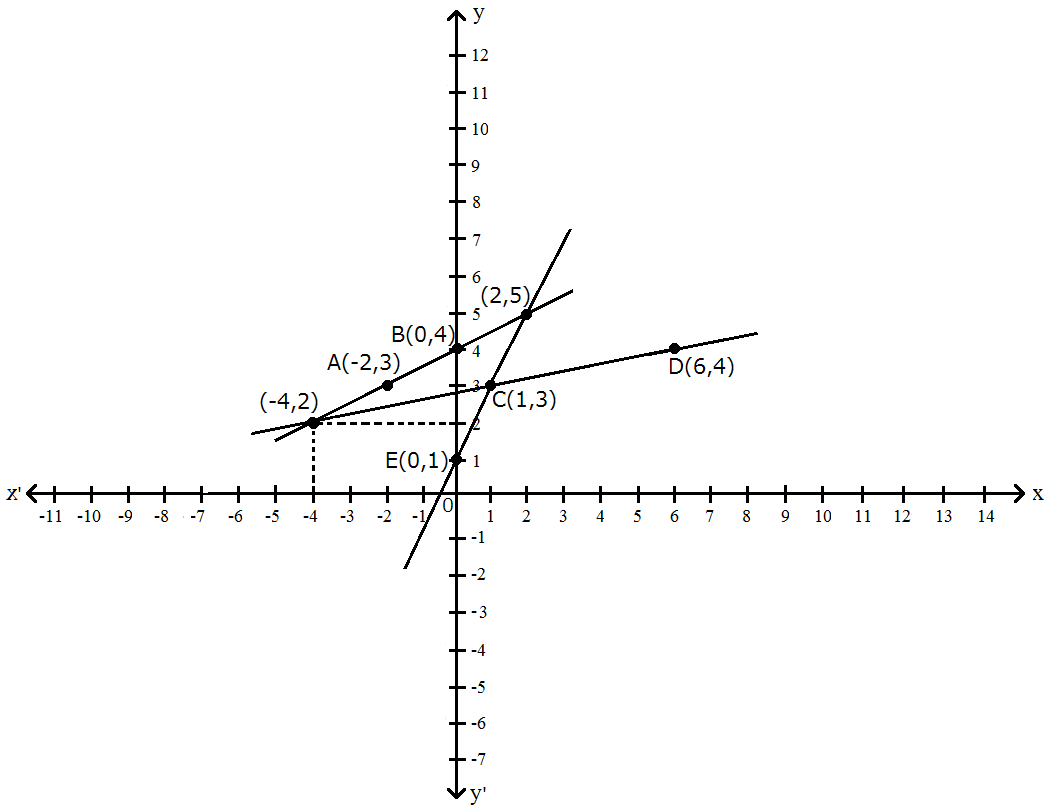
Thus, the vertices of triangle are $(-4, 2), (1, 3)$ and $(2, 5)$
- The given system of equations is,
$y = x$
$y = 0$
$3x + 3y = 10$
We have,
$y = x$
When $x = 1$, we have
$y = 1$
when $x = -2$, we have
$y = -2$
Thus, we have the following table giving points on the line $y = x$
|
$x$
|
$1$
|
$-2$
|
|
$y$
|
$1$
|
$-2$
|
We have,
$3x + 3y = 10$
$\Rightarrow 3y = 10 - 3x$
$\Rightarrow\text{y}=\frac{10-3\text{x}}{3}$
When $x = 1$, we have,
$\Rightarrow\text{y}=\frac{10-3\times1}{3}=\frac{7}{3}$
When $x = 2$, we have,
$\Rightarrow\text{y}=\frac{10-3\times2}{3}=\frac{4}{3}$
Thus, we have the following table giving points on the line $3x + 3y = 10.$
|
$x$
|
$1$
|
$2$
|
|
$y$
|
$\frac{7}{3}$
|
$\frac{4}{3}$
|
Graph of the given equations.
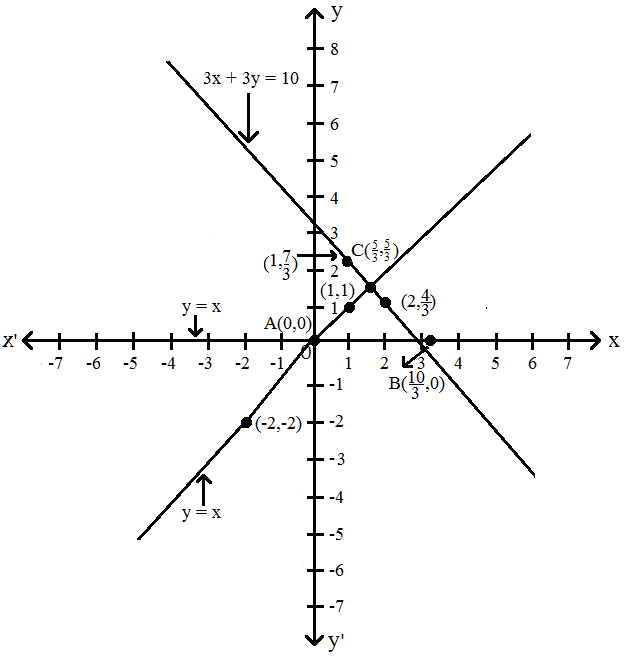
From the graph of the lines represented by the given equations, we observe that the lines taken in pairs intersect each other at points $A(0, 0),$
$\text{B}\Big(\frac{10}{3},0\Big)$ and$\text{C}\Big(\frac{5}{3},\frac{5}{3}\Big).$
Hence, the required vertices of the triangle are $A(0, 0)$, $\text{B}\Big(\frac{10}{3},0\Big)$ and $\text{C}\Big(\frac{5}{3},\frac{5}{3}\Big).$ View full question & answer→Question 1674 Marks
Determine, by drawing graphs, whether the following system of linear equations has a unique solution or not:
$2x - 3y = 6, x + y = 1.$
AnswerThe given equations are
$2x - 3y = 6 .......(i)$
$x + y = 1 ..........(ii)$
Putting x = 0 in equation (i), we get,
$\Rightarrow 2 \times 0 - 3y = 6$
$\Rightarrow y = -2$
$\Rightarrow x = 0, y = -2$
Putting y = 0 in equation (i), we get,
$\Rightarrow 2x - 3 \times 0 = 6$
$\Rightarrow x = 3$
$\Rightarrow x = 3, y = 0$
Use the following table to draw the graph.
Draw the graph by plotting the two points $A(0, -2), B(3, 0)$ from table.
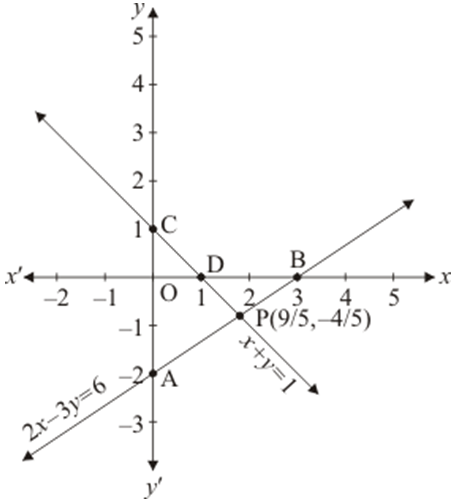
Graph of the equation.
$x + y = 1 .......(ii)$
Putting $x = 0$ in equation $(ii)$, we get,
$\Rightarrow 0 + y = 1$
$\Rightarrow y = 1$
$\therefore x = 0, y = 1$
Putting $y = 0$ in equation $(ii)$, we get,
$\Rightarrow x + 0 =1$
$\Rightarrow x = 1$
$\Rightarrow x = 1, y = 0$
Use the following table to draw the graph.
Draw the graph by plotting the two points $C(0, 1), D(1, 0)$ from table. The two lines intersect at point $\text{P}\Big(\frac{9}{5},\frac{-4}{5}\Big).$
Hence the equations have unique solution. View full question & answer→Question 1684 Marks
Solve graphically that the following system of equation has infinitely many solutions:
$2x + 3y = 6$
$4x + 6y = 12$
AnswerSo we have $2x + 3y = 6$ and $4x + 6y = 12.$
Now, $2x + 3y = 5$
$\text{x}=\frac{6-3\text{y}}{2}$
When $y = 0$ then,$ x = 3$ when $y = 2$ then, $x = 0$
Now, 4x + 6y = 12
$\text{x}=\frac{12-6\text{y}}{4}$
When $y = 0$, then $x = 3$ When $y = 2$, then $x = 0$
Thus, we have the following table giving points on the line $4x + 6y = 12$
Graph of the equation $2x + 3y = 6$ and $4x + 6y = 12$
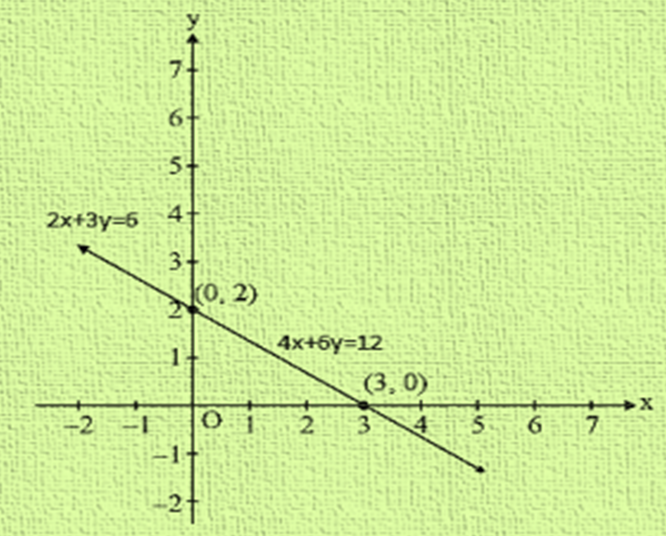
Thus the graphs of the two equations are coincident. Hence, the system of equations has infinitely many solutions. View full question & answer→Question 1694 Marks
Yash scored $40$ marks in a test, getting $3$ marks for each right answer and losing $1$ mark for each wrong answer. Had $4$ marks been awanded for each correct answer and $2$ marks been deducted for each incorrect answer, the Yash would have scored $50$ marks. How many question were there in the test?
AnswerLet we taxe right answer be $x$ then wrong answer will be $y.$
Therefore the total no. question $= x + y ....(i)$
It is given that if yash secord $40$ marks in a test getting $3$ marks for each right answer and losing $1$ maks for each wrong answer then
$\Rightarrow 3x - y = 40$
$3x - y - 40 ....(ii)$
It is also given that if $4$ maks awarded for each right answer and $2$ maks deducted for each wrong answer then he scored $50$ marks.
$4x - 2y = 50$
$4x - 2y - 50 ....(iii)$
By multiplying eq. $(ii)$ by $2$ and we get
$2(3x - y - 40)$
$= 6x - 2y - 80 = 0 .....(iv)$
Now, subtracting eq. $(iii)$ from eq. $(iv)$
$6x - 2y - 80 - (4x - 2y - 50) = 0$
$6x - 2y - 80 - 4x + 2y + 50 = 0$
$2x - 30 = 0$
$2x = 30$
$x = 15$
Now, Putting the value of x in eq. $(ii)$ and we get
$3 \times 15 - y - 40 = 0$
$45 - y - 40 = 0$
$-y + 5 = 0$
$y = 5$
Putting the value of x and y in eq. $(i)$ and we get
$x + y = 15 + 5 = 20$
Hence, the total number of question is $20.$
View full question & answer→Question 1704 Marks
Graphically, solve the following pair of equations:
$2x + y = 6$
$2x - y + 2 = 0$
Find the ratio of the areas of the two triangles formed by the lines representing these equations with the x axis and the lines with the y-axis. AnswerGiven equations are $2x + y - 6$ and $2x - y + 2 = 0$
Table for equation $2x + y = 6$
|
$x$
|
$0$
|
$3$
|
|
$y$
|
$6$
|
$0$
|
|
Points
|
$B$
|
$A$
|
Table for equation $2x - y + 2 = 0$
|
$x$
|
$0$
|
$-1$
|
|
$y$
|
$2$
|
$0$
|
|
Points
|
$D$
|
$C$
|
Let $A_1$ and $A_2$ represent the areas of $\triangle\text{ACE}$ and $\triangle\text{BDE},$ respectively.
Now, $\text{A}_1=\text{Area of }\triangle\text{ACE}=\frac{1}{2}\times\text{AC}\times\text{PE}$
$=\frac{1}{2}\times4\times4=8$
and $\text{A}_2=\text{Area of }\triangle\text{BDE}=\frac{1}{2}\times\text{BD}\times\text{QE}$
$=\frac{1}{2}\times4\times1=2$
$\therefore\text{A}_1:\text{A}_2=8:2=4:1$
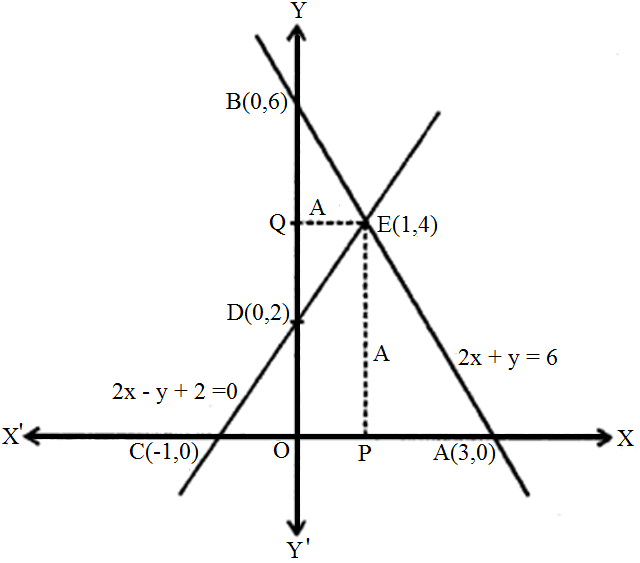
Hence, the pair of equations intersect graphically at point $E(1, 4)$, i, e.,$ x = 1$ and $y = 4.$ View full question & answer→Question 1714 Marks
Form the pair of linear equations in the following problems, and find their solution graphically:
Champa went to a 'sale' to purchase some pants and skirts. When her friends asked her how many of each she had bought, she answered, "The number of skirts is two less than twice the number of pants purchased. Also the number of skirts is four less than four times the number of pants purchased." Help her friends to find how many pants and skirts Champa bought.
AnswerLet us denote the number of pants by $x$ and the number of skirts by $y$. Then the equations formed are:
$y = 2x - 2 .....(i)$
$y = 4x - 4 .......(ii)$
The graphs of the equations $(i) $and $(ii)$ can be drawn by finding two solutions for each of the equations. They are given in the following table.
|
$x$
|
$2$
|
$0$
|
|
$y = 2x - 2$
|
$2$
|
$-2$
|
Hence, the graphic representation is as follows.
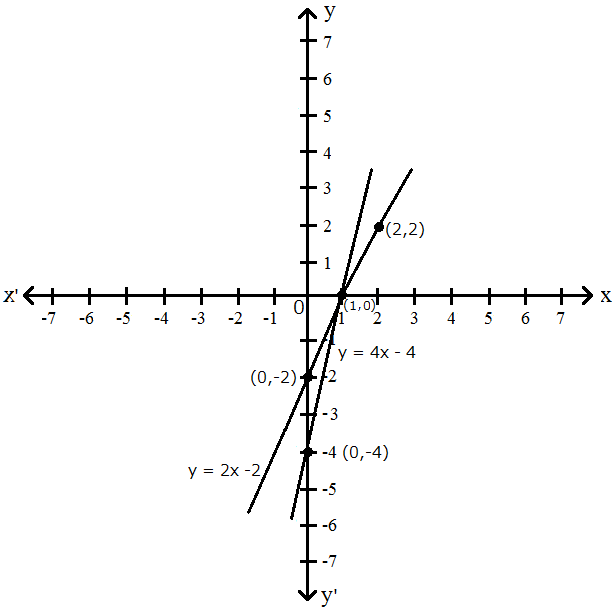
The two lines intersect at the point $(1, 0)$. So, $x = 1, y = 0$ is the required solution of the pair of linear equations, i.e., the number of pants she purchased is $1$ and she did not buy any skirt. View full question & answer→Question 1724 Marks
Draw the graph of the equations $x = 3, x = 5$ and $2x - y - 4 = 0$. Also, find the area of the quadrilateral formed by the lines and the x-axis.
AnswerGiven equation of lines $2x - y - 4 = 0, x = 3$ and $x = 5$
Table for line $2x - y - 4 = 0,$
|
$x$
|
$0$
|
$2$
|
|
$y = 2x - 4$
|
$-4$
|
$0$
|
|
Points
|
$P$
|
$Q$
|
Draw the points $P (0, -4)$ and $Q (2, 0)$ and join these points and form a line $PQ$ also draw the lines $x = 3$ and $x = 5.$
Area of quadrilateral $ABCD$ $=\frac{1}{2}\times$ distance between parallel lines $(AB) \times (AD + BC)$ [since, quadrilateral $ABCD$ is a trapezium]
$=\frac{1}{2}\times2\times(6+2)$ $\big[\because AB = OB - OA = 5 - 3 = 2, AD = 2$ and $BC = 6$ $\big]$
$=8\text{ sq. units.}$
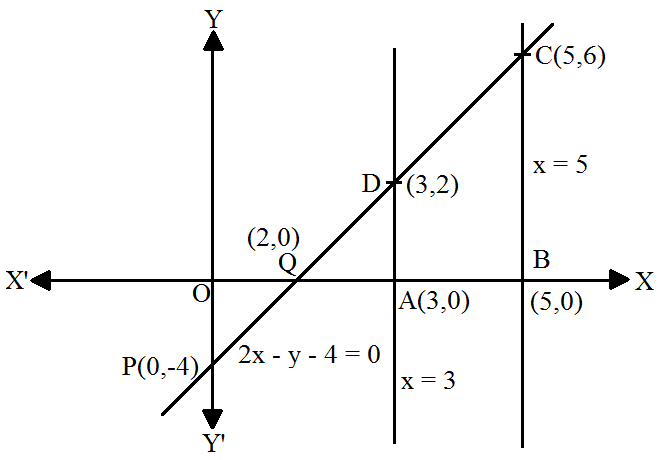
Hence, the required area of the quadrilateral formed by the lines and the x-axis is $8$ sq. units. View full question & answer→Question 1734 Marks
Show graphically that the following system of equation is in-consistent (i.e. has no solution):
$x - 2y = 6$
$3x - 6y = 0$
AnswerThe given equations are,
$x - 2y = 6 .......(i)$
$3x - 6y = 0 ........(ii)$
From (i), $\text{y}=\frac{\text{x}-6}{2}\ ......(\text{iii})$
Putting $x = 0$ in $(iii),$ we get $y = -3$
Putting $x = 2$ in $(iii),$ we get $y = -2$
Putting $x = 4$ in $(iii)$, we get $y = -1$
|
$x$
|
$0$
|
$2$
|
$4$
|
|
$y$
|
$-3$
|
$-2$
|
$-1$
|
From (ii), $\text{y}=\frac{3\text{x}}{6}\ ......(\text{iv})$
Putting $x = 0$ in $(iv),$ we get $y = 0$
Putting $x = 2$ in $(iii),$ we get $y = 1$
Putting $x = 4$ in $(iii),$ we get $y = 2$
|
$x$
|
$0$
|
$2$
|
$4$
|
|
$y$
|
$0$
|
$1$
|
$2$
|
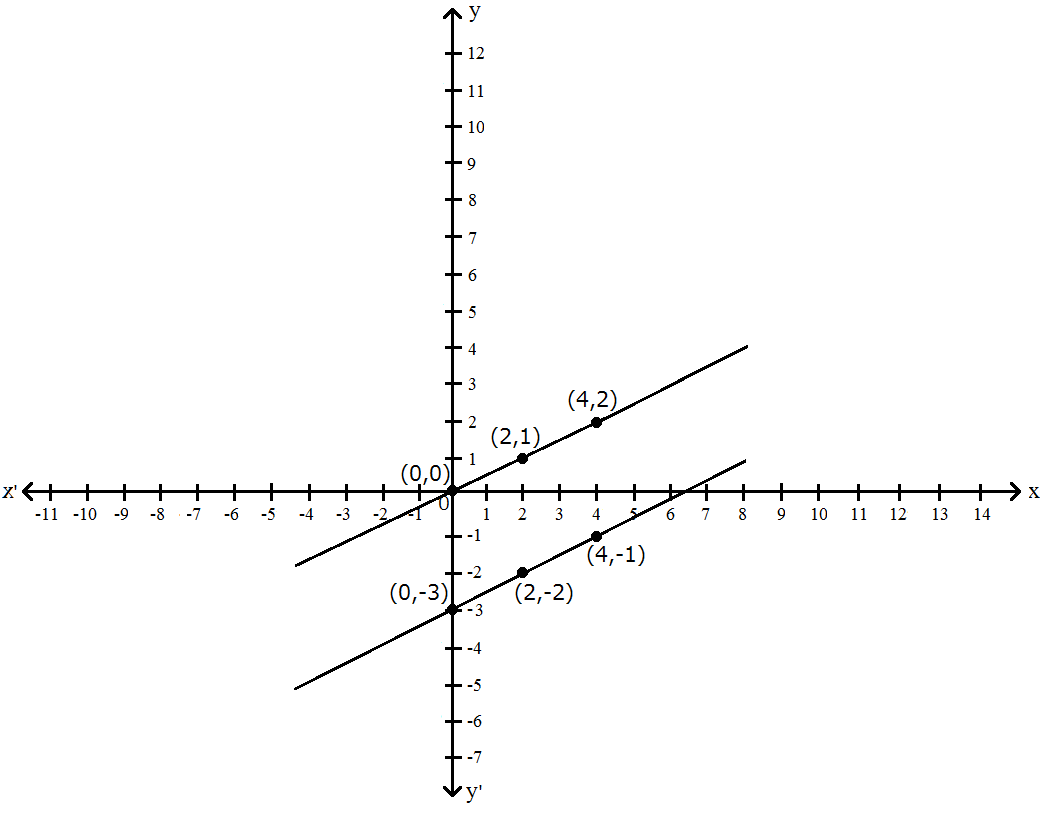
When we plot these points on graph paper we observe that both linesare parallel to each other means they have no solution so they are in-consistent. View full question & answer→Question 1744 Marks
Find the values of a and b for which the following system of equations has infinitely many solutions:
$2x + 3y = 7$
$(a - b)x + (a + b)y = 3a + b - 2$
AnswerGiven
$2x + 3y = 7$
$(a - b)x + (a + b)y = 3a + b - 2$
To find: To determine for what value of k the system of equation has infinitely many solutions,
We know that the system of equations,
$ a_1 x+b_1 y=c_1 $
$ a_2 x+b_2 y=c_2$
For infinitely many solution
$\frac{\text{a}_1}{\text{a}_2}=\frac{\text{b}_1}{\text{b}_2}=\frac{\text{c}_1}{\text{c}_2}$
Here,
$\frac{2}{(\text{a}-\text{b})}=\frac{3}{(\text{a}+\text{b})}=\frac{7}{3\text{a}+\text{b}-2}$
Consider the following
$\frac{3}{(\text{a}+\text{b})}=\frac{7}{3\text{a}+\text{b}-2}$
$9\text{a}+3\text{b}-6=7\text{a}+7\text{b}$
$2\text{a}-4\text{b}=6\ ....(\text{i})$
Again consider the following
$\frac{2}{(\text{a}-\text{b})}=\frac{7}{3\text{a}+\text{b}-2}$
$6a + 2b - 4 = 7a - 7b$
$a - 9b = -4 .....(ii)$
Multiplying eq. $(ii)$ by $2$ and subtracting eq. $(i)$ from eq. $(ii)$
$\Rightarrow -14b = -14$
$\Rightarrow b = 1$
Substituting the value of b in eq. $(ii)$ we get
$\Rightarrow a - 9 = -4$
$\Rightarrow a = 5$
Hence for $a = 5$ and $b = 1$ the system of equation has infinitely many solution.
View full question & answer→Question 1754 Marks
Draw the graphs of the equations $5x - y = 5$ and $3x - y = 3$. Determine the co-ordinates of the vertices of the triangle formed by these lines and y-axis. Calculate the area of the triangle so formed.
AnswerThe given equations are,
$5x - y = 5 ......(i)$
$3x - y = 3 ........(ii)$
Putting $x = 0$ in equations $(i)$, we get,
$\Rightarrow 5 \times 0 - y = 5$
$\Rightarrow y = -5$
$x = 0, y = -5$
Putting $y = 0$ in equations $(i)$, we get,
$\Rightarrow 5x - 0 = 5$
$\Rightarrow x = 1, y = 0$
Use the following table to draw the graph.
Draw the graph by plotting the two points $A(0, -5), B(1, 0)$ from table.
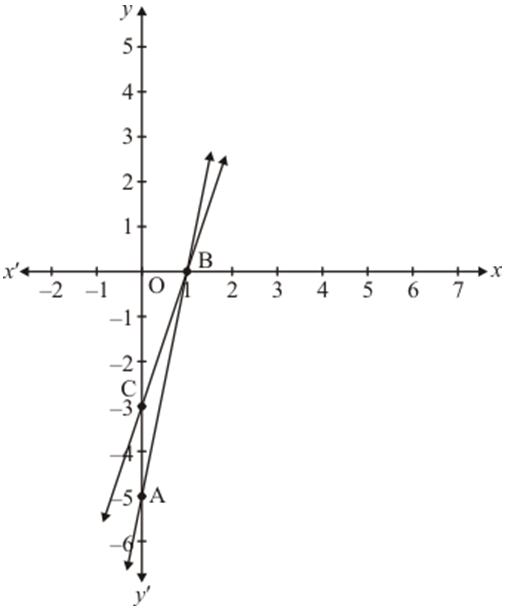
$3x - y = 3 ......(ii)$
Putting $x = 0$ in equations $(ii)$, we get,
$\Rightarrow 3 \times 0 - y = 3$
$\Rightarrow y= - 3$
$\Rightarrow x = 0, y = -3$
Putting $y = 0$ in equations $(ii)$, we get,
$\Rightarrow 3x - 0 = 3$
$\Rightarrow x = 1$
$\Rightarrow x = 1, y = 0$
Use the following table to draw the graph.
Draw the graph by plotting the two points $C(0, -3), D(1, 0)$ from table. Hence the vertices of the required triangle are $B(1, 0), C(0, -3)$ and $A(0, -5)$. Now,
$\Rightarrow $ Required area = Area of $PCA$
$\Rightarrow $ Required area $=\frac{1}{2}(\text{Base}\times\text{Height}) $
$\Rightarrow $ Required area $=\frac{1}{2}(2\times1)\text{sq.units.}$
Hence the required area is 1 sq. units. View full question & answer→Question 1764 Marks
Determine graphically the coordinates of the vertices of a triangle, the equations of whose sides are:
$y = x, y = 2x$ and $y + x = 6.$
AnswerThe system of the given equations is,
$y = x$
$y = 2x$
$y + x = 6$
Now, $y = x$
When $x = 0$, we have
$y = 0$
When $x = -1$, we have
$y = -1$
Thus, we have the following table.
|
$x$
|
$0$
|
$-1$
|
|
$y$
|
$0$
|
$-2$
|
We have, $y = 2x$
When $x = 0,$ we have
$y = 2 × 0 = 0$
When $x = -1$, we have
$y = 2(-1) = -2$
Thus, we have the following table.
|
$x$
|
$0$
|
$-1$
|
|
$y$
|
$0$
|
$-2$
|
We have,$ y + x = 6$
$⇒ y = 6 - x$
When $x = 2$, we have
$y = 6 - 2 = 4$
When $x = 4$, we have
$y = 6 - 4 = 2$
Thus, we have the following table.
Graph of the given system of equations.
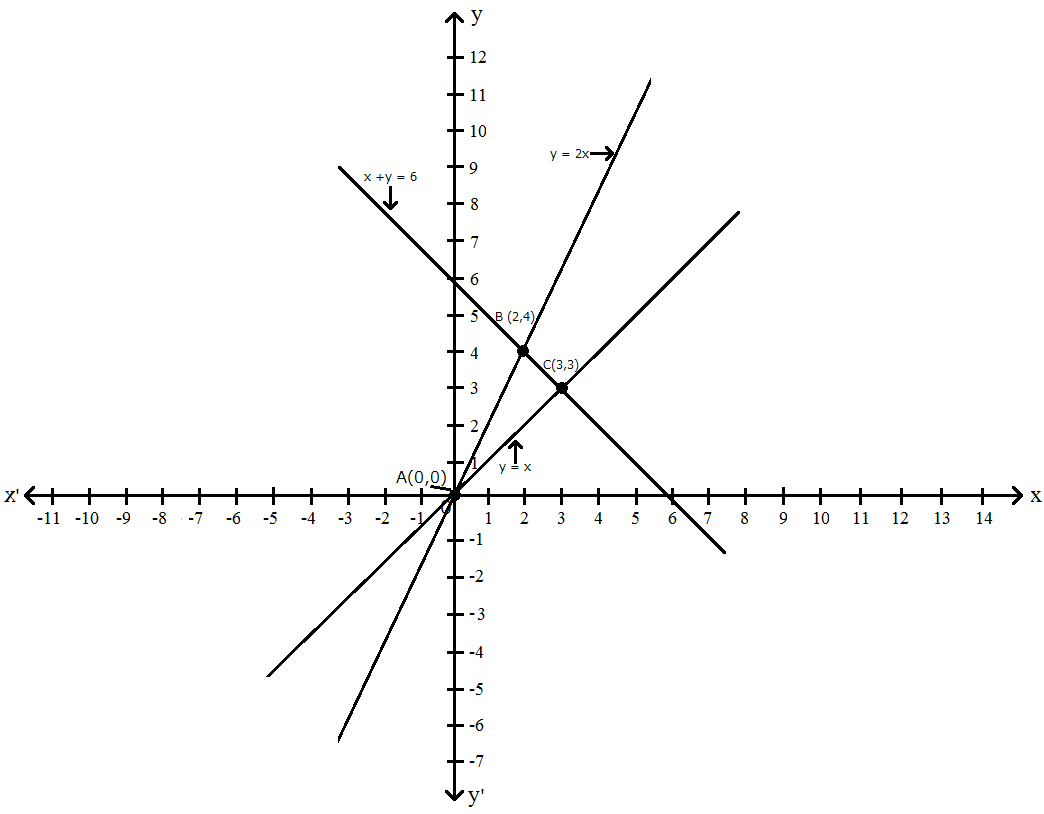
From the graph of the three equations, we find that the three lines taken in pairs intersect each other at points $A(0, 0), B(2, 4)$ and $C(3, 3)$.
Hence, the vertices of the required triangle are $(0, 0), (2, 4)$ and $(3, 3).$ View full question & answer→Question 1774 Marks
In a $\triangle\text{ABC},$ $\angle\text{x}^\circ,\angle\text{B}=(3\text{x}-2)^\circ,\angle\text{C}=\text{y}^\circ$ Also $\angle\text{C}-\angle\text{B}=9^\circ.$ Find the three angles.
AnswerIt is given that,
$\angle\text{A}=\text{x}^\circ ....(\text{i})$
$\angle\text{B}=(3\text{x}-2)^\circ\ ...(\text{ii})$
$\angle\text{C}=\text{y}^\circ\ ....(\text{iii})$
And, $\angle\text{C}-\angle\text{B}=9^\circ\ ....(\text{iv})$
Putting $\angle\text{C}=\text{y}^ \circ$ and $\angle\text{B}=(3\text{x}-2)^\circ$ in equation (iv), we get
$y - (3x - 2) = 9$
$\Rightarrow y - 3x + 2 = 9$
$\Rightarrow y - 3x = 9 - 2$
$\Rightarrow -3x + y = 7 .....(v)$
We know that, the sum of angles of a triangle is $180^\circ $
$\therefore\angle\text{A}+\angle\text{B}+\angle\text{C}=180^\circ$
$\Rightarrow x + 3x - 2 + y = 180^\circ $
$\Rightarrow 4x - 2 + y = 180^\circ $
$\Rightarrow 4x + y = 180 + 2$
$\Rightarrow 4x + y = 182 .......(vi)$
Subtracting equation $(v)$ from equatoin $(vi)$ we get
$4x + 3x = 182 - 7$
$\Rightarrow 7x = 175$
$\Rightarrow\text{x}=\frac{175}{7}$
$\Rightarrow x = 25$
Putting $x = 25$ in equation $(v)$ we get
$-3 \times 25 + y = 7$
$\Rightarrow -75 + y = 7$
$\Rightarrow y = 7 + 75$
$\Rightarrow y = 82$
$\therefore\angle\text{A}=\text{x}^\circ=25^\circ$
$\angle\text{B}=(3\text{x}-2)^\circ$
$(3 \times 25 - 2)^\circ $
$= (75 - 2)$
$= 73^\circ $
And, $\angle\text{C}=\text{y}^\circ=82^\circ$
View full question & answer→Question 1784 Marks
Draw the graphs of the pair of linear equations $x - y + 2 = 0$ and $4x - y - 4 = 0$. Calculate the area of the triangle formed by the lines so drawn and the x-axis.
AnswerFor drawing the graphs of the given equations, we find two solutions of each of the equations, which are given in table. Plot the points $A(0, 2), B(-2, 0), P(0, -4)$ and $Q(1, 0)$ on the graph paper, and join the points to form the lines $AB$ and $PQ$ as shown in the figure.
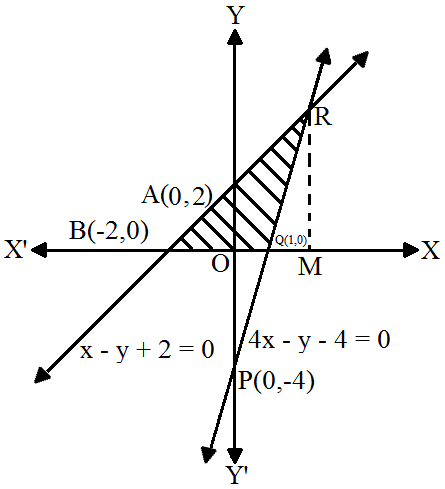
We observe that there is a point $R(2,4)$ common to both the lines $AB$ and $PQ$. The triangle formed by these lines and the x-axis is $BQR. $ The vertices of this triangle are $B(-2, 0), Q(1, 0)$ and $R(2, 4)$. We know that;
Area of triangle $=\frac{1}{2}$ × Base × Altitude
Here, Base $= BQ = BO + OQ$
$= 2 + 1 = 3$ units.
Altitude $= RM =$ Ordinate of $R = 4$ units.
So, area of $ABQR =\frac{1}{2}\times3\times4$
$=6\text{ sq. units.}$ View full question & answer→Question 1794 Marks
Solve the following system of equations graphically.
$2x - 3y + 6 = 0$
$2x + 3y - 18 = 0$
AnswerThe given system of equations is,
$2x - 3y + 6 = 0$
$2x + 3y - 18 = 0$
Now, $2x - 3y + 6 = 0$
$\Rightarrow 2x + 6 = 3y$
$\Rightarrow 3y = 2x + 6$
$\Rightarrow\text{y}=\frac{2\text{x}+6}{3}$
When $x = 0$, we have
$\text{y}=\frac{2\times0+6}{3}=2$
When x = -3 we have
$\text{y}=\frac{2\times(-3)+6}{3}=0$
Thus, we have the following table.
Graph of the given system of equations.
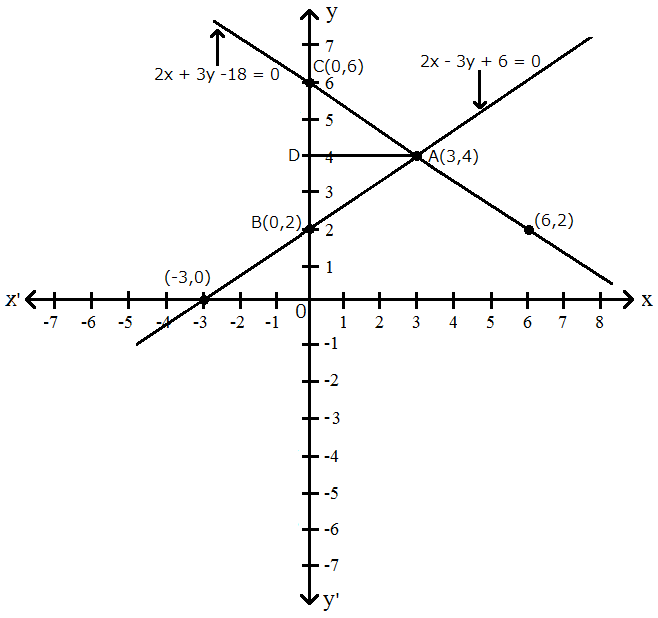
Clearly, the two lines intersect at $A(3, 4).$
Hence, $x = 3, y = 4$ is the solution of the given system of equations.
we also observe that the lines represented by the equations $2x - 3y + 6 = 0$ and $2x + 3y - 18 = 0$ meet y-axis at $B(0, 2)$ and $C(0. 6)$ respectively.
Thus, $x = 3, y = 4$ is the solution of the given system of equations. Draw $AD$ perpendicular from A on Y-axis. Clearly,
We have, $AD = x$ - Coordinate of point $A(3, 4)$
$\Rightarrow AD = 3$ and $BC = 6 - 2 = 4$
Area of the shaded region = Area of $\triangle\text{ABC}$
Area of the shaded region $=\frac{1}{2}(\text{Base}\times\text{Height})$
$=\frac{1}{2}(\text{BC}\times\text{AD})$
$=\frac{1}{2}\times4\times3$
$=2\times3$
$=6\text{sq.units.}$
$\therefore$ Area of the region bounded by these two lines and y-axis is $6$ sq. units. View full question & answer→Question 1804 Marks
Solve the following systems of equations graphically:
$3x - y + 1 = 0$
$2x - 3y + 8 = 0$
AnswerWe have,
$3x + y + 1 = 0$
$2x + 3y + 8 = 0$
Now,
$3x + y + 1 = 0$
$\Rightarrow y = -1 - 3x$
When $x = 0$, we have
$y = -1$
$$When$ x = -1$, we have
$y = -1 - 3 \times (-1) = 2$
Thus, we have the following table giving points on the line $3x + y + 1 = 0$
|
$x$
|
$-1$
|
$0$
|
|
$y$
|
$2$
|
$-1$
|
Now,
$2x - 3y + 8 = 0$
$\Rightarrow 2x = 33y - 8$
$\Rightarrow\text{x}=\frac{3\text{y}-8}{2}$
When $y = 0,$ we have
$\text{x}=\frac{3\times0-8}{2}=-4$
When $y = 2$, we have
$\text{x}=\frac{3\times2-8}{2}=-1$
Thus, we have the following table giving points on the line 2x - 3y + 8 = 0
|
$x$
|
$-4$
|
$-1$
|
|
$y$
|
$0$
|
$-2$
|
Graph of the equation are:
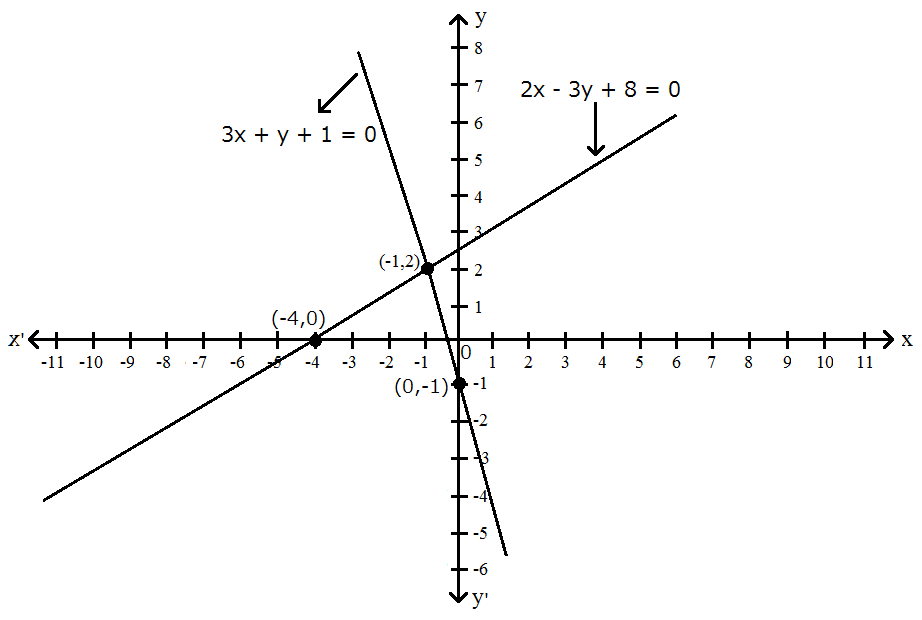
Clearly, two lines intersect at $(-1, 2)$
Hence, $x = -1, y = 2$ is the solution of the given system of equations. View full question & answer→Question 1814 Marks
Solve the following system of equations by the method of cross-multiplication:
$\frac{\text{b}}{\text{a}}\text{x}+\frac{\text{a}}{\text{b}}\text{y}=\text{a}^2+\text{b}^2$
$\text{x}+\text{y}=2\text{ab}$
AnswerThe given equation are,
$\frac{\text{b}}{\text{a}}\text{x}+\frac{\text{a}}{\text{b}}\text{y}=\text{a}^2+\text{b}^2$
$$$\text{b}^2\text{x}+\text{a}^2\text{y}-(\text{a}^2+\text{b}^2)\text{ab}=0\ ...(\text{i})$
$\text{x}+\text{y}-2\text{ab}=0\ ....(\text{ii})$
By cross-multiplication method we get,
$\Rightarrow\frac{\text{x}}{\text{a}^2(-2\text{ab})-\big\{-(\text{a}^2+\text{b}^2)\text{ab}\big\}}=\frac{\text{y}}{-(\text{a}^2+\text{b}^2)\text{ab}-\text{b}^2(-2\text{ab})}\\=\frac{1}{\text{b}^2-\text{a}^2}$
$\Rightarrow \frac{\text{x}}{-2\text{a}^3\text{b}+\text{a}^3\text{b}+\text{ab}^3}=\frac{\text{y}}{-\text{a}^3\text{b}-\text{ab}^3+2\text{ab}^3}=\frac{1}{\text{b}^2-\text{a}^2}$
$\Rightarrow \frac{\text{x}}{\text{ab}^3-\text{a}^3\text{b}}=\frac{\text{y}}{\text{ab}^3-\text{a}^3\text{b}}=\frac{1}{\text{b}^2-\text{a}^2}$
$\Rightarrow\frac{\text{x}}{\text{ab}(\text{b}^2-\text{a}^2)}=\frac{\text{y}}{\text{ab}(\text{b}^2-\text{a}^2)}=\frac{1}{\text{b}^2-\text{a}^2}$
$\Rightarrow \text{x}=\frac{\text{ab}(\text{b}^2-\text{a}^2)}{(\text{b}^2-\text{a}^2)}=\text{ab}$
$\Rightarrow\text{y}=\frac{\text{ab}(\text{b}^2-\text{a}^2)}{(\text{b}^2-\text{a}^2)}=\text{ab}$
Thus, x = y = ab
View full question & answer→Question 1824 Marks
The sum of a two digit number and the number obtained by reversing the order of its digits is $99$. If the digits differ by $3$, find the number.
AnswerLet the digit at unit place and tens olace be x and y respectively.
number $= 10y + x$
The number obtaines after reversing the order of digits $= 10x + y$
According to question
$10y + x + 10x + y = 99$
$11x + 11y = 99$
$x + y = 9 .....(i)$
and, $x - y = 3 ....(ii)$
Adding $(i)$ and $(ii)$ we get
$\Rightarrow 2x = 12$
$\Rightarrow x = 6$
Putting $x = 6$ in $(i)$ we get
$\Rightarrow 6 + y = 9$
$\Rightarrow y = 3$
Thus, number will be $(3 \times 10 + 6) = 36$
When adding $(i)$ and $(ii)$ we get
$\Rightarrow 2y = 12$
$\Rightarrow y = 6$
Putting $y = 6$ in $(i)$ we get
$\Rightarrow 6 + x = 9$
$\Rightarrow x = 3$
Thus, the number will be $(6 \times 10 + 3) = 63$
View full question & answer→Question 1834 Marks
Show graphically that the following systems of equations is in-consistent (i.e. has no solution):
$3\text{x}-4\text{y}-1=0$
$2\text{x}-\frac{8}{3}\text{y}+5=0$
AnswerWe have,
$3\text{x}-4\text{y}-1=0$
$2\text{x}-\frac{8}{3}\text{y}+5=0$
Now,
$3\text{x}-4\text{y}-1=0$
$\Rightarrow3\text{x}=1+4\text{y}$
$\Rightarrow\text{x}=\frac{1+4\text{y}}{3}$
When $y = 2$, we have
$\text{x}=\frac{1+4\times2}{3}=3$
When $y = -1$, we have
$\text{x}=\frac{1+4\times(-1)}{3}=-1$
Thus, we have the following table giving points on the line $3x - 4y - 1 = 0.$
|
$x$
|
$-1$
|
$3$
|
|
$y$
|
$-1$
|
$2$
|
$2\text{x}-\frac{8}{3}\text{y}+5=0$
$\Rightarrow\frac{6\text{x}-8\text{y}+15}{3}=0$
$\Rightarrow6\text{x}-8\text{y}+15=0$
$\Rightarrow6\text{x}=8\text{y}-15$
$\Rightarrow\text{x}=\frac{8\text{y}-15}{6}$
When $y = 0$, we have,
$\text{x}=\frac{8\times0-15}{6}=-2.5$
When $y = 3$, we have,
$\text{x}=\frac{8\times3-15}{6}=1.5$
Thus, we have the following table giving points on the line $2\text{x}-\frac{8}{3}\text{y}+5=0.$
|
$x$
|
$-2.5$
|
$1.5$
|
|
$y$
|
$0$
|
$3$
|
Graph of the given equations.
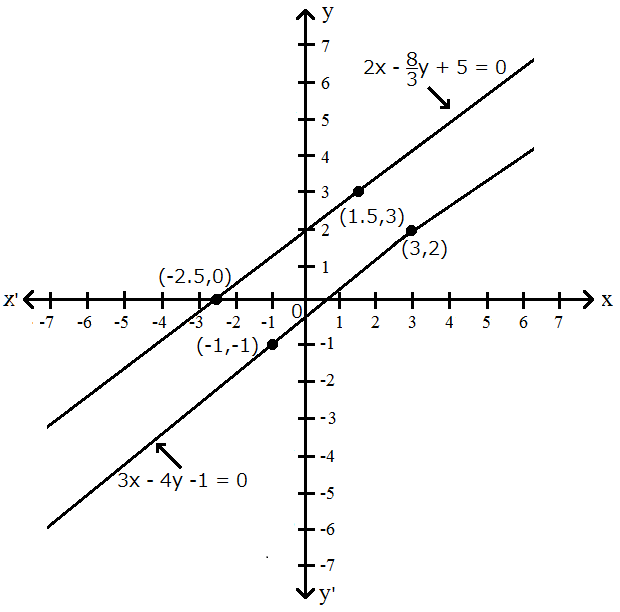
We find the lines represented by equations $3x - 4y - 1 = 0$ and $2\text{x}-\frac{8}{3}\text{y}+5=0$ are parallel. So, the two lines have no common point.
Hence, the given system of equations is in-consistent. View full question & answer→Question 1844 Marks
Draw the graphs of the lines $x = -2$, and $y = 3$. Write the vertices of the figure formed by these lines, the x-axis and the y-axis. Also, find the area of the figure.
AnswerWe know that the graph of $x = -2$ is a line parallel to y-axis at a distance of $2$ units to the left of it. So, the line l is the graph of $x = -2$
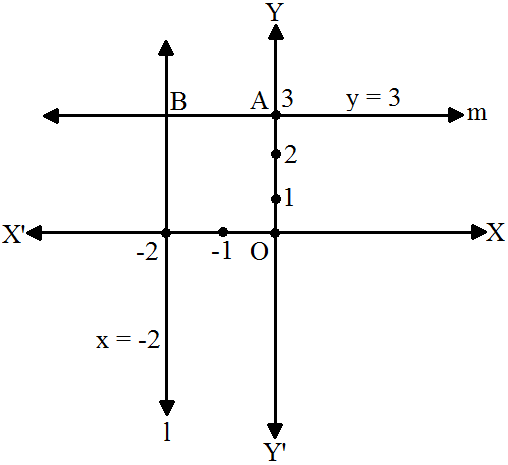
The graph of $y = 3$ is a line parallel to the x-axis at a distance of $3$ units above it. So, the line m is the graph of $y = 3$. The figure enclosed by the line $x = -2, y = 3$, the x-axis and the y-axis is $OABC$, which is a rectangle. A is a point on the y-axis at a distance of $3$ units above the x-axis. So, the coordinates of A are $(0, 3)$. $C$ is a point on the x-axis at a distance of $2$ units to the left of y-axis. So, the coordinates of $C$ are $(-2, 0). B$ is the solution of the pair of equations $x = -2$ and $y = 3$. So, the coordinates of $B$ are $(-2, 3).$ So, the vertices of the rectangle $OABC$ are $O(0, 0), A(0, 3), B(-2, 3), C(-2, 0)$. The length and breadth of this rectangle are $2$ units and $3$ units, respectively.
As the area of a rectangle = length x breadth,
The area of rectangle $OABC = 2 \times 3 = 6$ sq. units. View full question & answer→Question 1854 Marks
Solve the following system of equations by the method of cross-multiplication:
$\frac{5}{\text{x}+\text{y}}-\frac{2}{\text{x}-\text{y}}=-1,$
$\frac{15}{\text{x}+\text{y}}+\frac{7}{\text{x}-\text{y}}=-10,$ where $\text{x}\neq0$ and $\text{y}\neq0.$
AnswerLet $\frac{1}{\text{x}+\text{y}}=\text{u}$ and $\frac{1}{\text{x}-\text{y}}=\text{v}.$ Then, the given system of equations becomes.
$5u - 2v = -1$
$15u + 7v = 10$
Here, $a_1=5, b_1=-2, c_1=1$
$a_2=15, b_2=7 \text { and } c_2=-10$
By cross-multiplication, we get,
$\Rightarrow\frac{\text{u}}{(-2)\times(-10)-1\times7}=\frac{-\text{v}}{(5)\times(-10)-1\times15}\\=\frac{1}{5\times7-(-2)\times15}$
$\Rightarrow\frac{\text{u}}{20-7}=\frac{-\text{v}}{-50-15}=\frac{1}{35+30}$
$\Rightarrow\frac{\text{u}}{13}=\frac{-\text{v}}{-65}=\frac{1}{65}$
Now, $\frac{\text{u}}{13}=\frac{1}{65}$
And, $\frac{\text{v}}{65}=\frac{1}{65}$
$\Rightarrow\text{v}=\frac{65}{65}=1$
Now, $\text{u}=\frac{1}{\text{x}+\text{y}}$
$\Rightarrow\frac{1}{\text{x}+\text{y}}=\frac{1}{5}$
$\text{x}+\text{y}=5\ ...(\text{i})$
And, $\text{v}=\frac{1}{\text{x}-\text{y}}$
$ \Rightarrow\frac{1}{\text{x}-\text{y}}=1$
$\Rightarrow\text{x}-\text{y}=1\ ....(\text{ii})$
Adding equation (i) and (ii) we get,
$2\text{x}=5+1$
$\Rightarrow2\text{x}=6$
$\Rightarrow\text{x}=\frac{6}{2}=3$
View full question & answer→Question 1864 Marks
Find the values of a and b for which the following system of equations has infinitely many solutions:
$2x + 3y = 7$
$2ax + ay = 28 - by$
AnswerGiven
$2x + 3y = 7$
$2ax + ay = 28 - by$
$⇒ 2ax + (a + b)y = 28$
We know that the system of equations
$ a_1 x+b_1 y=c_1 $
$ a_2 x+b_2 y=c_2 $
has infinitely many solutions if
$\frac{\text{a}_1}{\text{a}_2}=\frac{\text{b}_1}{\text{b}_2}=\frac{\text{c}_1}{\text{c}_2}$
$\therefore\frac{2}{2\text{a}}=\frac{3}{\text{a}+\text{b}}=\frac{7}{28}$
$\Rightarrow\frac{1}{\text{a}}=\frac{3}{\text{a}+\text{b}}=\frac{1}{4}$
$\Rightarrow\frac{1}{\text{a}}=\frac{3}{\text{a}+\text{b}}$ and $\frac{3}{\text{a}+\text{b}}=\frac{1}{4}$
Now,
$\frac{1}{\text{a}}=\frac{3}{\text{a}+\text{b}}$
$\Rightarrow\text{a}+\text{b}=3\text{a}$
$\Rightarrow\text{b}=2\text{a}\ ....(\text{i})$
Also,
$\frac{3}{\text{a}+\text{b}}=\frac{1}{4}$
$\Rightarrow\text{a}+\text{b}=12\ .....(\text{ii})$
Solving (i) and (ii) we get
$a = 4$ and $b = 8$
View full question & answer→Question 1874 Marks
Susan invested certain amount of money in two schemes $A$ and $B$, which offer interest at the rate of $8\%$ per annum and $9\%$ per annum, respectively. She received ₹ $1860$ as annual interest. However, had she interchanged the amount of investment in the two schemes, she would have received $720$ more as annual interest. How much money did she invest in each scheme?
AnswerLet the amount of investments in schemes $A$ and $B$ be ₹ $x$ and ₹ $y$, respectively.
Case I:
Interest at the rate of $8\%$ per annum on scheme $A +$ Interest at the rate of $9\%$ per annum on scheme $B =$ Total amount received
$\Rightarrow\frac{\text{x}\times8\times1}{100}+\frac{\text{y}\times9\times1}{100}$
$=₹1860$
$\Big[\because\text{Simple interest}=\frac{\text{principal}\times\text{rate}\times\text{time}}{100}\Big]$
$\Rightarrow8\text{x}+9\text{y}=186000\ .....(\text{i})$
Case II:
Interest at the rate of $9\%$ per annum on scheme $A +$ Interest at the rate of $8\%$ per annum on scheme $B = ₹ 20$ more as annual interest.
$\Rightarrow\frac{\text{x}\times9\times1}{100}+\frac{\text{y}\times8\times1}{100}$
$=₹20+₹1860$
$\Rightarrow\frac{9\text{x}}{100}+\frac{8\text{y}}{100}=1880$
$\Rightarrow9\text{x}+8\text{y}=188000\ .....(\text{ii})$
On multiplying eq. $(i)$ by $9$ and eq. $(ii)$ by $8$ and then subtracting them, we get
(image)
$\big[(9\times186) - (8\times188)\big]$
$=1000(1674-1504)$
$=1000\times170$
$17\text{y}=170000$
$\Rightarrow\text{y}=10000$
On putting the value of y in eq. $(i)$ we get
$=8\text{x}+9\times10000=186000$
$\Rightarrow8\text{x}=186000-90000$
$\Rightarrow8\text{x}=96000$
$\Rightarrow\text{x}=12000$
Hence, she invested ₹ $12000$ and ₹ $10000$ in two schemes $A$ and $B$, respectively.
View full question & answer→Question 1884 Marks
A two-digit number is $4$ times the sum of its digits. If $18$ is added to the number, the digits are reversed. Find the number.
AnswerLet the digit in the unit's place be x and the digit at the ten's place be y. Then,
Number $= 10y + x$
The number obtained by reversing the order of the digit is $10x + y$
According to the given conditions we have
$10y + x = 4(x + y)$
$\Rightarrow 10y + x = 4x + 4y$
$\Rightarrow 0 = 4x - x + 4y - 10y$
$\Rightarrow 0 = 3x - 6y$
$\Rightarrow 3x - 6y = 0$
$\Rightarrow 3(x - 2y) = 0$
$\Rightarrow x - 2y = 0 ......(i)$
and, $10y + x + 18 = 10x + y$
$\Rightarrow 18 = 10x - x + y - 10y$
$\Rightarrow 18 = 9x - 9y$
$\Rightarrow 9x - 9y = 18$
$\Rightarrow 9(x - y) = 18$
$\Rightarrow x - y = 2 .....(ii)$
Subtracting equation $(ii)$ from equation $(i)$ we get
$-2y - (-y) = 0 - 2$
$\Rightarrow -2y + y = -2$
$\Rightarrow -y = -2$
$\Rightarrow y = 2$
Putting $y = 2$ in equation $(ii)$ we get
$x - 2 = 2$
$\Rightarrow x = 4$
Hence the required number is $10y + x = 10 \times 2 + 4 = 24$
View full question & answer→Question 1894 Marks
Find the values of $a$ and $b$ for which the following system of equations has infinitely many solutions:
$2x - (2a + 5)y = 5$
$(2b + 1)x - 9y = 15$
AnswerThe given system of equations is
$2x - (2a + 5)y = 5$
$(2b + 1)x - 9y = 15$
It is of the form
$ a_1 x+b_1 y+c_1=0 $
$ a_2 x+b_2 y+c_2=0$
Where $\mathrm{a}_1=2, \mathrm{~b}_1=-(2 \mathrm{a}+5), \mathrm{c}_1=-5$
And $a_2=(2 b+1), b_2=-9, c_2=-15$
The given system of equations will be have infinite number of solution, if
$\frac{\text{a}_1}{\text{a}_2}=\frac{\text{b}_1}{\text{b}_2}=\frac{\text{c}_1}{\text{c}_2}$
$\Rightarrow\frac{2}{2\text{b}+1}=\frac{-(2\text{a}+5)}{-9}=\frac{-5}{-15}$
$\Rightarrow\frac{2}{2\text{b}+1}=\frac{2\text{a}+5}{9}=\frac{1}{3}$
$\Rightarrow\frac{2}{2\text{b}+1}=\frac{1}{3}$ and $\frac{2\text{a}+5}{9}=\frac{1}{3}$
$\Rightarrow6=2\text{b}+1$ and $\frac{3(2\text{a}+5)}{9}=1$
$\Rightarrow6-1=2\text{b}$ and $2\text{a}=-2$
$\Rightarrow\frac{5}{2}=\text{b}$ and $\text{a}=\frac{-2}{2}=-1$
Hence, the given system of equations will have infinitely many solutions, if $a = -1$ and $\text{b}=\frac{5}{2}$
View full question & answer→Question 1904 Marks
Solve the following systems of equations:
$\frac{\text{x}}{7}+\frac{\text{y}}{3}=5,$
$\frac{\text{x}}{2}-\frac{\text{y}}{9}=6.$
AnswerThe given system of equation is
$\frac{\text{x}}{7}+\frac{\text{y}}{3}=5\ .......(\text{i})$
$\frac{\text{x}}{2}-\frac{\text{y}}{9}=6\ .......(\text{ii})$
From $(i),$ we get
$\frac{3\text{x}+7\text{y}}{21}=5$
$\Rightarrow3\text{x}+7\text{y}=105$
$\Rightarrow3\text{x}=105-7\text{y}$
$\Rightarrow\text{x}=\frac{105-7\text{y}}{3}$
From $(ii)$, we get
$\frac{9\text{x}-2\text{y}}{18}=6$
$\Rightarrow9\text{x}-2\text{y}=108\ .....(\text{iii})$
Substituting $\text{x}=\frac{105-7\text{y}}{3}$ in $(iii),$ we get
$9\Big(\frac{105-7\text{y}}{3}\Big)-2\text{y}=108$
$\Rightarrow\frac{948-63\text{y}}{3}-2\text{y}=108$
$\Rightarrow945-63\text{y}-6\text{y}=108\times3$
$\Rightarrow945-69\text{y}=324$
$\Rightarrow945-324=69\text{y}$
$\Rightarrow69\text{y}=621$
$\Rightarrow\text{y}=\frac{621}{69}$
$\Rightarrow\text{y}=9$
Putting $y = 9$ in $\text{x}=\frac{1105-7\text{y}}{3},$ we get
$\text{x}=\frac{105-7\times9}{3}$
$\text{x}=\frac{105-63}{3}$
$\Rightarrow\text{x}=\frac{42}{3}$
$\Rightarrow\text{x}=14$
Hence, the solution of the given system of equations is $x = 14, y = 9.$
View full question & answer→Question 1914 Marks
Find the values of p and q for which the following system of linear equations has infinite number of solutions:
$2x + 3y = 9$
$(p + q)x + (2p - q)y = 3(p + q + 1)$
AnswerThe given system of equations is
$2x + 3y - 9 = 0$
$(p + q)x + (2q - q)y - 3(p + q + 1) = 0$
It is of the form
$ a_1 x+b_1 y+c_1=0$
$ a_2 x+b_2 y+c_2=0$
Where, $a_1=2, b_1=3, c_1=-9$
And $a_2=p+q, b_2=2 p-q, c_2=-3(p+q+1)$
The given system of equations will have infinite number of solutions if
$\frac{\text{a}_1}{\text{a}_2}=\frac{\text{b}_1}{\text{b}_2}=\frac{\text{c}_1}{\text{c}_2}$
$\Rightarrow\frac{2}{\text{p}+\text{q}}=\frac{3}{2\text{a}-\text{q}}=\frac{3}{\text{p}+\text{q}+1}$
$\Rightarrow\frac{2}{\text{p}+\text{q}}=\frac{3}{2\text{a}-\text{q}}$ and $\frac{3}{2\text{a}-\text{q}}=\frac{3}{\text{p}+\text{q}+1}$
$⇒ 2(2p - q) = 3 (p + q)$ and $p + q + 1 = 2p - q$
$⇒ 4p - 2p = 3p + 3p$ and $-2p + p + q + q = -1$
$⇒ p - 5q - p + 2p = -1$ [on adding]
$⇒ - 3p = -1$
$\Rightarrow\text{q}=\frac{1}{3}$
Putting $\text{q}=\frac{1}{3}$ in p - 5q, we get
$\text{p}-5\Big(\frac{1}{3}\Big)=0$
$\Rightarrow\text{p}=\frac{5}{3}$
Hence the given system of equations will have infinitely many solutions, if $\text{p}=\frac{5}{3}$ and $\text{q}=\frac{1}{3}$
View full question & answer→Question 1924 Marks
The path of a train a is given by the equation $3x + 4y - 12 = 0$ and the path of another train $B$ is given by the equation $6x + 8y - 48 = 0.$ Represent this situation graphically.
AnswerThe paths of two trains are given by the following pair of linear equations.
$3x + 4y - 12 = 0 ......(i)$
$6x + 8y - 48 = 0 .......(ii)$
In order to represent the following sets of lines graphically we need two points for a single equation
We have, $3x + 4y - 12 = 0$ Putting $y = 0$
$\Rightarrow 3x + 4(0) = 12 $
$\Rightarrow 3x = 12 $
$\Rightarrow x = 4$
Hence the coordinate is $(4, 0)$
Putting $x = 0$
$3(0) + 4y = 12 $
$\Rightarrow 4y = 12 $
$\Rightarrow y = 3$
Hence the coordinate is $(0, 3)$
We have,$ 6x + 8y - 48 = 0$, Putting $x = 0$
$6(0) + 8y = 48 $
$\Rightarrow 8y = 48 $
$\Rightarrow y = 6$
Hence the coordinate is $(0, 6)$
$6x + 8y - 48 = 0$, Putting $y = 0$
$6x + 8(0) = 48 = 6x = 48 = x = 8$
Hence the coordinate is $(8, 0)$
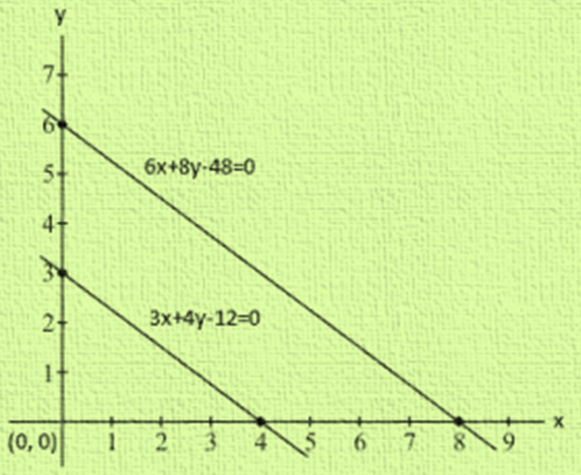
Hence the two lines intersect at point $(-1, 2)$ Hence $x = -1$ and $y = 2.$ View full question & answer→Question 1934 Marks
Write the set of values of $a$ and $b$ for which the following system of equations has infinitely many solutions.
$2x + 3y = 7$
$2ax + (a + b)y = 28$
AnswerThe given equations are
$2x + 3y - 7 = 0$
$2ax + (a + b)y - 28 = 0$
$\frac{\text{a}_1}{\text{a}_2}=\frac{2}{2\text{a}},\frac{\text{b}_1}{\text{b}_2}=\frac{3}{\text{a}+\text{b}},\frac{\text{c}_1}{\text{c}_2}=\frac{-7}{-28}$
For the equations to have infinite number of solutions,
$\frac{\text{a}_1}{\text{a}_2}=\frac{\text{b}_1}{\text{b}_2}=\frac{\text{c}_1}{\text{c}_2}$
Therefore
$\frac{2}{2\text{a}}=\frac{3}{\text{a}+\text{b}}=\frac{7}{28}$
Let us take
$\frac{2}{2\text{a}}=\frac{3}{\text{a}+\text{b}}$
$2(a + b) = 2a \times 3$
$2a + 2b = 6a$
$0 = 6a - 2a - 2b$
$0 = 4a - 2b$
$\frac{3}{\text{a}+\text{b}}=\frac{7}{28}$
$28 \times 3 = 7(a + b)$
$84 = 7a + 7b$
By dividing both the sides by $7$ we get,
$12 = a + b ....(ii)$
By multiplying equations $(ii)$ by $2$ we get
$24 = 2a + 2b .....(iii)$
Substituting $(iii)$ from $(i)$ we get
$4\text{a}\ -\ 2\text{b}\ =\ 0$
$2\text{a}\ +\ 2\text{b}\ =\ 24\over6\text{a}\ \ \ \ \ \ \ \ \ \ =\ 24$
$\text{a}=\frac{24}{6}$
$a = 4$
Subtracting $a = 4$ in equation $(iii)$ we have
$24 = 2a + 2b$
$24 = 2 \times 4 + 2b$
$24 = 8 + 2b$
$24 - 8 = 2b$
$16 = 2b$
$\frac{16}{2}=\text{b}$
$8 = b$
Hence, the value of $a = 4, b = 8$ when system of equations has infinity many solutions.
View full question & answer→Question 1944 Marks
$4$ tables and $3$ chairs, together, cost Rs. $2250$ and $3$ tables and $4$ chairs cost Rs. $1950$. Find the cost of $2$ chairs and $1$ table.
AnswerGiven,
Cost of $4$ tables and $3$ chairs = Rs. $2250$
Cost of $3$ tables and $4$ chairs = Rs. $1950$
To find: The cost of $2$ chairs and $1$ table.
Suppose, the cost of $1$ table = Rs. $x$
The cost of $1$ chair = Rs. $y$
According to the given conditions,
$4x + 3y = 2250$
$4x + 3y - 2200 = 0 ....(i)$
$3x + 4y = 1950$
$3x + 4y - 1950 = 0 ........(ii)$
Solving eq. $(i)$ and eq. $(ii)$ by cross multiplication
$\frac{\text{x}}{-5850+9000}=\frac{-\text{y}}{-7800+6750}=\frac{1}{16-9}$
$\frac{\text{x}}{3150}=\frac{-\text{y}}{-1050}=\frac{1}{7}$
$\text{x}=\frac{3150}{7}$
$\text{x}=450$
$\therefore$ Cost of $1$ table = Rs. $450$
Cost of $1$ table = Rs. $450$
$\text{y}=\frac{1050}{7}$
$\text{y}=150$
$\therefore$ Cost of $1$ chairs = Rs. $150$
Cost of $2$ chairs = Rs. $300$
Hence total Cost of $2$ chairs and $1$ table = $Rs. 750$
View full question & answer→Question 1954 Marks
Solve the following systems of equations:
$\sqrt{2}\text{x}-\sqrt{3}\text{y}=0,$
$\sqrt{3}\text{x}-\sqrt{8}\text{y}=0.$
AnswerThe given equations are,
$\sqrt{2}\text{x}-\sqrt{3}\text{y}=0\ ......(\text{i})$
$\sqrt{3}\text{x}-\sqrt{8}\text{y}=0\ .....(\text{ii})$
Multiplying (i) by $\sqrt{3}$ and (ii) by $\sqrt{2}$ we get,
$\Rightarrow\sqrt{6}\text{x}-3\text{y}=0\ ......(\text{iii})$
$\Rightarrow\sqrt{6}\text{x}-4\text{y}=0\ ......(\text{iv})$
Subtracting (iii) from (iv) we get,
$\Rightarrow-\text{y}=0$
$\Rightarrow\text{y}=0$
Putting y = 0 in (i) we get,
$\Rightarrow\sqrt{2}\text{x}-\sqrt{3}\times0=0$
$\Rightarrow\sqrt{2}\text{x}-0=0$
$\Rightarrow\sqrt{2}\text{x}=0$
$\Rightarrow\text{x}=0$
Thus, the solution is x = 0 and y = 0.
View full question & answer→Question 1964 Marks
Solve the following system of equations by the method of cross-multiplication:
$2ax + 3by = a + 2b,$
$3ax + 2by = 2a + b.$
AnswerThe given system of equations is,
$2ax + 3by = a + 2b .......(i)$
$3ax + 2by = 2a + b .........(ii)$
$ \text { Here, } a_1=2 a, b_1=3 b, c_1=-(a+2 b)$
$ a_2=3 a, b_2=2 b, c_2=-(2 a+b)$
By cross-multiplication we have,
$\Rightarrow\frac{\text{x}}{-3\text{b}\times(2\text{a}+\text{b})-\big[-(\text{a}+2\text{b})\big]\times2\text{b}}\\=\frac{-\text{y}}{-2\text{a}\times(2\text{a}+\text{b})-\big[-(\text{a}+2\text{b})\big]\times3\text{a}}\\=\frac{1}{2\text{a}\times2\text{b}-3\text{b}\times3\text{a}}$
$\Rightarrow\frac{\text{x}}{-3\text{b}(2\text{a}+\text{b})+2\text{b}(\text{a}+2\text{b})}\\=\frac{-\text{y}}{-2\text{a}(2\text{a}+\text{b})+3\text{a}(\text{a}+2\text{b})}\\=\frac{1}{4\text{ab}-9\text{ab}}$
$\Rightarrow\frac{\text{x}}{-6\text{ab}-3\text{b}^2+2\text{ab}+4\text{b}^2}\\=\frac{-\text{y}}{-4\text{a}^2-2\text{ab}+3\text{a}^2+6\text{ab}}\\=\frac{1}{-5\text{ab}}$
$\Rightarrow\frac{\text{x}}{-4\text{ab}+\text{b}^2}=\frac{-\text{y}}{-\text{a}^2+4\text{ab}}\\=\frac{1}{-5\text{ab}}$
Now, $\frac{\text{x}}{-4\text{ab}+\text{b}^2}=\frac{1}{-5\text{ab}}$
$\Rightarrow\text{x}=\frac{-4\text{ab}+\text{b}^2}{-5\text{ab}}$
$\Rightarrow\text{x}=\frac{-\text{b}(4\text{a}-\text{b})}{-5\text{ab}}$
$\Rightarrow\text{x}=\frac{4\text{a}-\text{b}}{5\text{a}}$
and, $\frac{-\text{y}}{-\text{a}^2+4\text{ab}}=\frac{1}{-5\text{ab}}$
$\Rightarrow-\text{y}=\frac{-\text{a}^2+4\text{ab}}{-5\text{ab}}$
$ \Rightarrow-\text{y}=\frac{-\text{a}(\text{a}-4\text{b})}{-5\text{ab}}$
$\Rightarrow-\text{y}=\frac{\text{a}-4\text{b}}{5\text{b}}$
$\Rightarrow\text{y}=\frac{4\text{b}-\text{a}}{5\text{b}}$
Hence, $\text{x}=\frac{4\text{a}-\text{b}}{5\text{a}},\text{y}=\frac{4\text{b}-\text{a}}{5\text{b}}$ is the solution of the given system of equations.
View full question & answer→Question 1974 Marks
Solve the following system of equations by the method of cross-multiplication:
$\frac{\text{ax}}{\text{b}}-\frac{\text{by}}{\text{a}}=\text{a}+\text{b}$
$\text{ax}-\text{by}=2\text{ab}$ AnswerThe given system of equations may be written as,
$\frac{\text{a}}{\text{b}}\times\text{x}-\frac{\text{b}}{\text{a}}\times\text{y}-(\text{a}+\text{b})=0$
$\text{ax}-\text{by}=2\text{ab}$
Here,
$\text{a}_1=\frac{\text{a}}{\text{b}},\text{b}_1=-\frac{\text{b}}{\text{a}},$ $\text{c}_1=-(\text{a}+\text{b})$
$\text{a}_2=\text{a},\text{b}_2=-\text{b}$ and $\text{c}_2=-2\text{ab}$
By cross-multiplication we get,
$\Rightarrow\frac{\text{x}}{\frac{\text{b}}{\text{a}}\times2\text{ab}-\text{b}(\text{a}+\text{b})}=\frac{-\text{y}}{\frac{\text{a}}{\text{b}}\times(-2\text{ab})+\text{a}(\text{a}+\text{b})}\\=\frac{1}{-\text{b}\times\frac{\text{a}}{\text{b}}+\frac{\text{b}}{\text{a}}\times\text{a}}$
$\Rightarrow\frac{\text{x}}{2\text{b}^2-\text{ab}-\text{b}^2}=\frac{-\text{y}}{-2\text{a}^2+\text{a}^2+\text{ab}}=\frac{1}{-\text{a}+\text{b}}$
$\Rightarrow\frac{\text{x}}{\text{b}^2-\text{ab}}=\frac{-\text{y}}{-\text{a}^2+\text{ab}}=\frac{1}{-\text{a}+\text{b}}$
$ \Rightarrow\frac{\text{x}}{\text{b}(\text{b - a})}=\frac{-\text{y}}{\text{a}(-\text{a + b})}=\frac{1}{\text{b}-\text{a}}$
Now, $ \frac{\text{x}}{\text{b}(\text{b - a})}=\frac{1}{(\text{b}-\text{a})}$
$\Rightarrow\text{x}=\frac{\text{b}(\text{b - a})}{(\text{b}-\text{a})}$
$\text{x}=\text{b}$
and, $ \frac{-\text{y}}{\text{a}(\text{b}-\text{a})}=\frac{1}{\text{b} - \text{a}}$
$\Rightarrow{-\text{y}}=\frac{\text{a}(\text{b}-\text{a})}{\text{b} - \text{a}}$
$\Rightarrow-\text{y}=\text{a}$
$\Rightarrow\text{y}=-\text{a}$
Hence, x = b, y = -a is the solution of the given system of equations.
View full question & answer→Question 1984 Marks
Find the values of a and b for which the following system of equations has infinitely many solutions:
$3x + 4y = 12$
$(a + b)x + 2(a - b)y = 5a - 1$
AnswerThe given system of equations is
$3x + 4y - 12 = 0$
$(a + b)x + 2(a - b)y - (5a - 1) = 0$
It is of the form
$ a_1 x+b_1 y+c_1=0 $
$a_2 x+b_2 y+c_2=0$
Where, $a_1=3, b_1=4, c_1=-12$
and, $a_2=a+b, b_2=2(a-b), c_2=-(5 a-1)$
The given system of equations will have infinite number of solution, if
$\frac{\text{a}_1}{\text{a}_2}=\frac{\text{b}_1}{\text{b}_2}=\frac{\text{c}_1}{\text{c}_2}$
$\Rightarrow\frac{3}{\text{a}+\text{b}}=\frac{4}{2(\text{a}-\text{b})}=\frac{-12}{-(5\text{a}-1)}$
$\Rightarrow\frac{3}{\text{a}+\text{b}}=\frac{2}{\text{a}-\text{b}}=\frac{12}{5\text{a}-1}$
$\Rightarrow\frac{3}{\text{a}+\text{b}}=\frac{2}{\text{a}-\text{b}}$ and $\frac{2}{\text{a}-\text{b}}=\frac{12}{5\text{a}-1}$
$⇒ 3(a - b) = 2(a + b)$ and $2(5a - 1) = 12(a - b)$
$⇒ 3a - 3b = 2a + 2b$ and $10a - 2 = 12a - 12b$
$⇒ 3a - 2b = 2a + 3b$ and $10a - 12a = -12b + 2$
$⇒ a = 5b$ and $-2a = -12b + 2$
Substituting $a = 5b$ in $- 2a = -12b + 2,$ we get
$-2(5b) = -12b + 2$
$⇒ -10b = -12b + 2$
$⇒ 12b - 10b = 2$
$⇒ 2b=2$
$⇒ b = 1$
Putting $b = 1$ in $a = 5b$ we get
$a = 5 × 1 = 5$
Hence, the given system of equations will have infinitely many solutions, if $a = 5$ and $b = 1$
View full question & answer→Question 1994 Marks
Find the values of a and b for which the following system of equations has infinitely many solutions:
$x + 2y = 1$
$(a - b)x + (a + b)y = a + b - 2$
AnswerThe given system of equations is
$x + 2y = 1$
$(a - b)x + (a + b)y = a + b - 2$
We know that the system of equations
$a_1 x+b_1 y=c_1 $
$ a_2 x+b_2 y=c_2$
$\frac{\text{a}_1}{\text{a}_2}=\frac{\text{b}_1}{\text{b}_2}=\frac{\text{c}_1}{\text{c}_2} $
So, $\frac{1}{\text{a}-\text{b}}=\frac{2}{\text{a}+\text{b}}=\frac{1}{\text{a}+\text{b}-2}$
$\Rightarrow\frac{1}{\text{a}-\text{b}}=\frac{2}{\text{a}+\text{b}}$ and $\frac{2}{\text{a}+\text{b}}=\frac{1}{\text{a}+\text{b}-2}$
$⇒ a + b = 2a - 2b$ and $2a + 2b - 4 = a + b$
$⇒ a = 3b$ and $a + b = 4$
$⇒ a - 3b = 0$ and $a + b = 4$
Solving these two equations, we get
$-4b = -4$
$⇒ b = 1$
Putting $b = 1$ in $a + b = 4,$ we get
$a = 3$
View full question & answer→Question 2004 Marks
Solve the following systems of equations:
$\frac{1}{2\text{x}}+\frac{1}{3\text{y}}=2$
$\frac{1}{3\text{x}}+\frac{1}{2\text{y}}=\frac{13}{6}$
AnswerLet $\frac{1}{\text{x}}=\text{u}$ and $\frac{1}{\text{y}}=\text{v},$ the given equations become
$\frac{\text{u}}{2}+\frac{\text{v}}{3}=2$
$\Rightarrow\frac{3\text{u}+2\text{v}}{6}=2$
$\Rightarrow3\text{u}+2\text{v}=12\ ......(\text{i})$
And $\frac{\text{u}}{3}+\frac{\text{v}}{2}=\frac{13}{6}$
$\Rightarrow\frac{2\text{u}+3\text{v}}{6}=\frac{13}{6}$
$\Rightarrow2\text{u}+3\text{v}=13\ .....(\text{ii})$
Let us eliminate V from equations (i) and (ii) multiplying equation (i) by 3 and (ii) by 2, we get
$9\text{u}+6\text{v}=36\ .....(\text{iii})$
$4\text{v}+6\text{v}=26\ .....(\text{iv})$
Subtracting equation (iv) from equation (iii), we get
$9\text{u}-4\text{u}+6\text{v}-6\text{v}=36-26$
$\Rightarrow5\text{u}=10$
$\Rightarrow\text{u}=\frac{10}{5}=2$
Putting u = 2 in equationg (i), we get
$3\times2+2\text{v}=12$
$\Rightarrow6+2\text{v}=12$
$\Rightarrow2\text{v}=12-6$
$\Rightarrow\text{v}=\frac{6}{2}=3$
Hence, $\text{x}=\frac{1}{\text{u}}=\frac{1}{2}$ and $\text{y}=\frac{1}{\text{v}}=\frac{1}{3}$
So, the solution of the given system of equation is $\text{x}=\frac{1}{2},\text{y}=\frac{1}{3}.$
View full question & answer→