Fe = 10cm, L = 1m = 100cm
S0, f0 = L - fe = 100 - 10 = 90cm
and, magnifying power
$=\frac{\text{f}_0}{\text{f}_\text{e}}=\frac{90}{10}=9$Fe = 10cm, L = 1m = 100cm
S0, f0 = L - fe = 100 - 10 = 90cm
and, magnifying power
$=\frac{\text{f}_0}{\text{f}_\text{e}}=\frac{90}{10}=9$Explantion:
If the experimentalist is looking at a vertical tube containing some water, he has to be careful, as the lower meniscus will appear as upper.
$\text{u}= \infty$ and $\text{v}=-200\text{cm}=-2\text{m}$
So,
$\frac{1}{\text{f}}=\frac{1}{\text{v}}-\frac{1}{\text{u}}=\frac{1}{-2}-\frac{1}{\infty}$$\frac{1}{\text{f}}=-\frac{1}{2}=-0.5$
So, power of the lens is -0.5D
u = -20cm, v = -50cm
from lens formula
$\frac{1}{\text{v}}-\frac{1}{\text{u}}=\frac{1}{\text{f}}$$\frac{1}{\text{f}}=\frac{1}{-50}-\frac{1}{-20}=\frac{1}{-20}-\frac{1}{50}=\frac{3}{100}$
$\Rightarrow\text{f}=\frac{100}{3}\text{cm}=\frac{1}{3}\text{m}$
So, power of the lens
$=\frac{1}{\text{f}}=3\text{ Diopter}$

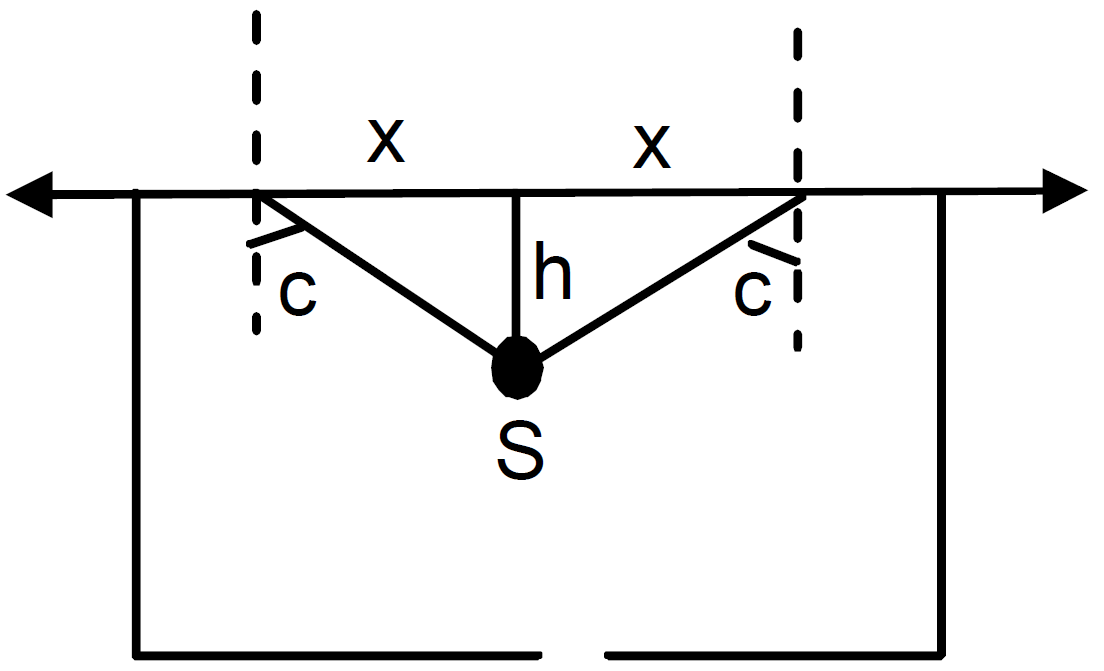
$\frac{\text{x}}{\text{h}}=\tan\theta_\text{C}$ (where C is the critical angle)
$\Rightarrow\frac{\text{x}}{\text{h}}=\frac{\sin\theta_\text{C}}{\sqrt{1-\sin^2\theta_\text{C}}}=\frac{\frac{1}{\mu}}{\sqrt{1-\frac{1}{\mu^2}}} \ \Big(\because \ \sin\theta_\text{C}=\frac{1}{\mu}\Big)$
$\Rightarrow\frac{\text{x}}{\text{h}}=\frac{1}{\sqrt{\mu^2-1}}$ or $\text{x}=\frac{\text{h}}{\sqrt{\mu^2-1}}$
So, light escapes through a circular area on the water surface directly above the point source.


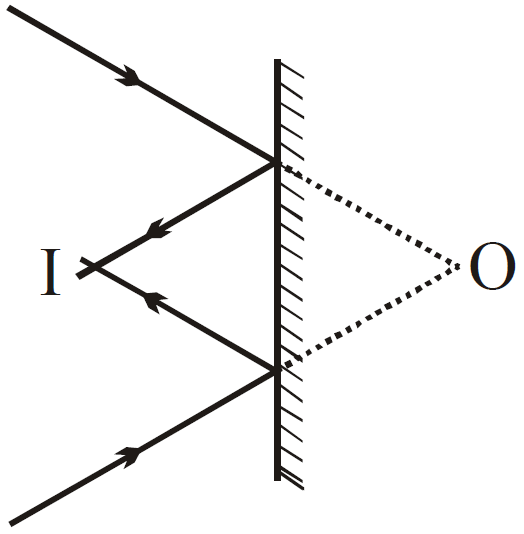
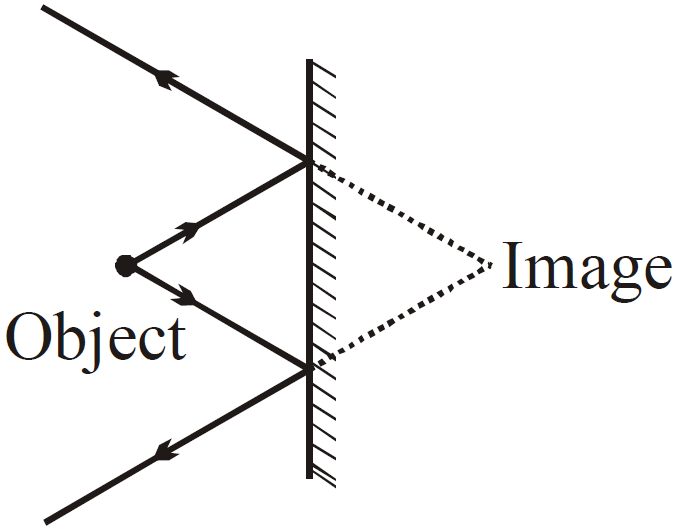
Yes, when you stand in front of plane mirror image is virtual and can be photographed.
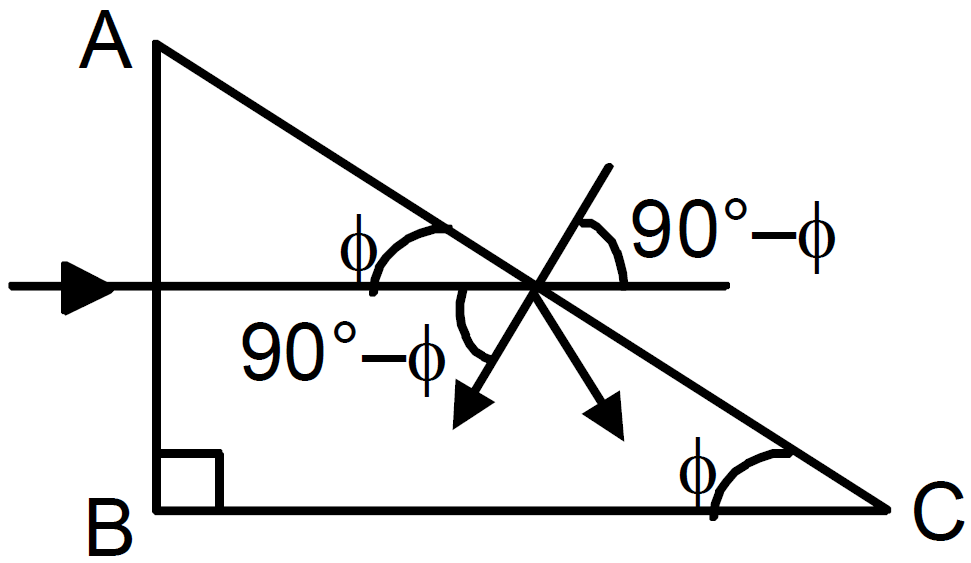
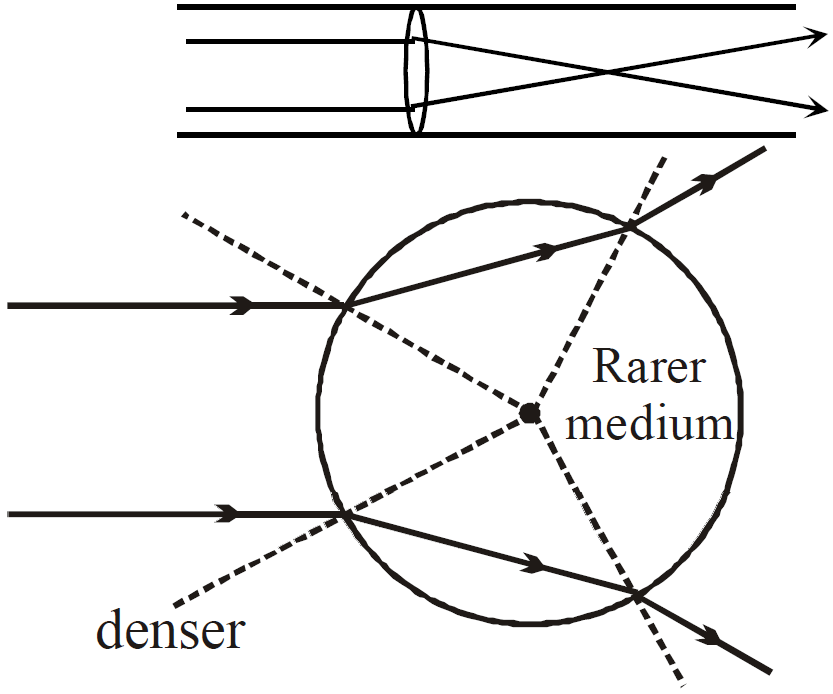
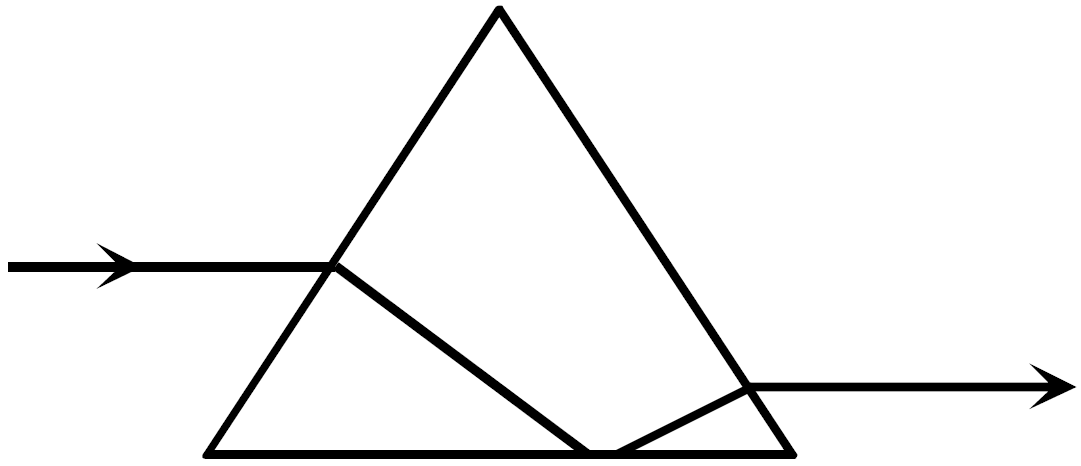
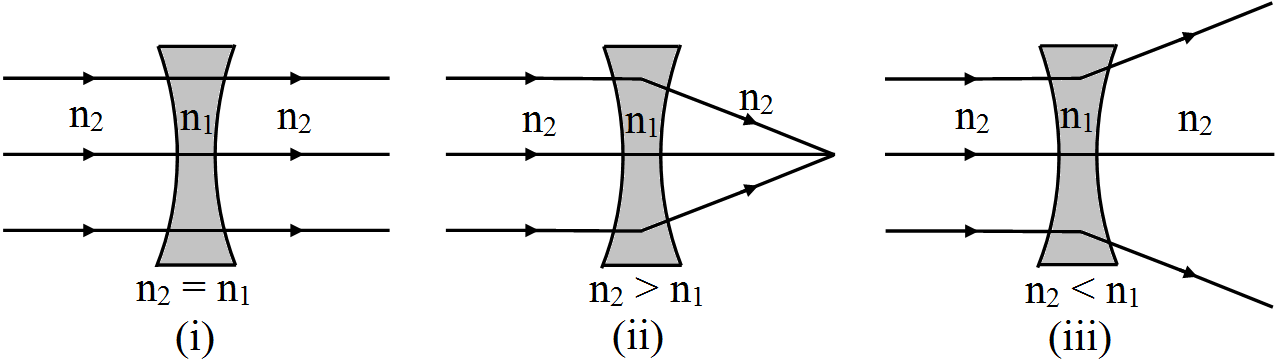
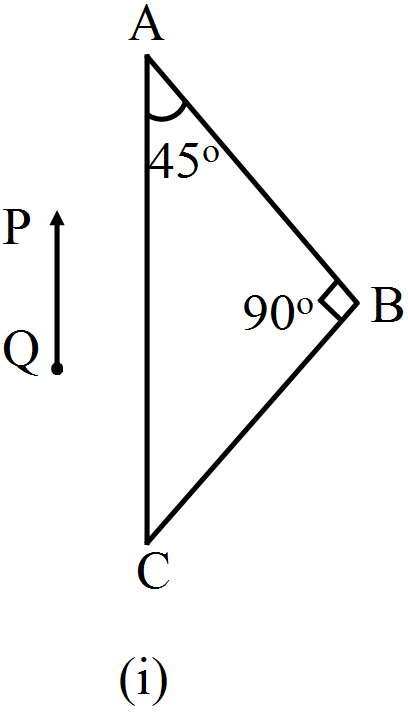
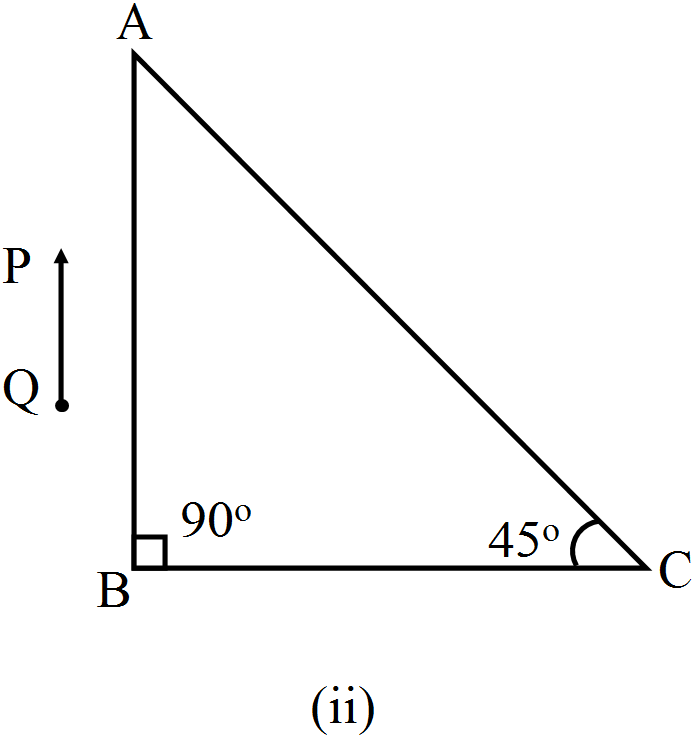
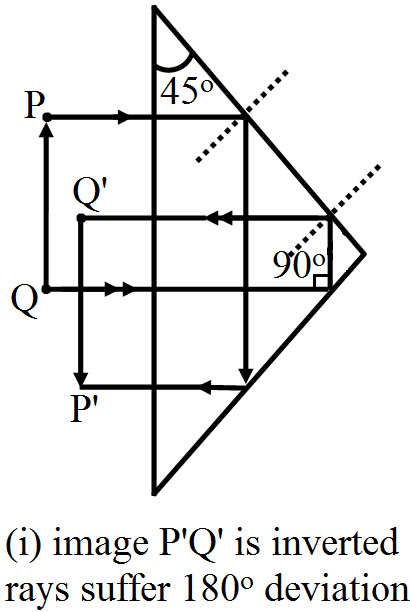
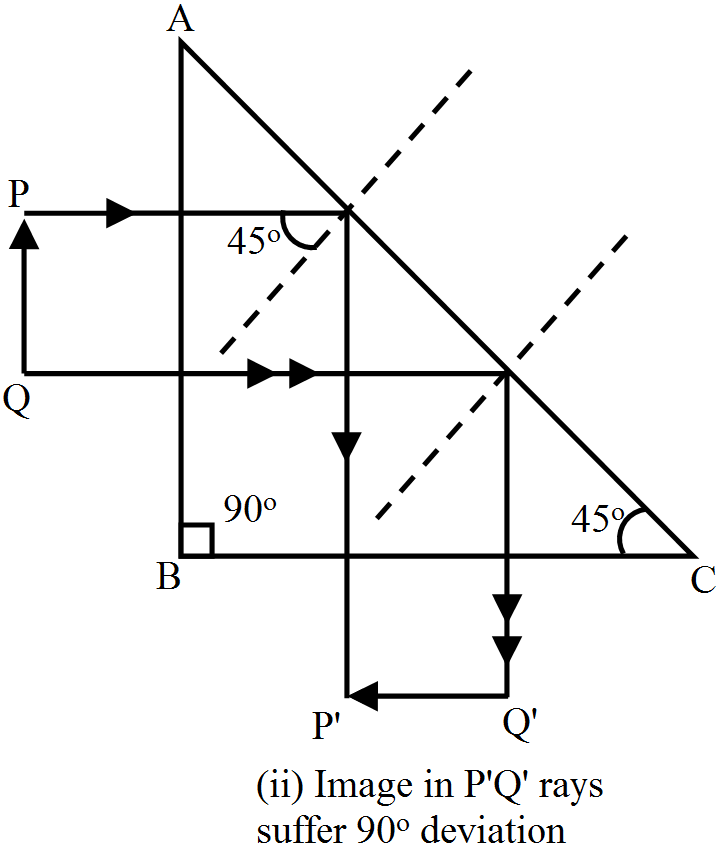
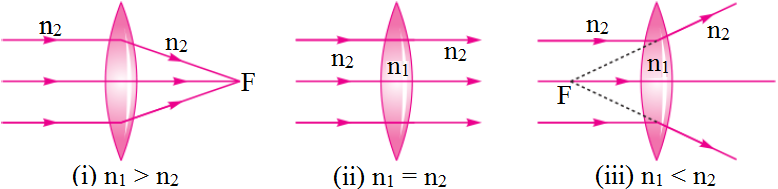
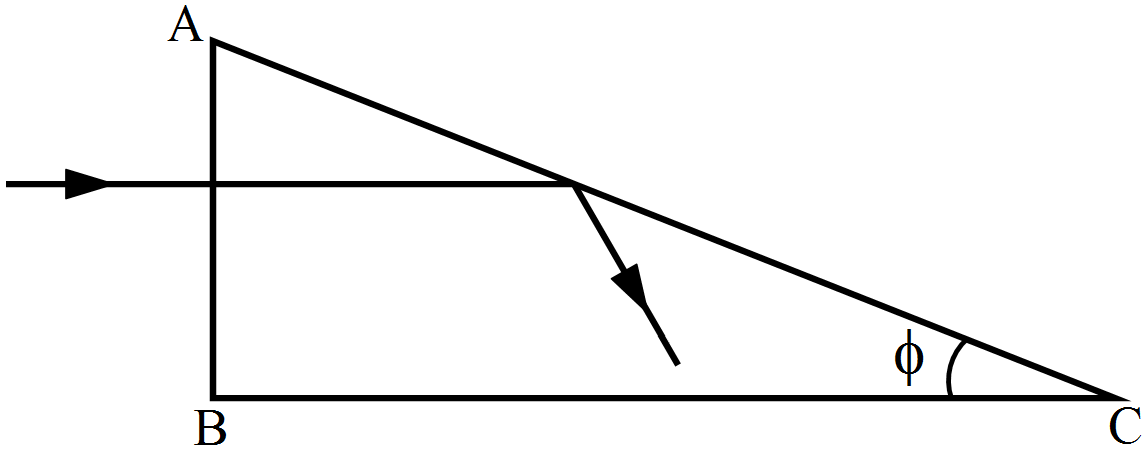
The path of rays in all the three cases is shown in fig.

Because, the eye is relaxed the image is formed at infinity (normal adjustment)
So, $\text{m}=5=\frac{\text{D}}{\text{f}}=\frac{25}{\text{f}}\Rightarrow\text{f}=5\text{cm}$
For the relaxed farsighted eye, $\text{D} = 40\text{cm}$
So, $\text{m}=\frac{\text{D}}{\text{f}}=\frac{40}{5}=8$
So, its magnifying power is 8X.
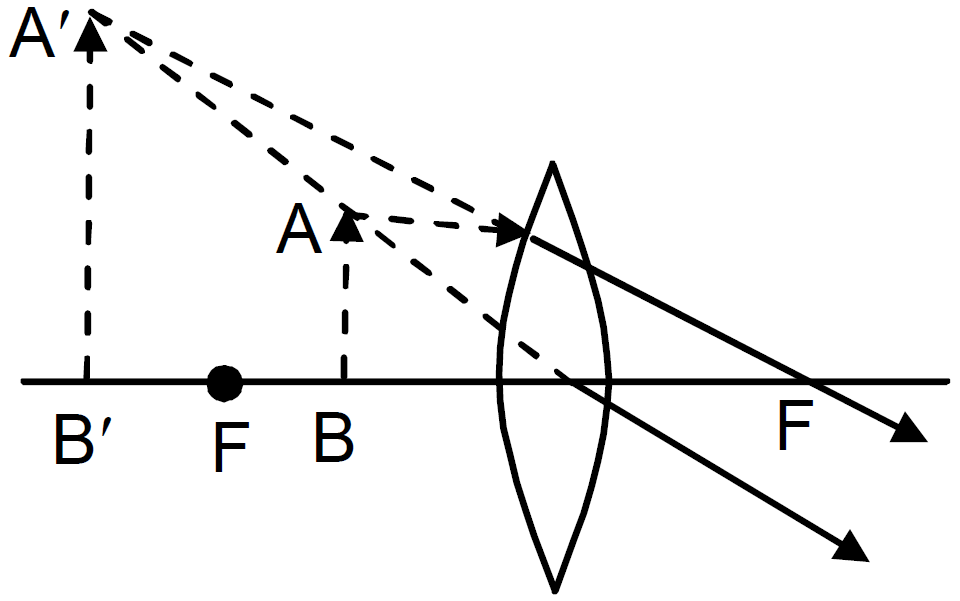
So, $\Rightarrow\frac{1}{\text{v}}-\frac{1}{\text{u}}=\frac{1}{\text{f}}$
$\Rightarrow\frac{1}{8}-\frac{1}{5}=\frac{-3}{40}$
$\Rightarrow\text{v}=-13.3\text{cm}$ (virtual image).
f0 = 30cm, L = 27cm
Since L = f0 - |fe|
[Since, concave eyepiece lens is used in Galilean Telescope]
⇒ fe = f0 - L = 30 - 27 = 3cm
Given that, $\mu_\text{v}-\mu_\text{r}=0.014$
$\text{Again,}\ \mu_\text{y}=\frac{\text{Real depth}}{\text{Apparent depth}}=\frac{2.00}{1.30}=1.515$
So, dispersive power $=\frac{\mu_\text{v}-\mu_\text{r}}{\mu_\text{y}-1}=\frac{0.014}{1.515-1}=0.027$
So, the person must be near sighted
$\text{u}=\infty,$
$\text{v}=\text{far point,}$ $\text{f}=\frac{1}{-2.5}=-0.4\text{m}=-40\text{cm}$Now,
$\frac{1}{\text{v}}-\frac{1}{\text{v}}=\frac{1}{\text{f}}$$\Rightarrow\frac{1}{\text{v}}=\frac{1}{\text{u}}+\frac{1}{\text{f}}=0+\frac{1}{-40}$
$\Rightarrow \text{v}=-40\text{cm}$
So, the far point of the person is 40cm.