Question
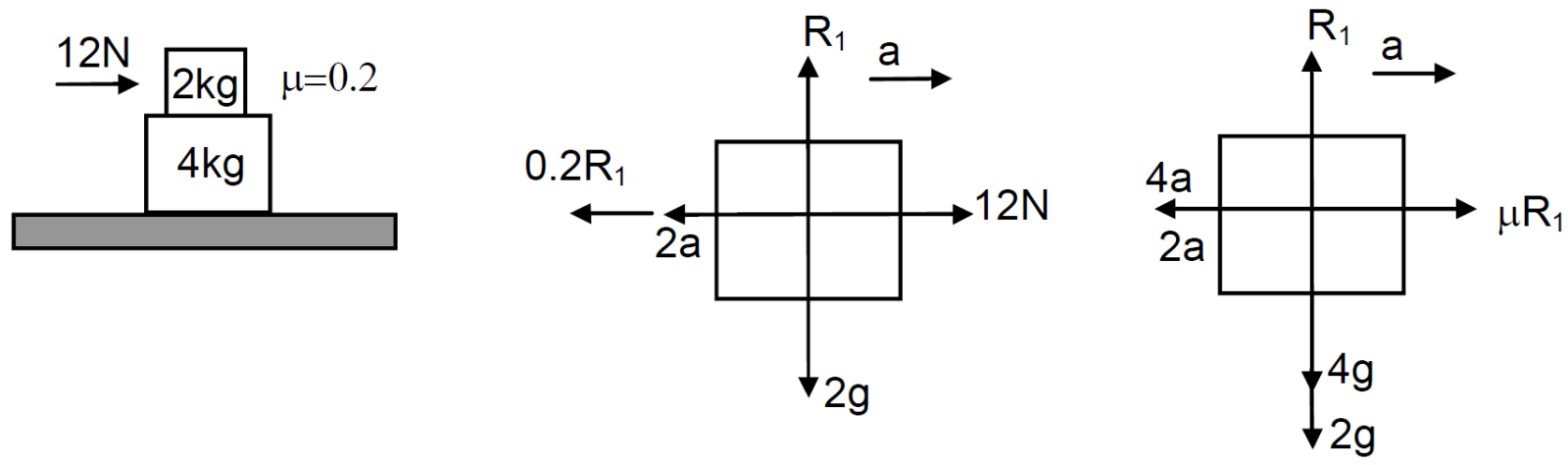
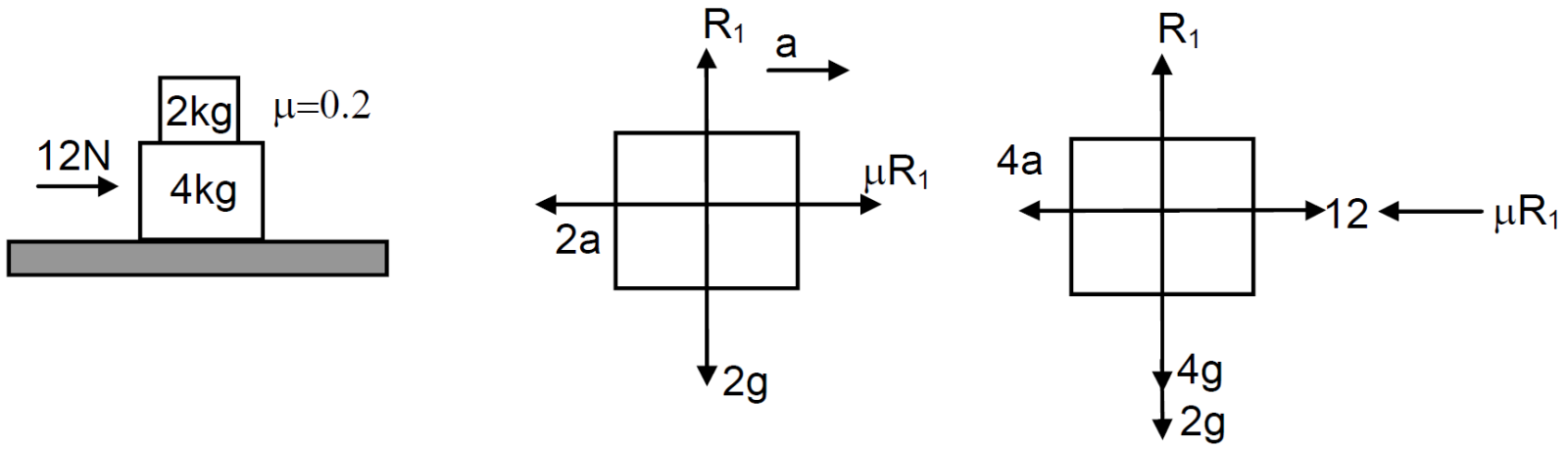
A 2kg block is placed over a 4kg block and both are placed on a smooth horizontal surface. The coefficient of friction between the blocks is 0.20. Find the acceleration of the two blocks if a horizontal force of 12N is applied to:
  1. The upper block.
  2. The lower block. Take $g = 10m/s^2.$
Answer

  1.  

$R_1 - 2g = 0$
$\Rightarrow R_1 = 2 \times 10 = 20$
$2a + 0.2 R_1 - 12 = 0$
$\Rightarrow 2a + 0.2(20) = 12$
$\Rightarrow 2a = 12 - 4 = 8$
$\Rightarrow a = 4m/s^2$
$4\text{a}_1-\mu\text{R}_1=0$
$\Rightarrow4\text{a}_1=\mu\text{R}_1=0.2(20)$
$\Rightarrow 4a_1 = 4$
$\Rightarrow a_1 = 1m/s^2$
$2kg$ block has acceleration $4m/s^2$ & that of 4kg is $1m/s^2$
  1.  

$R_1 = 2g = 20$
$\text{Ma}-\mu\text{R}_1=0$
$\Rightarrow 2a = 0.2(20) = 4$
$\Rightarrow a = 2m/s^2$
$4a + 0.2 \times 2 \times 10 - 12 = 0$
$\Rightarrow 4a + 4 = 12$
$\Rightarrow 4a = 8$
$\Rightarrow a = 2m/s^2$​​​​​​​

Need a full question paper?

Generate a complete, print-ready paper with questions like this in minutes — across 16+ boards, with answer keys.

Start Generating Free

Similar questions

Answer the following questions:
  1. Define electric flux. Write its SI unit.
  2. Using Gauss’s law, prove that the electric field at a point due to a uniformly charged infinite plane sheet is independent of the distance from it.
  3. How is the field directed if:
  • The sheet is positively charged.
  • Negatively charged?
Derive Einstein’s photoelectric equation $\frac{1}{2}\text{m}\text{v}^2=\text{h}\nu-\text{h}\nu_0.$
The $\text{K}_\beta$ X-rays from certain elements are given below. Draw a Moseley-type plot of $\sqrt{\text{v}}$ versus Z for $\text{K}_\beta$ radiation.
Element
Ne
P
Ca
Mn
Zn
Br
Energy (keV)
0.858
2.14
4.02
6.51
9.57
13.3
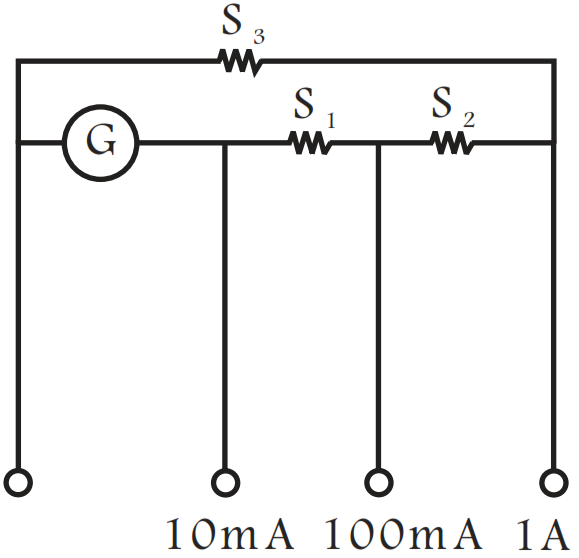
A multirange current meter can be constructed by using a galvanometer circuit as shown in Fig. We want a current meter that can measure 10mA, 100mA and 1A using a galvanometer of resistance 10Ω and that prduces maximum deflection for current of 1mA. Find $S_1, S_2$ and $S_3$ that have to be used.
A body of mass m makes an elastic collision with another identical body at rest. Show that if the collision is not head-on, the bodies go at right angle to each other after the collision.
A charge Q is placed at the centre of an uncharged, hollow metallic sphere of radius a:
  1. Find the surface charge density on the inner surface and on the outer surface.
  2. If a charge q is put on the sphere, what would be the surface charge densities on the inner and the outer surfaces?
  3. Find the electric field inside the sphere at a distance x from the centre in the situations (a) and (b).
The plates of a parallel plate capacitor have an area of $90cm^2$ each and are separated by 2.5mm. The capacitor is charged by connecting it to a 400V supply.
  1. How much electrostatic energy is stored by the capacitor?
  2. View this energy as stored in the electrostatic field between the plates, and obtain the energy per unit volume u. Hence arrive at a relation between u and the magnitude of electric field E between the plates.
State the principle of working of p-n diode as a rectifier. Explain, with the help of a circuit diagram, the use of p-n diode as a full wave rectifier. Draw a sketch of the input and output waveforms.
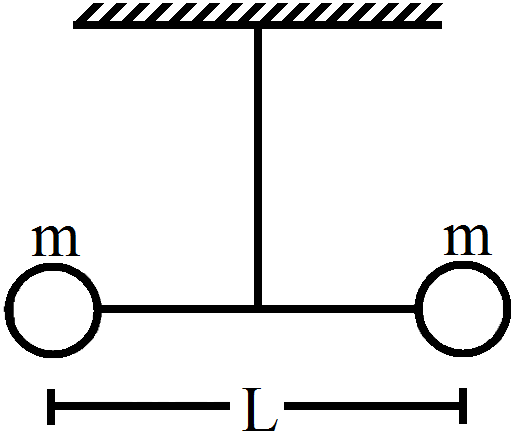
Two small balls, each of mass m are connected by a light rigid rod of length L. The system is suspended from its centre by a thin wire of torsional constant k. The rod is rotated about the wire through an angle $\theta_0$ and released. Find the tension in the rod' as the system passes through the mean position.
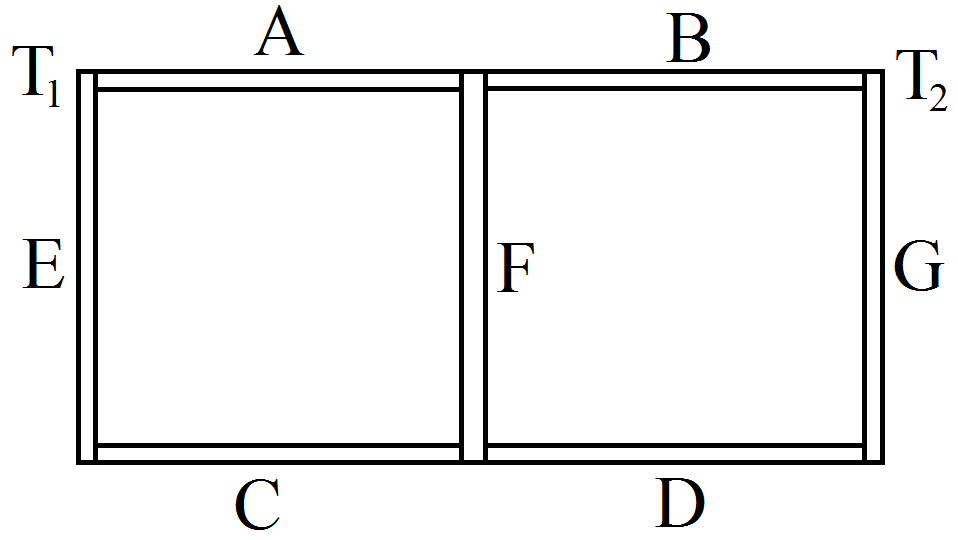
Seven rods A, B, C, D, E, F and G are joined as shown in figure. All the rods have equal cross-sectional area A and length l. The thermal conductivities of the rods are $K_A = K_c = K_0, K_B = K_D = 2K_0, K_E= 3K_{0,} K_F = 4K_0,$ and $K_G = 5K_0.$ The rod E is kept at a constant temperature $T_2$ and the rod G is kept at a constant temperature $T_2(T_2 > T_1).$
  1. Show that the rod F has a uniform temperature $\text{T}=\frac{(\text{T}_1+2\text{T}_2)}{3}.$
  2. Find the rate of heat flowing from the source which maintains the temperature $T_2.$