A particle executes simple harmonic motion. Its amplitude is $8 \,cm$ and time period is $6 \,s$. The time it will take to travel from its position of maximum displacement to the point corresponding to half of its amplitude, is ............. $s$
JEE MAIN 2022, Medium


Download our appand get started for free
Experience the future of education. Simply download our apps or reach out to us for more information. Let's shape the future of learning together!No signup needed.*
Similar Questions
- 1A mass $m =100\, gms$ is attached at the end of a light spring which oscillates on a frictionless horizontal table with an amplitude equal to $0.16$ metre and time period equal to $2 \,sec$. Initially the mass is released from rest at $t = 0$ and displacement $x = - 0.16$ metre. The expression for the displacement of the mass at any time $t$ isView Solution
- 2$y = 2\, (cm)\, sin\,\left[ {\frac{{\pi t}}{2} + \phi } \right]$ what is the maximum acceleration of the particle doing the $S.H.M.$View Solution
- 3The total energy of the body executing $S.H.M.$ is $E$. Then the kinetic energy when the displacement is half of the amplitude, isView Solution
- 4A particle is executing simple harmonic motion with a period of $T$ seconds and amplitude a metre. The shortest time it takes to reach a point $\frac{a}{{\sqrt 2 }}\,m$ from its mean position in seconds isView Solution
- 5The amplitude of a particle executing $SHM$ is made three-fourth keeping its time period constant. Its total energy will beView Solution
- 6A spring whose unstretched length is $\ell $ has a force constant $k$. The spring is cut into two pieces of unstretched lengths $\ell_1$ and $\ell_2$ where, $\ell_1 = n\ell_2$ and $n$ is an integer. The ratio $k_1/k_2$ of the corresponding force constants, $k_1$ and $k_2$ will beView Solution
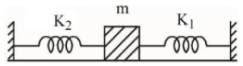
- 7A mass $m$ is attached to two springs as shown in figure. The spring constants of two springs are $K _1$ and $K _2$. For the frictionless surface, the time period of oscillation of mass $m$ isView Solution
- 8What is the period of small oscillations of the block of mass $m$ if the springs are ideal and pulleys are massless ?View Solution

- 9The equation of motion of a particle of mass $1\,g$ is $\frac{{{d^2}x}}{{d{t^2}}} + {\pi ^2}x = 0$ where $x$ is displacement (in $m$ ) from mean position. The frequency of oscillation is .... $s$ (in $Hz$ )View Solution
- 10A ring of diameter $2m$ oscillates as a compound pendulum about a horizontal axis passing through a point at its rim. It oscillates such that its centre move in a plane which is perpendicular to the plane of the ring. The equivalent length of the simple pendulum is .... $m$View Solution