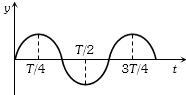
A particle executing $S.H.M.$ of amplitude 4 cm and $T = 4 \,sec.$ The time taken by it to move from positive extreme position to half the amplitude is ..... $\sec$
Medium
Download our app for free and get started
(c) Equation of motion $y = a\cos \omega t$
$\frac{a}{2} = a\cos \omega t$
$\Rightarrow \cos \omega t = \frac{1}{2}$
$\Rightarrow \omega t = \frac{\pi }{3}$
$ \Rightarrow \frac{{2\pi t}}{T} = \frac{\pi }{3}$
$\Rightarrow t = \frac{{\frac{\pi }{3} \times T}}{{2\pi }} = \frac{4}{{3 \times 2}} = \frac{2}{3}\sec $

Download our appand get started for free
Experience the future of education. Simply download our apps or reach out to us for more information. Let's shape the future of learning together!No signup needed.*
Similar Questions
- 1View SolutionTime period of pendulum, on a satellite orbiting the earth, is
- 2A pendulum bob has a speed of $3\, m/s$ at its lowest position. The pendulum is $0.5\, m$ long. The speed of the bob, when the length makes an angle of ${60^o}$ to the vertical, will be ..... $m/s$ (If $g = 10\,m/{s^2}$)View Solution
- 3The displacements of two particles executing $S.H.M.$ on the same line are given. as $y_1=a \sin \left(\frac{\pi}{2} t+\phi\right)$ and $y_2=b \sin \left(\frac{2 \pi}{3} t+\phi\right)$. The phase difference between them at $t=1 \,s$ is .........View Solution
- 4The displacement of a damped harmonic oscillator is given by $x\left( t \right) = {e^{ - 0.1\,t}}\,\cos \left( {10\pi t + \varphi } \right)$ The time taken for its amplitude of vibration to drop to half of its initial value is close to .... $s$View Solution
- 5If a simple pendulum is taken to place where g decreases by $2\%$, then the time periodView Solution
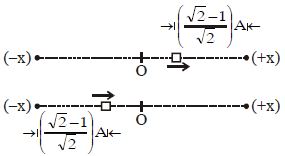
- 6Two bodies performing $SHM$ have same amplitude and frequency. Their phases at a certain instant are as shown in the figure. The phase difference between them isView Solution
- 7A body is executing simple harmonic motion with an angular frequency $2\,rad/s$. The velocity of the body at $20\, mm$ displacement, when the amplitude of motion is $60\, mm$, is ...... $mm/s$View Solution
- 8The variation of displacement with time of a particle executing free simple harmonic motion is shown in the figure. The potential energy ${U}({x})$ versus time $({t})$ plot of the particle is correctly shown in figure:View Solution
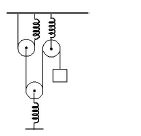
- 9Assuming all pulleys, springs and string massless. Consider all surface smooth. Choose the correct statement $(s)$View Solution
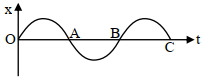
- 10View SolutionThe graph shows the variation of displacement of a particle executing S.H.M. with time. We infer from this graph that