A particle of mass $200 \,gm$ executes $S.H.M.$ The restoring force is provided by a spring of force constant $80 \,N / m$. The time period of oscillations is .... $\sec$
Easy


Download our appand get started for free
Experience the future of education. Simply download our apps or reach out to us for more information. Let's shape the future of learning together!No signup needed.*
Similar Questions
- 1The displacement of a particle from its mean position (in metre) is given by $y = 0.2\sin (10\pi t + 1.5\pi )\cos (10\pi t + 1.5\pi )$. The motion of particle isView Solution
- 2A particle of mass $10$ grams is executing simple harmonic motion with an amplitude of $0.5\, m$ and periodic time of $(\pi /5)$ seconds. The maximum value of the force acting on the particle is ... $N$View Solution
- 3The time period of a particle executing $S.H.M.$ is $8 \,s$. At $t=0$ it is at the mean position. The ratio of distance covered by the particle in $1^{\text {st }}$ second to the $2^{\text {nd }}$ second is .............. $s$View Solution
- 4A loaded vertical spring executes $S.H.M.$ with a time period of $4\; sec$. The difference between the kinetic energy and potential energy of this system varies with a period of ........$sec$View Solution
- 5An ideal spring with spring-constant $K$ is hung from the ceiling and a block of mass $M$ is attached to its lower end. The mass is released with the spring initially unstretched. Then the maximum extension in the spring isView Solution
- 6A particle of mass m is attached to a spring (of spring constant k) and has a natural angular frequency ${\omega _0}$ - An external force $F (t)$ proportional to $\cos \omega \,t((\omega \ne {\omega _0})$ is applied to the oscillator. The time displacement of the oscillator will be proportional toView Solution
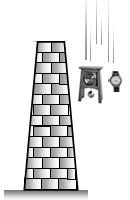
- 7A man having a wrist watch and a pendulum clock rises on a $TV$ tower. The wrist watch and pendulum clock per chance fall from the top of the tower. ThenView Solution
- 8View SolutionA simple pendulum is vibrating in an evacuated chamber, it will oscillate with
- 9Two particles are executing $SHM$ in a straight line. Amplitude $'A'$ and time period $'T'$ of both the particles are equal. At time $t = 0$ one particle is at displacement $x_1 = +A$ and other at ${x_2} = \frac{{ - A}}{2}$ and they are approaching towards each other. Time after which they will cross each other isView Solution
- 10The energy of a particle executing simple harmonic motion is given by $E = Ax^2 + Bv^2$, where $x$ is the displacement from mean position $x = 0$ and $v$ is the velocity of the particle at $x$ then choose the incorrect statementView Solution