Question
A plane electromagnetic wave is passing through a region. Consider (a) electric field (b) magnetic field (c) electrical energy in a small volume and (d) magnetic energy in a small volume. Construct the pairs of the quantities that oscillate with equal frequencies.
Answer

Let the electromagnetic wave be propagating in the z-direction. The vibrations of the electric and magnetic fields are given by,

$\text{E}_\text{x}=\text{E}_0\sin(\text{kz}-\omega\text{t})$

$\text{B}_\text{y}=\text{B}_0\sin(\text{kz}-\omega\text{t})$

Let the volume of the region be V.

The angular frequency of the vibrations of the electric and magnetic fields are same and are equal to $\omega$

Therefore, their frequency, $\text{f}=\frac{\omega}{2\pi},$ is same.

The electrical energy in the region,

$\text{U}_\text{E}=\Big(\frac{1}{2}\in_0\text{E}^2\Big)\times\text{V}$

It can be written as,

$\text{U}_\text{E}=\Big(\frac{1}{2}\in_0\big(\text{E}^2_0\sin^2(\text{kz}-\omega\text{t})\big)\Big)\times\text{V}$

$\text{U}_\text{E}=\Bigg(\frac{1}{2}\in_0\text{E}_0^2\times\frac{\big(1-\cos2(\text{kz}-\omega\text{t})\big)}{2}\Bigg)\times\text{V}$

$\text{U}_\text{E}=\Big(\frac{1}{4}\in_0\text{E}_0^2\times(1-\cos2(\text{kz}-\omega\text{t}))\Big)\times\text{V}$

The magnetic energy in the region,

$\text{U}_\text{B}=\Big(\frac{\text{B}^2}{2\mu_0}\Big)\times\text{V}$

$\text{U}_\text{B}=\bigg(\frac{\text{B}^2_0\sin^2(\text{kz}-\omega\text{t})}{2\mu_0}\bigg)\times\text{V}$

$\text{U}_\text{B}=\Bigg(\frac{\text{B}^2_0\big(1-\cos(2\text{kz}-2\omega\text{t})\big)}{4\mu_0}\Bigg)\times\text{V}$

The angular frequency of the electric and magnetic is same and is equal to $2\omega$

Therefore, their frequency,

$\text{f}'=\frac{2\omega}{2\pi}=2\text{f}$

Will be same.

Thus, the electric and magnetic fields have same frequencies and the electrical and magnetic energies will have same frequencies.

Need a full question paper?

Generate a complete, print-ready paper with questions like this in minutes — across 16+ boards, with answer keys.

Start Generating Free

Similar questions

Derive a relation for work done in a gravitational field. Using it, (i) find potential difference between a pair of points. (ii) express whether gravitational force is conservative or non-conservative.
A constant current exists in an inductor-coil connected to a battery. The coil is short-circuited and the battery is removed. Show that the charge flown through the coil after the short-circuiting is the same as that which flows in one time constant before the short-circuiting.
Explain the difference between static friction, kinetic friction and rolling friction.
Gives the x-t plot of a particle executing one-dimensional simple harmonic motion. (You will learn about this motion in more detail in Chapter 14). Give the signs of position, velocity and acceleration variables of the particle at t = 0.3 s, 1.2 s, – 1.2 s.

A block of weight 100N is slowly slid up on a smooth incline of inclination 37° by a person. Calculate the work done by the person in moving the block through a distance of 2.0m, if the driving force is:
  1. Parallel to the incline.
  2. In the horizontal direction.
A rocket accelerates straight up by ejecting gas downwards. In a small time interval $\Delta\text{t},$ it ejects a gas of mass $\Delta\text{m}$ at a relative speed u. Calculate KE of the entire system at $\text{t}+\Delta\text{t}$ and t and show that the device that gas does work $=\Big(\frac{1}{2}\Big)\Delta\text{mu}^2$ in this time interval (neglect gravity).
Two ideal gas thermometers A and B use oxygen and hydrogen respectively. The following observations are made:
Temperature
Pressure thermometer A
Pressure thermometer B
Triple-point of water
1.250 × 10⁵Pa
0.200 × 10⁵Pa
Normal melting point of sulphur
1.797 × 10⁵Pa
0.287 × 10⁵Pa

What is the absolute temperature of normal melting point of sulphur as read by thermometers A and B?

What do you think is the reason behind the slight difference in answers of thermometers A and B? (The thermometers are not faulty). What further procedure is needed in the experiment to reduce the discrepancy between the two readings?

A boy's catapult is made of a rubber cord 42cm long and 6mm in diameter. The boy stretches the cord by 20cm. Find the Young's modulus of the rubber if a stone weighing 0.02kg when catapulted flies with a velocity of 20ms-1. Disregard the change in the cross-section of the cord in stretching.
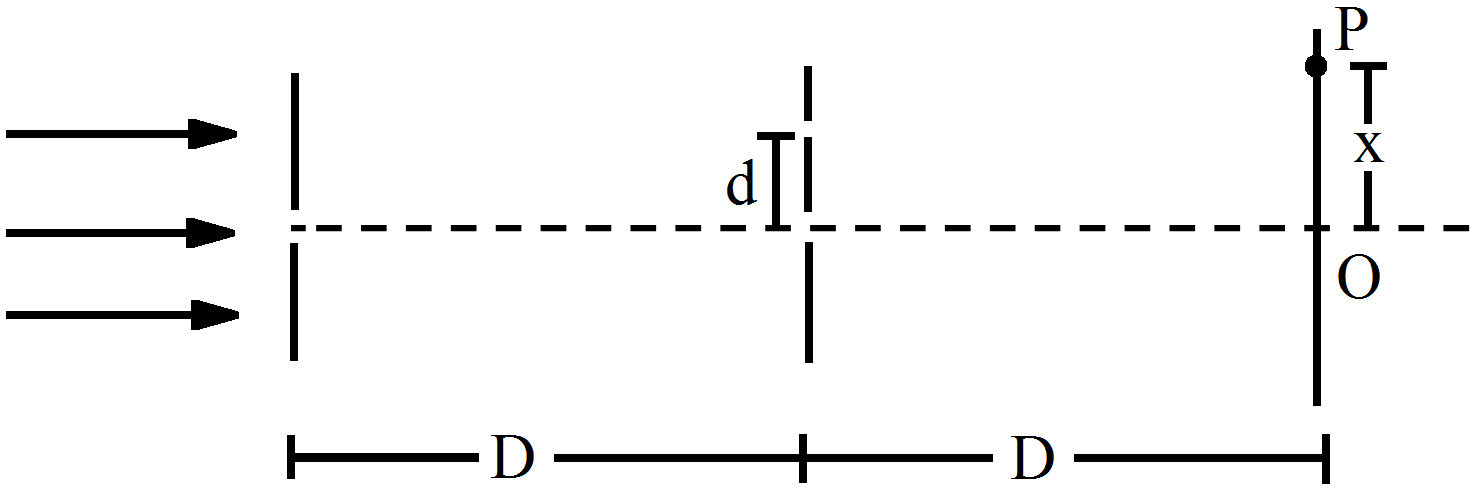
Consider the arrangement shown in figure (17-E4). The distance D is large compared to the separation d between the slits.
  1. Find the minimum value of d so that there is a dark fringe at 0.
  2. Suppose d has this value. Find the distance x at which the next bright fringe is formed.
  3. Find the fringe-width.

Find the currents through the resistances in the circuits shown in figure.