MCQ
A ring of mass $M$ and radius $R$ is rotating about its axis with angular velocity $\omega $. Two identical bodies each of mass $m$ are now gently attached at the two ends of a diameter of the ring. Because of this, the kinetic energy loss will be
  • A
    $\frac{{m\left( {M + 2m} \right)}}{M}\,{\omega ^2}{R^2}$
  • B
    $\frac{{Mm}}{{\left( {M + m} \right)}}\,{\omega ^2}{R^2}$
  • $\frac{{Mm}}{{\left( {M + 2m} \right)}}\,{\omega ^2}{R^2}$
  • D
    $\frac{{\left( {M + m} \right)M}}{{\left( {M + 2m} \right)}}\,{\omega ^2}{R^2}$

Answer

Correct option: C.
$\frac{{Mm}}{{\left( {M + 2m} \right)}}\,{\omega ^2}{R^2}$
c
$\begin{array}{l}
Kinetic\,energ{y_{\left( {rotational} \right)}}{K_R} = \frac{1}{2}I{\omega ^2}\\
kinetic\,energ{y_{(translational)}}{K_r} = \frac{1}{2}M{v^2}\\
\,\,\,\,\,\,\,\,\,\,\,\,\,\,\,\,\,\,\,\,\,\,\,\,\,\,\,\,\,\,\,\,\,\,\,\,\,\,\,\,\,\,\,\,\,\,\,\,\,\,\,\,\,\,\,\,\,\,\,\,\,\,\left( {v = R\omega } \right)\\
M.{\mathop{\rm I}\nolimits} {._{(initial)}}{I_{ring}} = M{R^2};{\omega _{initial}} = \omega \\
M.I{._{\left( {new} \right)}}I{'_{\left( {system} \right)}} = M{R^2} + 2m{R^2}\\
\omega {'_{\left( {system} \right)}} = \frac{{m\omega }}{{M + 2m}}
\end{array}$

Solving we get loss in $K.E.$

$ = \frac{{Mm }}{{\left( {M + 2m} \right)}}{\omega ^2}{R^2}$

Need a full question paper?

Generate a complete, print-ready paper with questions like this in minutes — across 16+ boards, with answer keys.

Start Generating Free

Similar questions

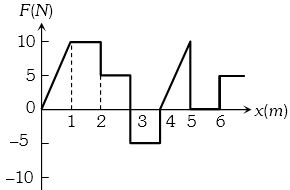
The relationship between the force $F$ and position $x$ of a body is as shown in figure. The work done in displacing the body from $x = 1$ m to $x = 5 $ m will be ........ $J$
Two uniform solid spheres having unequal masses and unequal radii are released from rest from the same height on a rough incline. If the spheres roll without slipping:
  1. The heavier sphere reaches the bottom first.
  2. The bigger sphere reaches the bottom first.
  3. The two spheres reach the bottom together.
  4. The information given is not sufficient to tell which sphere will reach the bottom first.
Measure of two quantities along with the precision of respective measuring instrument  $A = 2.5\,m{s^{ - 1}} \pm 0.5\,m{s^{ - 1}}$, $B = 0.10\,s \pm 0.01\,s$ The value of $AB$ will be
A pendulum clock keeps correct time at $0°C$. Its mean coefficient of linear expansions is $\alpha /^\circ C$, then the loss in seconds per day by the clock if the temperature rises by $t°C$ is
The molar specific heat at constant pressure of an ideal gas is $\big(\frac{ 7}{2}\big) \text{R. }$The ratio of specific heat at constant pressure to that at constant volume is.
A force vector applied on a mass is represented as $\vec F = 6\hat i - 8\hat j + 10\hat k$ and accelerates with $1\;m/{s^2}$. What will be the mass of the body in $kg$.
A cylindrical steel rod of length $0.10 \,m$ and thermal conductivity $50 \,Wm ^{-1} K ^{-1}$ is welded end to end to copper rod of thermal conductivity $400 \,Wm ^{-1} K ^{-1}$ and of the same area of cross-section but $0.20 \,m$ long. The free end of the steel rod is maintained at $100^{\circ} C$ and that of the copper rod at $0^{\circ} C$. Assuming that the rods are perfectly insulated from the surrounding, the temperature at the junction of the two rods is ................... $^{\circ} C$
What is the distance of the centre of mass of a half ring from its centre if its radius is 0.5 m?
Density of ice is $\rho $ and that of water is $\sigma $. What will be the decrease in volume when a mass $M$  of ice melts
The value of escape velocity on a certain planet is $2 \,km/s$. Then the value of orbital speed for a satellite orbiting close to its surface is