Question
Distinguish between: DNA and RNA
| DNA | RNA |
| 1. DNA is deoxyribonucleic acid. | 1. RNA is ribonucleic acid. |
| 2. DNA is double stranded, helical molecule. | 2. RNA is single stranded molecule. |
| 3. In DNA, there is deoxyribose sugar. | 3. In RNA, there is ribose sugar. |
| 4. The pyrimidine nitrogen bases are cytosine and thymine. | 4. The pyrimidine nitrogen bases are cytosine and uracil. |
| 5. DNA is the genetic material in all types of organisms. | 5. RNA is genetic material in few viruses only. |
| 6. In eukaryotic cells, DNA is present in nucleus. | 6. In eukaryotic cells, RNA is present in nucleus as well as cytoplasm. |
| 7. The number of purine : pyrimidine ratio is always 1 : 1 in DNA molecule. | 7. The number of purine : pyrimidine ratio may not be 1 : 1 in RNA molecule. |
| 8. DNA sends the codon for the synthesis of proteins, but otherwise it does not participate in the protein synthesis. | 8. RNA takes part in the protein synthesis through transcription and translation. |
Generate a complete, print-ready paper with questions like this in minutes — across 16+ boards, with answer keys.
| Column I [Organs] | Column II [Functions] |
| (1) Epididymis | (a) Transport of sperms |
| (2) Sertoli cells | (b) Copulatory organ |
| (3) Vas deferens | (c) Nourishment to developing sperms |
| (4) Penis | (d) Maturation of sperms |
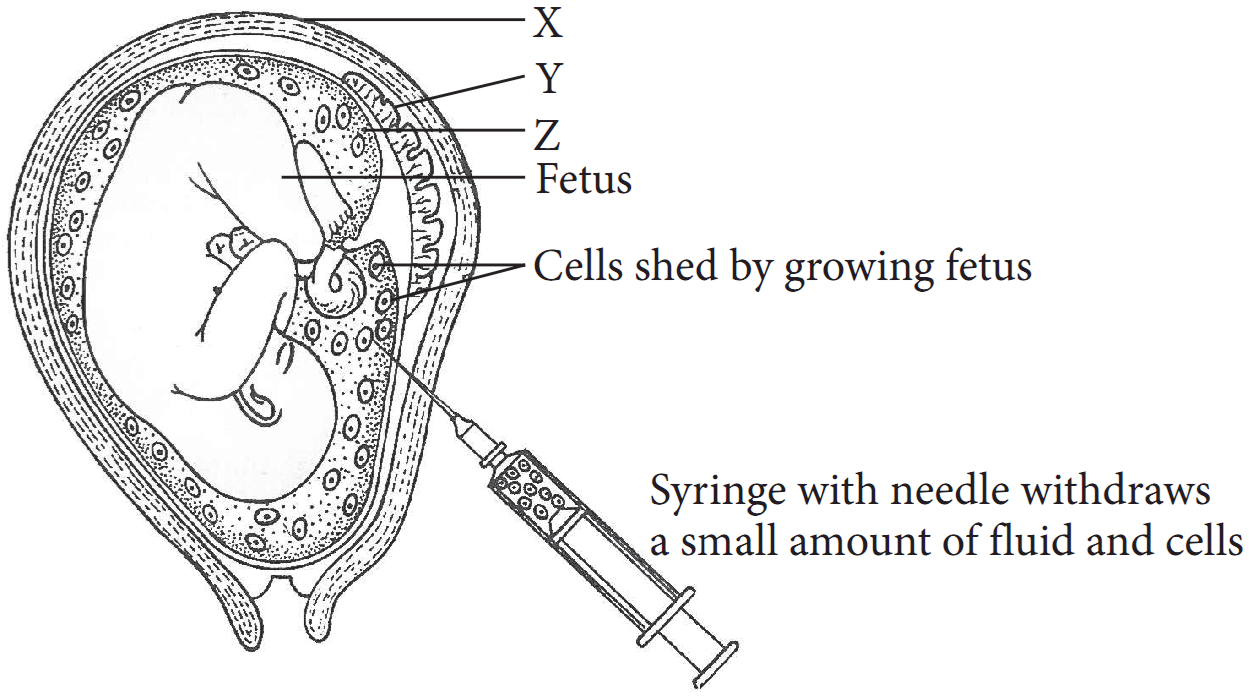
|
S. No
|
X
|
Y
|
|
(a)
|
Amnion
|
Chorion
|
|
(b)
|
Uterine wall
|
Placenta
|
|
(c)
|
Placenta
|
Uterine wall
|
|
(d)
|
Uterine wall
|
Amnion
|
| Column A (Artificial Vegetative Propagation) | Column B (Examples) |
| (1) Leaf cutting | (a) Blackberry |
| (2) Stem cutting | (b) Apple |
| (3) Grafting | (c) Bougainvillea |
| (4) Root cutting | (d) Sansevieria |
| Column A (Scientist) | Column B (Theory) |
| (1) Dixon and Joly | (a) Starch-sugar inter conversion |
| (2) Steward | (b) Osmotic absorption theory |
| (3) Atkins and Pristley | (c) Non-osmotic absorption theory |
| (4) Kramer and Thimann | (d) Cohesion tension theory |


|
S.No
|
Genotypes of parents
|
Genotypes of $1^{St}$ and $3^{rd}$ child in $F_1$
|
|
(a)
|
$Hb^A Hb^S Hb^A Hb^A$
|
$Hb^A Hb^A Hb^A Hb^S$
|
|
(b)
|
$Hb^A Hb^S Hb^A Hb^S$
|
$Hb^A Hb^A Hb^A Hb^A$
|
|
(c)
|
$Hb^A Hb^A Hb^A Hb^S$
|
$Hb^A Hb^A Hb^S Hb^S$
|
|
(d)
|
$Hb^A Hb^S Hb^A Hb^S$
|
$Hb^A Hb^S Hb^S Hb^S$
|