Question
Eurythermal and stenothermal.

Answer

EurythermalStenothermal
1. Animals which can tolerate wide range of temperatures are called eurythermal.1. Animals which can tolerate only narrow range of temperature fluctuations are called stenothermal.
2. Eurythermal animals show reduced temperature sensitivity.2. Stenothermal animals show high temperature sensitivity.
3. Body functions of eurythermal animals can occur at wide range of temperature range. E.g. Goat, man, cat, dog, tiger, cow, sheep, monkey, crab, etc.3. Body functions of stenothermal animals can occur at only narrow range of temperature range. E.g. Insects, fishes, reptiles, snakes, etc.

Need a full question paper?

Generate a complete, print-ready paper with questions like this in minutes — across 16+ boards, with answer keys.

Start Generating Free

Similar questions

​​​​Read the following and answer any four questions from (i) to (v) given below: Edward Wilson described diversity at all levels of biological organisation ranging from macromolecules inside the cells to biomes. It is of three inter-related hierarchial levels-genetic diversity, species diversity and conununity ecosystem diversity. Species diversity is the variety in the number and richness of the species of a region. For example, the Western ghats have a greater amphibian species diversity than the Eastern ghats.
  1. The number of species per unit area is called.
  1. Species evenness.
  2. Species richness.
  3. Species equitability.
  4. Both (a) and (c).
  1. The table below gives the population (in thousands) of ten species (A - J) in four areas (I - IV) consisting of the number of habitats given within brackets against each. Study the table and answer the question which follows:
Area and number of habitats
Species and their population (in thousands) in the area
A
B
C
D
E
F
G
H
I
J
I(11)
23
12
0.52
6.0
-
3.1
1.1
9.0
-
10.3
II(11)
10.2
-
0.62
-
1.5
3.0
-
8.2
1.1
11.2
III(13)
11.3
0.9
0.48
2.4
1.4
4.2
0.8
8.4
2.2
4.1
IV(12)
3.2
10.2
1.1
4.8
0.4
3.3
0.8
7.3
1.3
2.1
Which are out of I to IV shows maximum species diversity?
  1. II
  2. III
  3. IV
  4. I
  1. Study the given populations and choose the correct answer in relation to species diversity.
Population
Species
Species
Individuals
Population A
I
Mammals
3
II
Birds
2
III
Amphibians
2
Population B
I
Mammals
2
II
Mammals
2
III
Amphibians
1
Population C
I
Mammals
3
II
Mammals
2
III
Mammals
4
 
Maximum diversity
Minimum diversity
(a)
Population B
Population C
(b)
Population A
Population C
(c)
Population A
Population B
(d)
Population B
Population A
  1. The concept of species diversity has two components : evenness and richness. Evenness is based on the relative abundance of species. Richness is based on the total number of species present. Diversity indices combine a measure of richness and evenness. The Simpson index (D) is calculated from the following equations:
$\text{D}=\displaystyle\sum_{\text{i}=1}(\text{n}_\text{i}/\text{N})^2$
where, n = total number of organisms of particular species
N = total number of organisms of all species
Below are data collected in two terrestrial plant conununities that represent part of a successional chronosequence. ln this case the values were measured as percent cover.
Early Successional Community
Late Successional Community
Species
Percent Cover
Species
Percent Cover
A
83
F
24
B
5
G
20
C
9
H
18
D
2
I
23
E
1
J
15
The data indicate that, relative to the early successional community, the late successional community has which of the following characteristics?
 
Species Richness
Evenness
(a)
Higher
Higher
(b)
Higher
Lower
(c)
Same
Lower
(d)
Same
Higher
  1. Select the incorrect statement regarding species diversity.
  1. It results in polymorph formation and is useful in adaptation to changes in environmental conditions.
  2. Number of individuals of different species represent species evenness.
  3. It influences biotic interactions and stability of the community.
  4. It is a trait of the community.
Read the following and answer any four questions from (i) to (v) given below:
During teaching about various environmental factors, a teacher draw a figure that depicts like history strategies for three plant species (X, Y and Z) along 3 axes - strength of competition with other organisms, level of disturbance in the habitat and level of environmental stress in the habitat. Species X grows in habitats where competition among species is high but disturbance and stress are low. Species Y grows in habitats with high environmental stress but with low intraspecies competition. Species Z grows in highly disturbed habitats with low environmental stress.
  1. Which of the following is correct regarding plant type X?
  1. It has slow growth rate.
  2. It lives in area with high probability of severe environmental changes.
  3. It has good competitive ability at low population densities near the carrying capacity.
  4. None of these.
  1. Environmental stress occurs through.
  1. Very low temperature.
  2. Drought.
  3. Nutrient deficiency.
  4. All of these.
  1. Select the correct option regarding plant type X, Y and Z.
  1. X type of plants are likely to be trees.
  2. Y type of plants could be desert plants.
  3. Z type of plants could be herbaceous plant.
  4. All of these.
  1. Y type of plants grow under high stress and:
  1. Produce large number of seeds in a short time after rains.
  2. Have rapid growth.
  3. Produce less number of seed in a long time after rain.
  4. Both (a) and (b).
  1. Assertion: Plant growth rate is high in area of high stress and high disturbance.
Reason: High stress and high disturbance promote breeding capacity in plants.
  1. Both assertion and reason are true and reason is the correct explanation of assertion.
  2. Both assertion and reason are true but reason is not the correct explanation of assertion.
  3. Assertion is true but reason is false.
  4. Both assertion and reason are false.
Distinguish between : Primary and secondary succession.
Distinguish between: Homologous organs and Analogous organs.
Read the following and answer any four questions from (i) to (v) given below:
The pollen grains or microspores are the male reproductive bodies of a flower and are contained in the pollen sac or microsporangia. Each pollen grain consists of a single microscopic cell, possessing two coats: the exine and the in tine. The exine of a pollen grain is made of chemically stable material. Because of this, pollen grains are often very well preserved for thousands of years in soil and sediments.
  1. One of the most resistant biological material present in the exine of pollen grain is:
  1. Pectocellulose.
  2. Sporopollenin.
  3. Suberin.
  4. Cellulose.
  1. The exine possesses one or more thin places known as:
  1. Raphe.
  2. Germ pores.
  3. Hilum.
  4. Endothecium.
  1. What is the function of germ pore?
  1. Emergence of radicle.
  2. Absorption of water for seed germination.
  3. Initiation of pollen tube.
  4. All of these.
  1. What is the key advantage to the plant for having such strong pollen grain walls?
  1. It protects the vital genetic material in the pollen grain.
  2. It allows pollen to serve as a valuable fossil record for the study of ancient plants.
  3. It prevents the pollen tube from growing out before the pollen grain reaches the stigma of a compatible species.
  4. It gives weight to the pollen grain, allowing it to cling better to the body surfaces of insect pollinators.
  1. The number of germ pores in dicots and monocots respectively are:
  1. One and three.
  2. Three and two.
  3. Two and three.
  4. Three and one.
Read the following and answer any four questions from (i) to (v) given below:
A typical angiospermic ovule is a small structure attached to the placenta by means of a stalk called funicle. The body of the ovule fuses with funicle in the region called hilum. Each ovule has one or two protective envelopes called integuments. Integuments encircle the nucellus except at the tip where a small opening called the micropyle is formed. Mature ovules are classified on the basis of funiculus. It can be orthotropous, anadromous, hernitropous, campylotropous, etc.
  1. The body of the ovule consists of a mass of parenchymatous cells called:
  1. Integuments.
  2. Nucellus.
  3. Hilum.
  4. Funiculus.
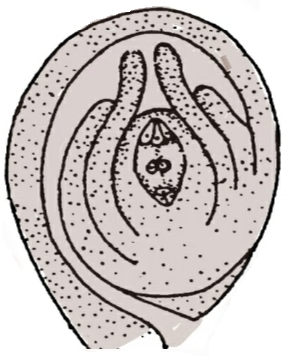
  1. Refer to the given figure and select the correct statement regarding it.
  1. This type of ovule is found in cactus.
  2. The micropyle comes to lie close to the funiculus due to unilateral growth of ovule.
  3. It is most common type of ovule found in the members of Chenopodiaceae.
  4. It is half inverted ovule.
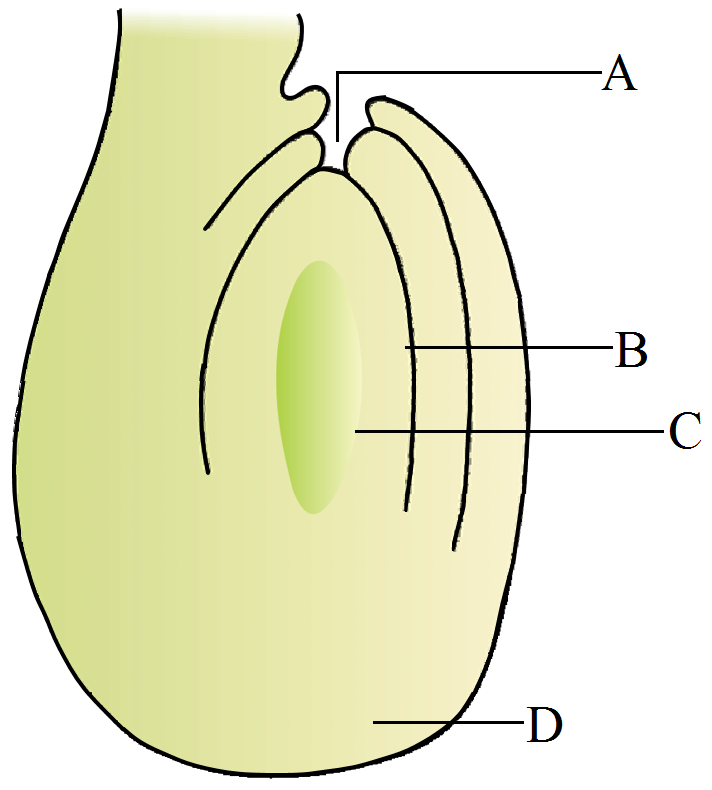
  1. Identify the parts labelled as A, B, C and D in the given figure and select the correct option.
S. No A B C D
(a) Chalaza Female gametophyte Embryo sac Micropyle
(b) Chalaza NuceIIus Embryo sac Micropyle
(c) Micropyle Egg Embryo sac Chalaza
(d) Micropyle Nucellus Embryo sac Chalaza
  1. Mature ovules are classified on the basis of funiculus. If micropyle lie close to the funiculus, the ovule is termed as:
  1. Orthotropous.
  2. Anatropous.
  3. Hemitropous.
  4. Campylotropous.
  1. In Asphodel us, ovule is:
  1. Unitegmic.
  2. Tritegmic.
  3. Bitegmic.
  4. Ategmic.
Column IColumn II
(1) Graafian follicle(a) Site of implantation
(2) Uterus(b) Birth canal
(3) Fallopian tube(c) Site of fertilization
(4) Vagina(d) Release of secondary oocyte
Column AColumn B
(1) Auxin(a) Bolting in rosette plants
(2) Cytokinin(b) Stimulate flowering in SDP
(3) Gibberellins(c) Promotion of growth of lateral buds
(4) Abscissic acid(d) Apical dominance
Distinguish between: Asexual Reproduction – Sexual Reproduction
Distinguish between: Spermatogenesis and Oogenesis.