If resistance of the filament increases with temperature, what will be power dissipated in a $220\, V- 100\, W$ lamp when connected to $110\, V$ power supply
Easy
Download our app for free and get started
If resistance does not vary with temperature $P_{consumed} = $${\left( {\frac{{{V_A}}}{{{V_R}}}} \right)^2} \times {P_R} = {\left( {\frac{{110}}{{220}}} \right)^2} \times 100 = 25\,W$. But in second cases resistance decreases so consumed power will be more than $25\, W$

Download our appand get started for free
Experience the future of education. Simply download our apps or reach out to us for more information. Let's shape the future of learning together!No signup needed.*
Similar Questions
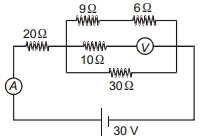
- 1In the circuit shown in figure, if ammeter and voltmeter are ideal, then the power consumed in $9 \,\Omega$ resistor will be .......... $W$View Solution
- 2View SolutionIt is easier to start a car engine on a hot day than on a cold day. This is because the internal resistance of the car battery
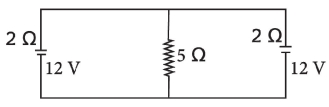
- 3In the arrangement shown in figure, the current through $5\,\Omega$ resistor is ............. $A$View Solution
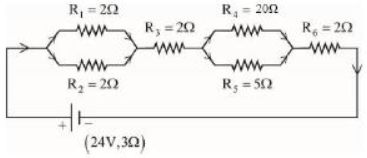
- 4As shown in the figure, a network of resistors is connected to a battery of $2\,V$ with an internal resistance of $3\,\Omega$. The currents through the resistors $R_4$ and $R_5$ are $I_4$ and $I_5$ respectively. The values of $I_4$ and $I_5$ are :View Solution
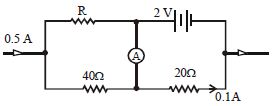
- 5In the circuit shown in the figure, no current flows through the ideal ammeter. If the internal resistance of the cell is negligible, the value of unknown resistance $R $ is .............. $\Omega$View Solution
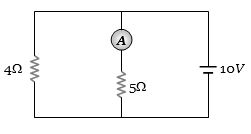
- 6if the internal resistance of the battery is $1\, ohm$, then what is the reading of ammeterView Solution
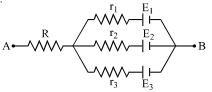
- 7In the network shown the potential difference between $A$ and $B$ is ................. $V$ $(R = r_1 = r_2 = r_3 = 1 \Omega$ ,$ E_1 = 3\, V, E_2 = 2\, V, E_3 = 1\, V)$View Solution
- 8$20\,\mu A$ current flows for $30$ seconds in a wire, transfer of charge will beView Solution
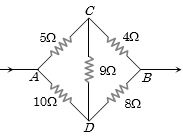
- 9Five resistors are connected as shown in the diagram. The equivalent resistance between $A$ and $B$ is .............. $ohm$View Solution
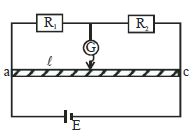
- 10Fig. shows rough sketch of meter bridge. $(G)$ deflects zero at length $l\, cm$. Now $R_1$ and $R_2$ are interchanged then balancing length increases by $25\, cm$. Find $R_1/R_2$View Solution