In a potentiometer experiment, it is found that no current passes through the galvanometer when the terminals of the cell are connected across $52\ cm$ of the potentiometer wire. If the cell is shunted by a resistance of $ 5\,\Omega$, a balance is found when the cell is connected across $40\ cm$ of the wire. Find the internal resistance of the cell ........... $\Omega$
JEE MAIN 2018, Medium


Download our appand get started for free
Experience the future of education. Simply download our apps or reach out to us for more information. Let's shape the future of learning together!No signup needed.*
Similar Questions
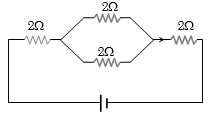
- 1The equivalent resistance of the circuit shown in the figure is ............. $\Omega$View Solution
- 2View SolutionThe example for non-ohmic resistance is
- 3The resistors of resistances $2$ $\Omega$, $4$ $\Omega$ and $8$ $\Omega$ are connected in parallel, then the equivalent resistance of the combination will beView Solution
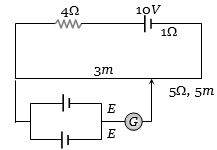
- 4A resistance of $4\,\Omega $ and a wire of length $5\,m$ and resistance $5\,\Omega $ are joined in series and connected to a cell of $e.m.f.$ $10\, V$ and internal resistance $1\,\Omega $. A parallel combination of two identical cells is balanced across $300\, cm$ of the wire. The $e.m.f.$ $E$ of each cell is ........... $V$View Solution
- 5Ratio of thermal energy released in two resistor $R$ and $3 R$ connected in parallel in an electric circuit is :View Solution
- 6View SolutionWhich is a wrong statement
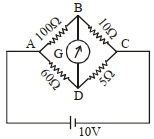
- 7The four arms of a Wheatstone bridge have resistances as shown in the figure. A galvanometer of $15\, \Omega$ resistance is connected across $BD$. Calculate the current through the galvanometer when a potential difference of $10\, V$ is maintained across $AC.$View Solution
- 8View SolutionThe resistance of a discharge tube is
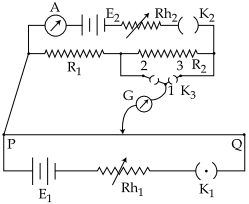
- 9A potentiometer $PQ$ is set up to compare two resistances as shown in the figure. The ameter $A$ in the circuit reads $1.0\, A$ when two way key $K_3$ is open. The balance point is at a length $l_1\, cm$ from $P$ when two way key $K_3$ is plugged in between $2$ and $1$ , while the balance point is at a length $l_2\, cm$ from $P$ when key $K_3$ is plugged in between $3$ and $1$ . The ratio of two resistances $\frac{{{R_1}}}{{{R_2}}}$ is found to beView Solution
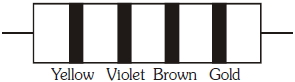
- 10View SolutionThe color code of a resistance is given below
The values of resistance and tolerance, respectively, are :