The displacement of a particle is represented by the equation $y = sin^3\,\,\,\omega t$ . The motion is
Medium


Download our appand get started for free
Experience the future of education. Simply download our apps or reach out to us for more information. Let's shape the future of learning together!No signup needed.*
Similar Questions
- 1A particle of mass $200 \,gm$ executes $S.H.M.$ The restoring force is provided by a spring of force constant $80 \,N / m$. The time period of oscillations is .... $\sec$View Solution
- 2A particle performs $SHM$ about $x = 0$ such that at $t = 0$ it is at $x = 0$ and moving towards positive extreme. The time taken by it to go from $x = 0$ to $x = \frac{A}{2}$ is ..... times the time taken to go from $x = \frac{A}{2}$ to $A$. The most suitable option for the blank space isView Solution
- 3When a mass $m$ is attached to a spring, it normally extends by $0.2\, m$. The mass $m$ is given a slight addition extension and released, then its time period will beView Solution
- 4The displacement $x$ (in metre) of a particle in, simple harmonic motion is related to time t (in seconds) asView Solution
$x = 0.01\cos \left( {\pi \,t + \frac{\pi }{4}} \right)$
The frequency of the motion will be
- 5The amplitude of a wave represented by displacement equationView Solution
$y = \frac{1}{{\sqrt a }}\,\sin \,\omega t \pm \frac{1}{{\sqrt b }}\,\cos \,\omega t$ will be
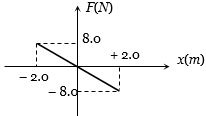
- 6A body of mass $0.01 kg$ executes simple harmonic motion $(S.H.M.)$ about $x = 0$ under the influence of a force shown below : The period of the $S.H.M.$ is .... $s$View Solution
- 7If the maximum velocity and maximum acceleration of a particle executing $SHM$ are equal in magnitude, the time period will be .... $\sec$View Solution
- 8View SolutionIn S.H.M. maximum acceleration is at
- 9Acceleration of a particle, executing $SHM$, at it’s mean position isView Solution
- 10A body oscillates with $S.H.M.$ according to the equation $x=(5.0 \,m ) \cos \left[\left(2 \pi \,rad s ^{-1}\right) t+\pi / 4\right]$ At $t=1.5 \,s$, its acceleration is ....... $m / s ^2$View Solution