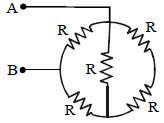
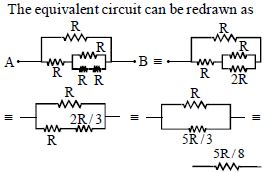
The equivalent resistance between $A$ and $B$ is
Medium


Download our appand get started for free
Experience the future of education. Simply download our apps or reach out to us for more information. Let's shape the future of learning together!No signup needed.*
Similar Questions
- 1The resistance of a wire of uniform diameter $d$ and length $L$ is $R$. The resistance of another wire of the same material but diameter $2d$ and length $4L$ will beView Solution
- 2If the resistivity of a potentiometer wire be $\rho $ and area of cross-section be $A$, then what will be potential gradient along the wireView Solution
- 3Which arrangement of four identical resistances should be used to draw maximum energy from a cell of voltage $V$View Solution
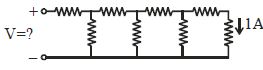
- 4Each element in the finite chain of resistors shown in the figure is $1\,\Omega $. A current of $1\, A$ flows through the final element. Then what is the potential difference $V$ across input terminals of the chain ............... $\mathrm{volt}$View Solution
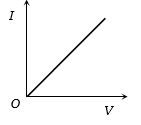
- 5$I-V$ characteristic of a copper wire of length $L$ and area of cross-section $A$ is shown in figure. The slope of the curve becomesView Solution
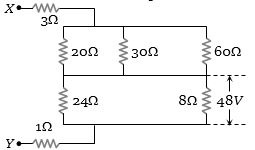
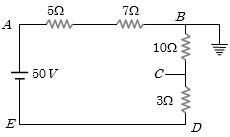
- 6In the circuit shown, the point ‘$B$’ is earthed. The potential at the point ‘$A$’ is ............. $V$View Solution
- 7In India electricity is supplied for domestic use at $220 \,V$. It is supplied at $110 \,V$ in USA. If the resistance of a $60 \,W$ bulb for use in India is $R$, the resistance of a $60 \,W$ bulb for use in USA will beView Solution
- 8There are two electric bulbs of $40\, W$ and $100\, W$. Which one will be brighter when first connected in series and then in parallel,View Solution
- 9For which of the following dependence of drift velocity $v$ on electric field $E$ is ohm's law obeyedView Solution
- 10The potential difference across $8\, ohm$ resistance is $48\, volt$ as shown in the figure. The value of potential difference across $X$ and $Y$ points will be ............. $volt$View Solution