Two electric bulbs rated ${P_1}\,watt$ $V\, volts$ and ${P_2}\, watt$ $V\, volts$ are connected in parallel and $V\, volts$ are applied to it. The total power will be
Medium
Download our app for free and get started
If resistances of bulbs are ${R_1}$ and ${R_2}$ respectively then in parallel
$\frac{1}{{{R_P}}} = \frac{1}{{{R_1}}} + \frac{1}{{{R_2}}}$$ \Rightarrow $ $\frac{1}{{\left( {\frac{{{V^2}}}{{{P_p}}}} \right)}} = \frac{1}{{\left( {\frac{{{V^2}}}{{{P_1}}}} \right)}} + \frac{1}{{\left( {\frac{{{V^2}}}{{{P_2}}}} \right)}}$
$ \Rightarrow $ ${P_P} = {P_1} + {P_2}$

Download our appand get started for free
Experience the future of education. Simply download our apps or reach out to us for more information. Let's shape the future of learning together!No signup needed.*
Similar Questions
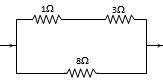
- 1Power dissipated across the $8 \,\,\Omega$ resistor in the circuit shown here is $2\,\, watt.$ The power dissipated in watt units across the $3 \,\,\Omega$ resistor isView Solution
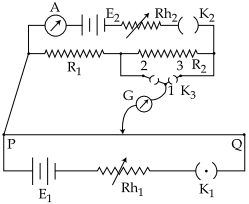
- 2A potentiometer $PQ$ is set up to compare two resistances as shown in the figure. The ameter $A$ in the circuit reads $1.0\, A$ when two way key $K_3$ is open. The balance point is at a length $l_1\, cm$ from $P$ when two way key $K_3$ is plugged in between $2$ and $1$ , while the balance point is at a length $l_2\, cm$ from $P$ when key $K_3$ is plugged in between $3$ and $1$ . The ratio of two resistances $\frac{{{R_1}}}{{{R_2}}}$ is found to beView Solution
- 3Current of $4.8\,A$ is flowing through a conductor. The number of electrons per second will beView Solution
- 4Two resistances of $400$ $\Omega$ and $800$ $\Omega$ are connected in series with $6\, volt$ battery of negligible internal resistance. A voltmeter of resistance $10,000$ $\Omega$ is used to measure the potential difference across $400$ $\Omega$. The error in the measurement of potential difference in volts approximately isView Solution
- 5View SolutionOhm's law fails in
- 6There are $n$ similar conductors each of resistance $R$. The resultant resistance comes out to be $x$ when connected in parallel. If they are connected in series, the resistance comes out to beView Solution
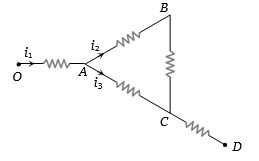
- 7The current in the arm $CD$ of the circuit will beView Solution
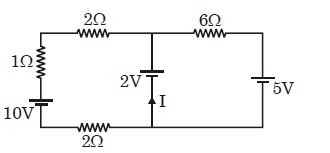
- 8Find the value of $I$ ?................ $\mathrm{A}$View Solution
- 9There are $0.8 \times 10^{23}$ free electrons $/ cm^3$ in copper. If $0.2\, A $ current is flowing is copper wire, then the drift velocity of electrons will be, if the cross sectional area of wire is $0.01 \,cm^2$View Solution
- 10The total current supplied to the circuit by the battery is ............. $A$View Solution