- A$4λ$
- B$2λ$
- ✓$\frac{1}{{2\lambda }}$
- D$\;\frac{1}{{4\lambda }}$
At $t=0,\left(N_{0}\right)_{A}=\left(N_{0}\right)_{B}$
$\frac{N_{A}}{N_{B}}=\left(\frac{1}{e}\right)^{2}$
According to radioactive decay, $\frac{N}{N_{0}}=e^{-\lambda t}$
$\therefore \,\frac{N_{A}}{\left(N_{0}\right)_{A}} =e^{-\lambda_{A} t} $ ..... $(i)$
$\frac{N_{B}}{\left(N_{0}\right)_{B}} =e^{-\lambda_{B} t}$ ..... $(ii)$
Divide $(i)$ by $(ii)$, we get
$\frac{N_{A}}{N_{B}}=e^{-\left(\lambda_{A}-\lambda_{B}\right) t}$ or, $\frac{N_{A}}{N_{B}}=e^{-(5 \lambda-\lambda) t}$
or, $\left(\frac{1}{e}\right)^{2}=e^{-4 \lambda t}$ or, $\left(\frac{1}{e}\right)^{2}=\left(\frac{1}{e}\right)^{4 \lambda t}$
or, $4 \lambda t=2$ $ \Rightarrow \quad t=\frac{2}{4 \lambda}=\frac{1}{2 \lambda}$
Generate a complete, print-ready paper with questions like this in minutes — across 16+ boards, with answer keys.
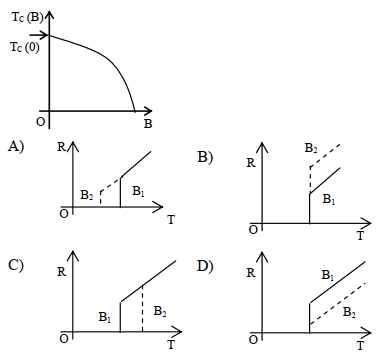
$1.$ In the graphs below, the resistance $\mathrm{R}$ of a superconductor is shown as a function of its temperature $\mathrm{T}$ for two different magnetic fields $\mathrm{B}_1$ (solid line) and $\mathrm{B}_2$ (dashed line). If $\mathrm{B}_2$ is larger than $\mathrm{B}_1$ which of the following graphs shows the correct variation of $\mathrm{R}$ with $\mathrm{T}$ in these fields?
MCQ $Image$
$2.$ A superconductor has $T_C(0)=100 \mathrm{~K}$. When a magnetic field of 7.5 Tesla is applied, its $\mathrm{T}_{\mathrm{c}}$ decreases to $75 \mathrm{~K}$. For this material one can definitely say that when
$(A)$ $\mathrm{B}=5$ Tesla, $\mathrm{T}_{\mathrm{c}}(\mathrm{B})=80 \mathrm{~K}$
$(B)$ $\mathrm{B}=5$ Tesla, $75 \mathrm{~K}<\mathrm{T}_{\mathrm{c}}(\mathrm{B})<100 \mathrm{~K}$
$(C)$ $\mathrm{B}=10 \mathrm{Tesla}, 75 \mathrm{~K}<\mathrm{T}_{\mathrm{c}}<100 \mathrm{~K}$
$(D)$ $\mathrm{B}=10$ Tesla, $\mathrm{T}_{\mathrm{c}}=70 \mathrm{~K}$
Give the answer question $1, 2$