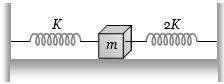
Two springs of force constants $K$ and $2K$ are connected to a mass as shown below. The frequency of oscillation of the mass is
AIIMS 2003, Medium
Download our app for free and get started
(c) $n = \frac{1}{{2\pi }}\sqrt {\frac{{{K_{effective}}}}{m}} = \frac{1}{{2\pi }}\sqrt {\frac{{(K + 2K)}}{m}} $=$\frac{1}{{2\pi }}\sqrt {\frac{{3K}}{m}} $

Download our appand get started for free
Experience the future of education. Simply download our apps or reach out to us for more information. Let's shape the future of learning together!No signup needed.*
Similar Questions
- 1A mass $M$, attached to a horizontal spring, executes S.H.M. with amplitude $A_1$. When the mass $M$ passes through its mean position then a smaller mass $m$ is placed over it and both of them move together with amplitude $A_2$. The ratio of $\frac{{{A_1}}}{{{A_2}}}$ isView Solution
- 2The angular velocity and the amplitude of a simple pendulum is $'\omega '$ and $'A'$ respectively. At a displacement $x$ from the mean position its kinetic energy is $'T'$ and potnetial energy is $'V'$. Then the ratio $\frac{V}{T}$ isView Solution
- 3A body is executing Simple Harmonic Motion. At a displacement $x$ its potential energy is ${E_1}$ and at a displacement y its potential energy is ${E_2}$. The potential energy $E$ at displacement $(x + y)$ isView Solution
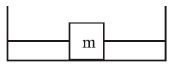
- 4A block of mass $m$ is having two similar rubber ribbons attached to it as shown in the figure. The force constant of each rubber ribbon is $K$ and surface is frictionless. The block is displaced from mean position by $x\,cm$ and released. At the mean position the ribbons are underformed. Vibration period isView Solution
- 5If the mass of the bob in a simple pendulum is increased to thrice its original mass and its length is made half its original length, then the new time period of oscillation is $\frac{x}{2}$ times its original time period. Then the value of $x$ is:View Solution
- 6A particle executes $SHM$ of period $1.2\, sec$ and amplitude $8\, cm.$ Find the time it takes to travel $3\,cm$ from the positive extremity of its oscillation. ..... $\sec$View Solution
- 7The displacement y of a particle executing periodic motion is given by $y = 4{\cos ^2}(t/2)\sin (1000t)$. This expression may be considered to be a result of the superposition of ........... independent harmonic motionsView Solution
- 8The resultant of two rectangular simple harmonic motions of the same frequency and equal amplitudes but differing in phase by $\frac{\pi }{2}$ isView Solution
- 9The time period of a simple pendulum is $2\, sec$. If its length is increased $4$ times, then its period becomes ..... $\sec$View Solution
- 10A particle executes simple harmonic motion along a straight line with an amplitude $A$. The potential energy is maximum when the displacement isView Solution