MCQ
When $EM$ wave propagates through vacuum then
  • A
    $E-$ field leads $B-$ field
  • B
    $E-$ field lags $B-$ field
  • $E-$ field and $B-$ field are in the same phase
  • D
    Energy is stored only in $E-$ field

Answer

Correct option: C.
$E-$ field and $B-$ field are in the same phase
c
In vacuum $E$ and $B$ are in the same in phase $EM$ waves.

Need a full question paper?

Generate a complete, print-ready paper with questions like this in minutes — across 16+ boards, with answer keys.
Start Generating Free

Similar questions

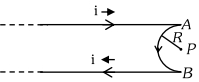
A very long conducting wire is bent in a semicircular shape from $A$ to $B$ as shown in figure. The magnetic field at point $P$ for steady current configuration is given by:
A length $L$ of wire carries a steady current $I$. It is bent first to form a circular plane coil of one turn. The same length is now bent more sharply to give a double loop of smaller radius. The magnetic field at the centre caused by the same current is
A motor car is going due north at a speed of 50km/h. It makes a 90° left turn without changing the speed. The change in the velocity of the car is about:
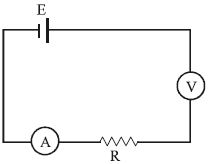
Assertion : All electric devices shown in the circuit are ideal. The reading of each of ammeter $(a)$ and voltmeter $(V)$ is zero.

Reason : An ideal voltmeter draws almost no current due to very large resistance, and hence $(V)$ and $(a)$ will read zero.
Assertion : Through the same current flows through the line wires and the filament of the bulb but heat produced in the filament is much higher then that in line wires.
Reason : The filament of bulbs is made of a material of high resistance and high melting point.
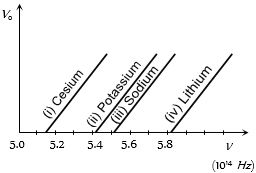
The figure shows different graphs between stopping potential $({V_0})$ and frequency $(v)$ for photosensitive surface of cesium, potassium, sodium and lithium. The plots are parallel. Correct ranking of the targets according to their work function greatest first will be
An iron bar of length $L$ has magnetic moment $M$. It is bent at the middle of its length such that the two arms make an angle $60^{\circ}$ with each other. The magnetic moment of this new magnet is :
Hubble's law is related with
Two charges are at a distance $‘d’$ apart. If a copper plate (conducting medium) of thickness $\frac{d}{2}$ is placed between them, the effective force will be
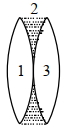
Two identical thin biconvex lenses of focal length $15\, cm$ and refractive index $1.5$ are in contact with each other. The space between the lenses is filled with a liquid of refractive index $1.25$. The focal length of the combination is $cm$.