Which of the following expressions represent simple harmonic motion
Easy
Download our app for free and get started
(d) $x = a\sin \omega \,t\cos \omega \,t = \frac{a}{2}\sin 2\omega \,t$

Download our appand get started for free
Experience the future of education. Simply download our apps or reach out to us for more information. Let's shape the future of learning together!No signup needed.*
Similar Questions
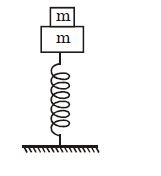
- 1A block of mass $m$ is at rest on an another block of same mass as shown in figure. Lower block is attached to the spring, then the maximum amplitude of motion so that both the block will remain in contact isView Solution
- 2Two particles are in $SHM$ in a straight line. Amplitude $A$ and time period $T$ of both the particles are equal. At time $t=0,$ one particle is at displacement $y_1= +A$ and the other at $y_2= -A/2,$ and they are approaching towards each other. After what time they cross each other ?View Solution
- 3Find maximum amplitude for safe $SHM$ (block does not topple during $SHM$) of $a$ cubical block of side $'a'$ on a smooth horizontal floor as shown in figure (spring is massless)View Solution

- 4A simple pendulum of frequency $f$ has a metal bob. If bob is charged negatively and is allowed to oscillate with large positive charged plate under it, frequency will beView Solution
- 5The amplitude of a damped oscillator becomes one third in $2\, sec$. If its amplitude after $6\, sec$ is $1/n$ times the original amplitude then the value of $n$ isView Solution
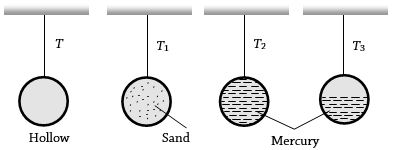
- 6The period of a simple pendulum, whose bob is a hollow metallic sphere, is $T$.The period is $T_1$ when the bob is filled with sand, $T_2$ when it is filled with mercury and $T_3$ when it is half filled with mercury. Which of the following is trueView Solution
- 7Two particles are executing $SHM$ in a straight line. Amplitude $'A'$ and time period $'T'$ of both the particles are equal. At time $t = 0$ one particle is at displacement $x_1 = +A$ and other at ${x_2} = \frac{{ - A}}{2}$ and they are approaching towards each other. Time after which they will cross each other isView Solution
- 8The force constants of two springs are ${K_1}$ and ${K_2}$. Both are stretched till their elastic energies are equal. If the stretching forces are ${F_1}$ and ${F_2}$, then ${F_1}:{F_2}$ isView Solution
- 9A particle executes simple harmonic motion with an amplitude of $5\, cm$. When the particle is at $4\, cm$ from the mean position, the magnitude of its velocity is $SI\,units$ is equal to that of its acceleration. Then, its periodic time in seconds isView Solution
- 10View SolutionThe velocity of a particle performing simple harmonic motion, when it passes through its mean position is