Question
Highlight five areas where biotechnology has influenced our lives.

Answer

  1. Food Security: The earlier Green Revolution has certain limitations. Biotechnology can help in overcoming those limitations. It can help in improving the food production to meet the growing demand because of growing population. Production of Spirulina is an example which shows that huge quantity of nutrient can be produced by minimum use of land.
  2. Medicine: Many vaccines and other pharmaceuticals products have been made through biotechnology. Several diagnostic techniques; using biotechnology; has made it easier to diagnose a disease in time and has helped in better cure.
  3. Environmental Protection: Use of Bt cotton helps in minimising the use of pesticides. This is beneficial for the environment because it helps in saving useful insets.
  4. Crime Detection: DNA fingerprinting can be used to trace the identity of a criminal by using even the smallest remains of criminal’s body parts.
  5. Legal Disputes: Parentage disputes are being settled with the use of DNA fingerprinting.

Need a full question paper?

Generate a complete, print-ready paper with questions like this in minutes — across 16+ boards, with answer keys.

Start Generating Free

Similar questions

Cuticular transpiration and Stomatal transpiration.
A regulatory body working under MoEF for the release of transgenic crop is ____________:
  1. NBPGR
  2. NSC
  3. NIPGR
  4. GEAC
Read the following and answer any four questions from (i) to (v) given below:
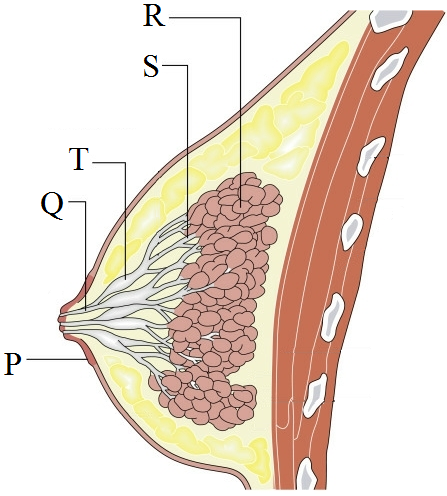
A functional mammary gland is characteristic of all female mammals. Mammary glands are paired structures that contain glandular tissue and variable amount of fat. Refer to the given figure of a mammary gland and answer the following questions.
  1. Mammary glands are modified:
  1. Sweat glands.
  2. Sebaceous glands.
  3. Sudoriferous glands.
  4. Lacrimal glands.
  1. Identify the incorrectly matched pair.
  1. P - Areola.
  2. Q - Lactiferous duct.
  3. S - Mammary duct.
  4. T - Mammary alveoli.
  1. Mammary ducts expand to form:
  1. Mammary alveoli.
  2. Mammary ampullae.
  3. Lactiferous ducts.
  4. Mammary tubules.
  1. What is areola?
  1. Grape-like clusters of milk secreting structures.
  2. Fatty tissue between the mammary lobes.
  3. Circular pigmented area of skin around nipple.
  4. Connective tissue that supports the alveoli and ducts.
  1. Assertion: The size of breast depends on the amount of adipose tissue.
Reason: The adipose tissue supports the alveoli and the ducts.
  1. Both assertion and reason are true, and reason is the correct explanation of assertion.
  2. Both assertion and reason are true, but reason is not the correct explanation of assertion.
  3. Assertion is true, but reason is false.
  4. Both assertion and reason are false.
Column I (Structure Before seed formation)Column II (Structure After seed formation)
A. Funiculusi. Hilum
B. Scar of Ovuleii. Tegmen
C. Zygoteiii. Testa
D. Inner Integumentiv. Stalk of Seed
 v. Embryo
Distinguish between : Cerebrum and cerebellum
Distinguish between: Spermatogenesis and Oogenesis.
Read the following and answer any four questions from 9(i) to 9(v) given below:
Bioreactors are considered as vessels in which raw materials are biologically converted into specific products by microbes, plant and animal cells or their enzymes. They are used for large scale production as they provide optimum growth conditions such as temperature, pH, substrate, vitamins, oxygen and salts for obtaining desired product. Most commonly used bioreactors are of stirring type which include simple stirred tank bioreactor and sparged stirred-tank bioreactor.
  1. Bioreactor are useful in:
  1. Amplifying a gene.
  2. Isolation of genetic material.
  3. Processing large volume of culture.
  4. Infecting DNA in a cell.
  1. Which of the following is essential to obtain desired product in a bioreactor?
  1. Size of the bioreactor.
  2. Sterile condition.
  3. Quantity of the raw material.
  4. All of these.
  1. Assertion: The stirred-tank is well suited for large scale production of microorganisms under aseptic conditions.
Reason: In sparged stirred tank bioreactor, surface area for oxygen transfer is increased.
  1. Both assertion and reason are true and reason is the correct explanation of assertion.
  2. Both assertion and reason are true but reason is not the correct explanation of assertion.
  3. Assertion is true but reason is false.
  4. Both assertion and reason are false.
  1. Growth condition that could affect the quality of obtained product in a bioreactor are:
  1. Temperature and pH only.
  2. pH and oxygen supply only.
  3. Temperature and oxygen supply only.
  4. Temperature, pH and oxygen supply.
  1. Vessels in which raw materials are biologically converted into specific products are.
  1. Bioreactors.
  2. Fermentors.
  3. Gene guns.
  4. Both (a) and (b).
Outcrossing and Crossbreeding.
Distinguish between: Menarche and Menopause.
Read the following and answer any four questions from (i) to (v) given below:
Mutation explains the relationship between gene and DNA. The effects of large deletions and rearrangement in a segment of DNA results in loss or gain of gene and its function. Insertion or deletion of one or two bases changes the reading frame from the point of insertion or deletion. A classical example of point mutation is a change of single base pair in the gene for beta globin chain that results in change of amino acid residue glutamate to valine and results into a diseased condition called sickle cell anaemia.
  1. A mutation is a change produced by an alteration in the genetic mechanism and.
  1. May arise spontaneously.
  2. Is always induced by the environment.
  3. Is never advantageous.
  4. Is not inherited.
  1. The DNA code for glutamic acid is CTC or CTT. The code for valine is CAA or CAT. In sickle cell haemoglobin, valine is present instead of glutamic acid.
Assuming a single base pair substitution has occurred, what is the mRNA code in the affected mutant?
  1. CUU
  2. GAA
  3. GAG
  4. GUA
  1. A mutation involving the substitution of one nitrogenous base for another has altered the base sequence of a DNA molecule, coding for four amino acids, as shown below.
Normal A-G-C-A-T-G-G-A-T-C-C-T

Mutant A-G-C-A-T-G-C-A-T-C-C-T
The table shows six codons and the corresponding amino acids into which each is translated.
mRNA codon
Amino acid
AAG
Lysine
CUA
Leucine
GGA
Glycine
GUA
Valine
UAC
Tyrosine
UCG
Serine
The mutation has changed the amino acid.
  1. Leucine to valine.
  2. Lysine to glycine.
  3. Serine to leucine.
  4. Tyrosine to lysine.
  1. Assertion : Insertion or deletion of three or its multiple bases, insert or delete one or multiple codons and so one or multiple amino acids.
Reason: Reading frame remains unaltered with insertion or deletion of three or its multiple bases.
  1. Both assertion and reason are true, and reason is the correct explanation of assertion.
  2. Both assertion and reason are true, but reason is not the correct explanation of assertion.
  3. Assertion is true, but reason is false.
  4. Both assertion and reason are false.
  1. Part of the amino acid sequences in normal and sickle cell haemoglobin are shown.
Normal haemoglobin Sickle cell haemoglobin
Thr-Pro-Glu-Glu Thr-Pro-Val-Glu
mRNA codons for these amino acids are
Glutamine (Glu) GAA GAG
Praline (Pro) CCU CCC
Threonine (Thr) ACU ACC
Valine (Val) GUA GUG
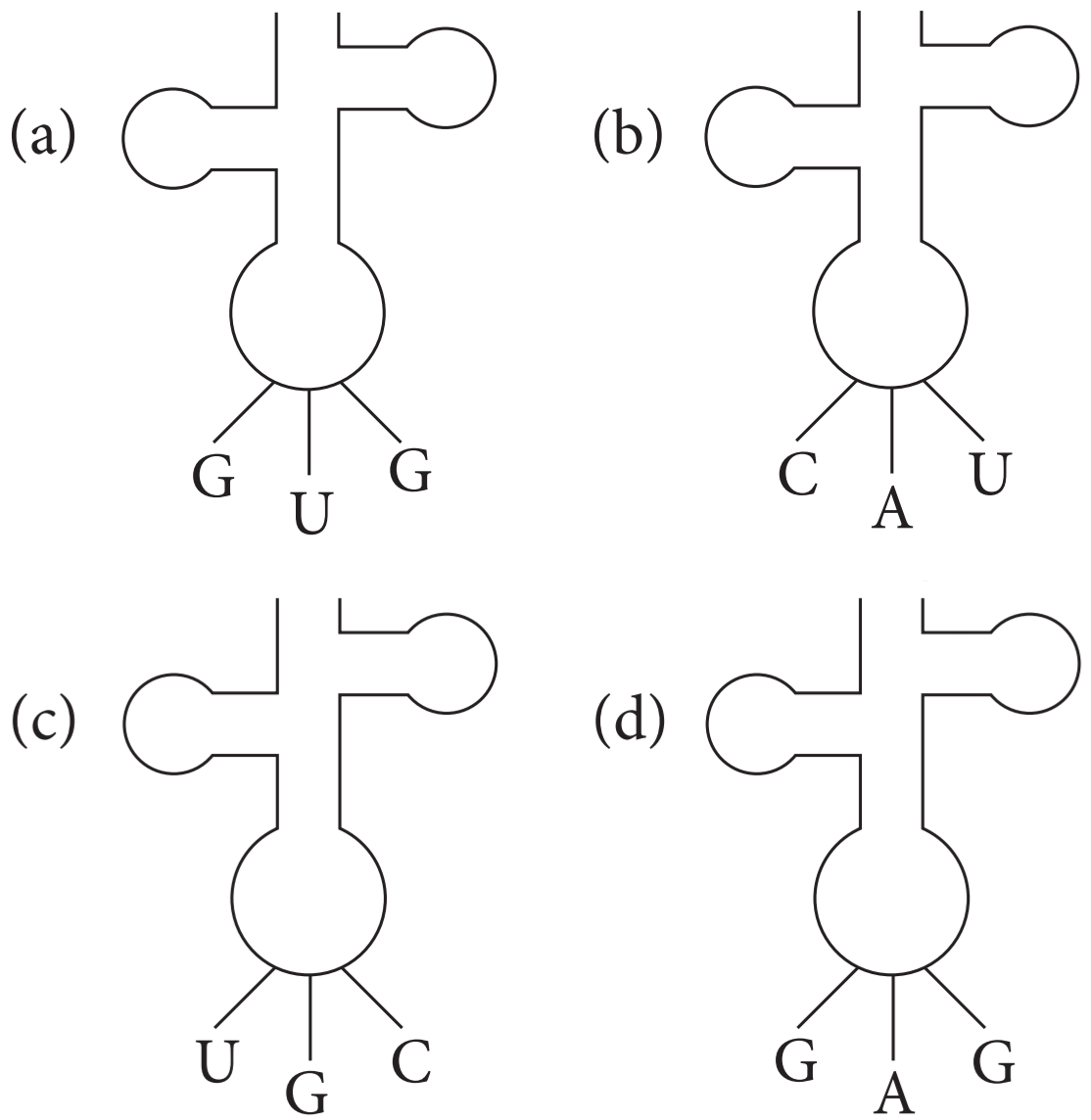
Which transfer RNA molecule is involved in the formation of this part of the sickle cell haemoglobin?