The motion of a particle as per $x=Asin \omega t + Bcos\omega t$ is :-
Medium
Download our app for free and get started
$\mathrm{x}=\mathrm{A} \sin \omega \mathrm{t}+\mathrm{B} \cos \omega \mathrm{t}$
$x=\sqrt{A^{2}+B}\left[\frac{A}{A^{2}+B^{2}} \sin \omega t+\frac{B}{\sqrt{A^{2}+B^{2}}} \cos \omega t\right]$
$\mathrm{x}=\sqrt{\mathrm{A}^{2}+\mathrm{B}^{2}}[\cos \phi \sin \omega \mathrm{t}+\sin \phi \cos \omega \mathrm{t}]$
$\mathrm{x}=\sqrt{\mathrm{A}^{2}+\mathrm{B}^{2}} \sin (\omega \mathrm{t}+\phi)$

Download our appand get started for free
Experience the future of education. Simply download our apps or reach out to us for more information. Let's shape the future of learning together!No signup needed.*
Similar Questions
- 1The equation of $S.H.M.$ is $y = a\sin (2\pi nt + \alpha )$, then its phase at time $t$ isView Solution
- 2A particle executing simple harmonic motion with amplitude of $0.1 \,m$. At a certain instant when its displacement is $0.02 \,m$, its acceleration is $0.5 \,m/s^2$. The maximum velocity of the particle is (in $m/s$)View Solution
- 3Equations $y = 2A \cos ^2 \omega \,t$ and $y = A (\sin \omega t + \cos \omega t )$ represent the motion of two particles.View Solution
- 4On the superposition of two harmonic oscillations represented by ${x_1} = a\,\sin \,\left( {\omega t + {\phi _1}} \right)$ and ${x_2} = a\,\sin \,\left( {\omega t + {\phi _2}} \right)$ a resulting oscillation with the same time period and amplitude is obtained. The value of ${\phi _1} - {\phi _2}$ is .... $^o$View Solution
- 5A particle is performing simple harmonic motion along $x$ -axis with amplitude $4\, cm$ and time period $1.2\, sec$. The minimum time taken by the particle to move from $x = 2\, cm$ to $x =+ 4 \,cm$ and back again is given by .... $s$View Solution
- 6A particle moving along the $X-$axis executes simple harmonic motion, then the force acting on it is given byView Solution
Where $A$ and $K$ are positive constants
- 7A block of mass $1 \,kg$ attached to a spring is made to oscillate with an initial amplitude of $12\, cm$. After $2\, minutes$ the amplitude decreases to $6\, cm$. Determine the value of the damping constant for this motion. (take In $2=0.693$ )View Solution
- 8The equation of $SHM$ is given as:View Solution
$x = 3\,sin\, 20\pi t + 4\, cos\, 20\pi t$ ,
where $x$ is in $cms$ and $t$ is in $seconds$ . The amplitude is ..... $cm$
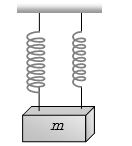
- 9A mass $m$ is suspended separately by two different springs of spring constant $K_1$ and $K_2$ gives the time-period ${t_1}$ and ${t_2}$ respectively. If same mass $m$ is connected by both springs as shown in figure then time-period $t$ is given by the relationView Solution
- 10The vertical extension in a light spring by a weight of $1\, kg$ suspended from the wire is $9.8\, cm$. The period of oscillationView Solution